Narada and Jyotisha: Subtle Knowledge of Panchanga, Muhurta and Omens
By Pt. Suvrat Sharma
The Jyotisha tradition linked with Narada Muni and its deeper principles of time, direction and omens
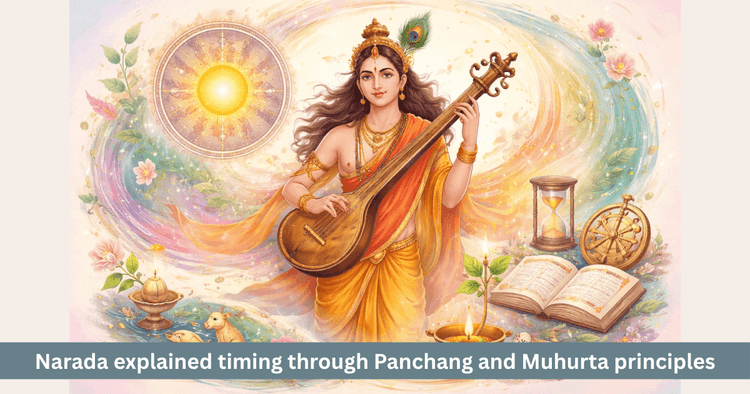
Table of Contents
To see Narada Muni only as a messenger of devotion and wisdom would be to see only part of his personality. A much deeper and less discussed dimension of his being is connected with jyotisha, sacred timing and the subtle understanding of signs. This is why traditions associated with the Narada Samhita speak not only of devotion but also of important principles related to muhurta and shakuna shastra, the reading of omens.
Jyotisha is not merely the study of planetary positions. It is a complete way of understanding time, direction and meaningful signs. The Narada related tradition places special emphasis on the truth that the success of any action does not depend only on effort but also on effort undertaken in the right time. This is a very subtle but powerful principle. A seed may be excellent but if it is planted in the wrong season, its result will not be what it could have been. The same insight appears in the jyotisha vision associated with Narada.
Why is Narada’s connection with jyotisha so important
Narada Muni had the rare capacity not only to witness events but to perceive the hidden rhythm behind them. He understood that in life the time of an event is often as important as the event itself. The same action may succeed in one period and meet resistance in another. This is why the traditions associated with him give importance to muhurta, the subtle structure of panchanga and the interpretation of omens.
Here jyotisha is not merely a tool for prediction. It becomes a way of aligning life with the movement of nature. It teaches that human beings should not struggle blindly against time but should learn to move with it. This wisdom is not restricted to ritual action alone. It has relevance for journeys, decisions, new beginnings, relationships and practical efforts.
This दृष्टि may be understood through the following points:
- Time is treated as living, not inert
- Every action is believed to have its proper moment
- A deep connection is acknowledged between nature and human life
- Success is linked not only with effort but with well timed effort
Why is it incomplete to think of jyotisha only as planetary calculation
Many people reduce jyotisha to the reading of planets alone. This is an incomplete understanding. Planetary positions are indeed important but the field is far wider. It includes time, direction, auspicious convergence, signs and attunement to the rhythms of nature. That is why the Narada tradition does not speak only of calculation. It also speaks of how the quality of time affects the unfolding of life.
The deeper insight of jyotisha is that life is not chaotic. It moves in rhythm. That rhythm is expressed through tithi, nakshatra, weekday, yogas and signs. One who understands this rhythm does not become superstitious. One becomes more sensitive and aware. One begins to see that not every moment carries the same quality.
This broader view may be understood as follows:
| Aspect of jyotisha | Common view | Subtle view |
|---|---|---|
| Planets | Means of telling fate | Indications of the quality of time |
| Panchanga | Calendar reference | Full structure of sacred time |
| Muhurta | Choosing an auspicious hour | Harmonizing action and timing |
| Omens | Folk signs | Reading the messages of nature |
Why are the five limbs of the Panchanga considered so central
In the jyotisha understanding associated with Narada, Panchanga plays a central role. The five limbs of the Panchanga are:
- Tithi
- Vara, weekday
- Nakshatra
- Yoga
- Karana
Together these five create a complete picture of time. It is not considered sufficient to look only at the day, nor only at the lunar date. The true quality of time is understood only when all these five are taken into account together. This reveals that time is not one layered. It is multidimensional.
Tithi can relate to inner mood, vara to planetary tone, nakshatra to subtle direction, yoga to energetic condition and karana to the practical suitability for action. When these are harmonious, a task proceeds more naturally. When they are misaligned, delay, friction or imbalance may arise.
What does the Panchanga teach us
The deepest message of the Panchanga is that to act without understanding time is like travelling without knowing direction. A person may still arrive but with greater wandering, greater fatigue and unnecessary obstacles. Panchanga does not teach fear of time. It teaches awareness of time.
Its usefulness may be understood through the following points:
- It helps choose a more suitable time for action
- It may reduce avoidable resistance
- It connects human life with the rhythm of nature
- It makes decision making more balanced
What is the real meaning of Muhurta
Muhurta does not simply mean a lucky hour. Its deeper meaning is a period in which the energy of time and the nature of the intended action stand in harmony. In the Narada related tradition, muhurta matters because it teaches that any beginning becomes more fruitful when joined with appropriate time.
Marriage, travel, beginning of trade, house entry, ritual work, vows, beginning of study and other major undertakings are all said to have distinct timing considerations. This diversity itself shows that not every action responds to the same type of time.
A simple example helps. The seed may be the same, the land may be the same and the farmer may be the same but if the season is wrong, the result changes. Muhurta applies this simple principle to major life undertakings.
Is Muhurta only for religious acts
No. This is an important clarification. Many assume that muhurta is relevant only for marriage, ritual worship or sacred ceremony. That is too limited a view. Muhurta is relevant wherever a beginning carries long term consequence. In such cases, the quality of the chosen moment can matter.
This does not mean that one must become helpless and stop acting until every detail becomes ideal. Rather, it means that in important decisions, one gives rightful place to the quality of time. This attitude makes a person more patient, balanced and farsighted.
The relevance of muhurta for different kinds of action may be viewed in the following way:
| Action | Why it matters | Purpose of Muhurta |
|---|---|---|
| Marriage | Beginning of a long bond | Stability and harmony |
| Travel | Direction and safety | Ease in departure |
| Beginning of business | Flow of prosperity | Support of auspicious energy |
| House entry | Establishing residence | Balanced entry into space |
| Beginning of study | Formation of learning | Receptivity and progress |
Why was shakuna shastra important in the tradition of Narada
The mention of shakuna shastra in the Narada tradition shows that ancient jyotisha was not limited to calculation alone. It also valued the subtle signs present in life and nature. Shakuna here does not mean blind superstition. It means the art of reading meaningful patterns arising through the environment, direction and surrounding events.
A sound from a particular direction, the appearance of a bird at a certain moment or an unexpected occurrence at the beginning of a journey could all be observed as possible signs. These were not treated as random in every case. They were understood as part of a larger dialogue with nature.
At the same time, this tradition does not encourage fear. The meaning is not that every small thing should be taken as good or bad omen. The meaning is that one should become sensitive, attentive and inwardly still enough to notice what life may be showing.
Why is understanding signs not the same as superstition
This is a very important question. Reading signs becomes superstition only when there is no discernment, when fear dominates and when one loses the power of thoughtful decision. But if signs are approached as subtle observation, as the language of nature and as part of situational awareness, then they can deepen sensitivity.
For example, an experienced farmer reads the sky and knows the direction of the season. A skilled sailor reads the wind. A contemplative person senses the mood of a space. In the same way, shakuna shastra teaches that life too offers signs which may be read with awareness.
A healthy approach to such signs includes the following:
- Signs may guide but they do not replace discernment
- Omens should not become a basis of fear
- Reading nature is awareness, not blind submission
- Signs are useful only when the mind is calm and balanced
How does Narada’s jyotisha vision become an art of living
The most beautiful aspect of the jyotisha vision associated with Narada is that it becomes an art of living. It does not tell the person merely to calculate but to listen. It does not ask one to rush. It asks one to understand time, direction, circumstance and then act.
In this vision, every major action is like planting a seed. If the seed is good but the ground unsuitable, struggle increases. If the seed is good, the ground prepared and the season favorable, then growth becomes easier. This harmony is at the heart of Narada’s approach to jyotisha.
This teaching shows us that:
- Effort is important but well timed effort is even more powerful
- Decision matters but the moment of decision also matters
- Signs can be useful if read in stillness
- Success in life depends not only on speed but also on rhythm
Why is this knowledge so relevant today
Modern life is driven by speed. Many people feel that moving quickly is enough. The subtle importance of timing, condition, preparedness and inward state is often ignored. As a result, much effort is made but fatigue also increases. Much is achieved, yet balance remains missing.
The jyotisha vision associated with Narada gently calls life back toward harmony. It says that success is not always forced into existence. Very often it comes more naturally when joined with the right time, right direction and right inner preparation. This is as relevant today as it was in ancient times.
For present life, it offers the following guidance:
- Not every task succeeds merely by being done quickly
- One should learn to recognize the quality of time
- Circumstance, sign and inner state should all be considered
- Only a balanced person can truly make use of right timing
To recognize the rhythm of life is subtle wisdom
Ultimately this vision leads us to a beautiful truth. Everything in life moves in rhythm. Day and night move in rhythm. The seasons move in rhythm. Breath moves in rhythm. The mind has rhythm. Relationships have rhythm. Karma and its result also move in rhythm. When a person begins to understand this rhythm, life becomes less harsh and more harmonious.
The connection between Narada and jyotisha teaches that right time, right direction and right understanding together make life more successful, more balanced and more peaceful. This is the essence of the teaching. Here jyotisha does not create fear. It teaches friendship with time.
FAQs
Which aspect of jyotisha is especially important in the Narada related tradition
The subtle understanding of muhurta, panchanga and shakuna shastra is especially emphasized.
What are the five limbs of the Panchanga
The five limbs are tithi, vara, nakshatra, yoga and karana.
What is the simple meaning of Muhurta
Muhurta means choosing a period of time that is suitable for the nature of a particular action.
What is meant by shakuna shastra
Shakuna shastra is the art of understanding subtle signs arising through nature, direction and circumstances.
What is the greatest teaching of this vision
It teaches that effort alone is not enough. Right timing, right direction and right understanding are also essential for success.
Get your accurate Kundali
Generate KundaliDid you like it?
Author
Pt. Suvrat Sharma (63)
Experience: 20
Consults About: Family Planning, Career
Clients In: Punjab, Haryana, Delhi
Share this article with friends and family
About ZODIAQ
ZODIAQ is an online Vedic Astrology platform. It connects clients seeking astrological advice to experienced astrologers with deep knowledge. Our users also generate kundali and perform kundali milan for free. ZODIAQ also offers services to the Astrologers. Astrologers utilize various offerings by ZODIAQ to serve their clients effectively.
If you are a User
Consult with experienced astrologers and seek their guidance. You can also order handwritten Janm Patrika report with life prediction prepared by experienced astrologers. Generate accurate Kundali, perform Kundali Matching and check horoscope and muhurat. Utilize our online library for all the necessary astrological and spiritual information.
If you are an Astrologer
Create accurate kundali for your clients and perform Kundali Matching for up to 5 people at a time. Write comprehensive Janm Patrika report for your clients with ZODIAQ. Check client details anytime by saving it in client directory. Become more productive by tracking how many clients you guide every day.
WELCOME TO
ZODIAQ
Right Decisions at the right time with ZODIAQ
