Who Provoked Kamsa: Narada’s Role and a Larger Divine Plan
By Aparna Patni
Narada Muni’s role in the story of Kamsa, Devaki and Krishna’s birth and the hidden divine purpose behind it
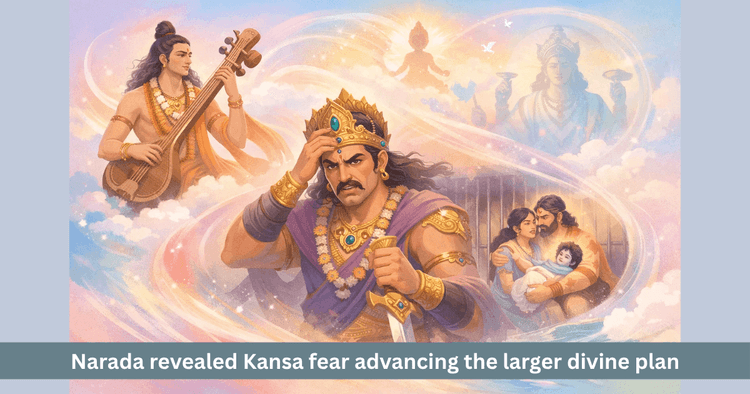
Table of Contents
In the sacred narratives of India, Narada Muni is often seen standing at the center of events that appear ordinary from the outside but are carrying a far deeper divine movement within. His presence is rarely accidental. He does not merely arrive to inform. He arrives to reveal. The episode of Kamsa, Devaki and the coming of Shri Krishna is one such powerful example.
According to the Vishnu Purana, when Kamsa heard the heavenly declaration that Devaki’s eighth son would be the cause of his death, he became filled with fear and rage. He immediately imprisoned Devaki and Vasudeva. Yet at the beginning, he was not fully driven by the complete frenzy that later came to define his cruelty. The deeper turning point came when Narada Muni entered the scene. At first glance it appears that Narada made the situation even more dangerous. But when the episode is understood more deeply, it becomes clear that his role was not merely to provoke Kamsa but to bring hidden truth to the surface and help unfold a larger divine purpose.
What was Kamsa’s first inner state after the heavenly voice
When Kamsa heard that Devaki’s eighth son would kill him, his first response was fear. This was not only fear of death. It was also fear of losing control, losing kingship and losing the future he imagined for himself. His nature was already harsh and power driven, so this prophecy struck at the deepest point of his insecurity.
He imprisoned Devaki and Vasudeva immediately. That act itself came from fear. Yet at that stage, his cruelty had not fully reached its ultimate form. He was disturbed, anxious and eager to prevent a future danger but the most extreme expression of his darkness had not yet fully emerged.
His initial condition may be understood in the following way:
- He was terrified by the heavenly prophecy
- He responded with immediate control and violence
- His mind became filled with suspicion and insecurity
- His cruelty had awakened but not yet reached its full intensity
Why does Narada Muni enter the story at this point
This is where the most important turn of the narrative appears. Narada Muni comes to Kamsa. Narada is never merely a passing visitor. He appears where a major spiritual or historical direction is taking form. In this case too, he did not come only to repeat what had already been said. He came to clarify the hidden truth in such a way that Kamsa’s inner nature would fully reveal itself.
Narada did not merely remind Kamsa that Devaki’s eighth son would kill him. He also revealed to him the truth of his previous birth. He told him that he had once been the asura Kalanemi, who had been slain by Lord Vishnu, and that the same Vishnu would again descend and bring about his end. This was not ordinary information. It struck directly at the root of Kamsa’s existence.
Narada’s presence becomes important for the following reasons:
| Event | Outer meaning | Deeper meaning |
|---|---|---|
| Narada’s arrival | Giving information | Bringing hidden truth to the surface |
| Reminder of past birth | Recalling an old story | Revealing karma and destiny |
| Mention of Vishnu’s return | A future warning | Confirmation of divine design |
| Increase of Kamsa’s fear | Provocation | Exposure of his true nature |
Why did the memory of Kalanemi disturb Kamsa so deeply
When a person hears only that danger will come in the future, one may try to prevent it. But when that same person is told that the danger is linked with past karma and divine justice, the fear becomes much deeper. This is what happened to Kamsa.
The reminder of Kalanemi showed him that this was not merely a political threat. It was not a worldly conspiracy. It was a karmic continuation from a previous existence. Earlier the heavenly voice had frightened him. Narada’s words turned that fear into certainty. Now Kamsa felt that the event was not something from which he could escape.
This was the point from which his mentality changed entirely. Imprisoning Devaki and Vasudeva no longer seemed enough. His fear now drove him toward more extreme violence.
Did Narada truly provoke Kamsa
From a surface perspective, it can certainly appear that Narada intensified Kamsa’s fear and pushed him toward greater cruelty. But if the episode is understood only at that level, half its meaning is lost. Narada’s purpose was not to take pleasure in destruction. His purpose was to move forward a divine process in which adharma, unrighteousness, had to fully reveal itself before it could be destroyed.
Sometimes evil can come to its destined end only after it has shown its complete face. If Kamsa had remained merely fearful, suspicious and inwardly hidden, his end would have remained a private tragedy. But once his asuric nature came fully into the open, once he began murdering the children of Devaki, he was no longer merely a frightened king. He had become the visible embodiment of opposition to dharma.
Narada’s role therefore may be understood in the following way:
- He did not speak falsehood
- He brought out the fear and arrogance already hidden in Kamsa
- He accelerated the movement of events
- He allowed adharma to appear in its full form
Why did Kamsa decide to kill the children of Devaki
After Narada spoke, Kamsa’s fear rose to a new level. He now believed that any child born to Devaki might become the threat foretold in the prophecy. That fear covered his intelligence. He did not ask how truth might be faced with wisdom. He did not ask whether another path was possible. He chose only one direction, destruction.
From that point onward, he began killing the children of Devaki one by one. This decision arose from fear, insecurity and desperate attachment to power. He could not understand that fear of death was not saving him. It was pushing him more rapidly toward the very end he wanted to escape.
A deep truth appears here. When a person fears truth, that person often tries to destroy it instead of understanding it. Yet truth cannot be destroyed. What is ultimately destroyed is the ego that lives in fear.
Was this only a cruel event or part of a greater plan
Here the most important spiritual layer of the story becomes visible. Kamsa’s cruelty, the killing of Devaki’s children and Narada’s words appear harsh from the outside. But behind them stood a greater divine plan. Adharma had already grown too powerful. Kamsa and other asuric forces had to reach their destined end. For dharma to be restored, the descent of the Divine was necessary. But the purpose of that descent becomes clear only when unrighteousness reaches its visible peak.
Narada helped accelerate that process. He brought out the darkness already hidden within Kamsa. That is why his role should not be understood merely as incitement. He came to awaken a truth already present in destiny.
This may be understood through the following table:
| Event | Surface meaning | Divine meaning |
|---|---|---|
| Heavenly prophecy | Fear of the future | Sign of divine intention |
| Narada’s revelation | Provoking Kamsa | Bringing karmic truth into motion |
| Killing of the children | Cruelty | Full manifestation of adharma |
| Krishna’s descent | Revenge | Restoration of dharma |
What is the relation between fear and truth in this story
Kamsa’s deepest problem was not death itself. It was his inability to receive truth rightly. The truth was revealed to him but he could not accept it with wisdom. If he had, that knowledge might have made him humble. He might have transformed his life. He might have released his arrogance. Instead, he treated truth as an enemy, not as a guide.
This reveals a subtle psychological truth. The same truth can work in two ways:
- It can awaken a person
- Or if the person is fearful and ego driven, it can harden the person further
The second happened in Kamsa’s case. He heard the truth but instead of letting it lead him inward, he turned it into a justification for violence.
What does Narada’s role teach us about knowledge
Narada’s role in this story teaches that knowledge is not merely information. It is power. The same truth may transform one person and harden another. The difference lies not in knowledge itself but in the consciousness that receives it.
Narada did not lie to Kamsa. He simply revealed what was already true. But Kamsa was not capable of bearing that truth in a healthy way. He did not take it as a divine signal. He took it as hostile threat. That is why knowledge did not become liberation in him. It became the means by which his hidden darkness fully emerged.
The lessons here are profound:
- Hearing truth is not enough. One must also receive it rightly
- Knowledge is a neutral force
- In a balanced person it becomes light
- In a fearful and ego bound person it may deepen destruction
Could Kamsa’s path have changed
This story also invites us to ask whether Kamsa’s path might have changed had he responded differently. This is important because it helps illuminate the relationship between destiny and free will. Destiny may give direction but a person still has the freedom to respond to truth in different ways.
If Kamsa had chosen humility instead of fear, if he had restrained his cruelty, if he had not harmed Devaki and Vasudeva, if he had taken Vishnu’s coming not as enmity but as divine truth, then the inner quality of his path would have been different. But he did not choose that. He nourished the asuric force within himself. That was his tragedy.
What does this story teach us today
This episode remains deeply relevant even in present life. Many times we hear truths we do not like. Someone points out the consequences of our actions, someone reveals our shadow or someone warns us of a coming crisis. In those moments, we too face the two paths Kamsa faced:
- To receive truth and change inwardly
- To fear truth and become more rigid
This is why the story remains powerful. It teaches that more important than the information itself is the inner response it awakens in us. That response shapes our direction.
For modern life, the major teachings of the episode are:
- Not every harsh event is merely negative
- Difficult truth may be the beginning of great transformation
- Fear leads to wrong decisions
- To receive truth with maturity is spiritual strength
Where divine plan and human response meet
Ultimately the story of Kamsa and Narada teaches that divine plan and human response together shape events. In the divine order, every event may have purpose but the direction of a person’s life still depends on how one responds to revealed truth. Narada revealed the hidden reality. Kamsa received it destructively. That determined the path of his life.
This story shows not only Kamsa’s cruelty but also the truth that a mind unable to hold truth wisely creates the path of its own downfall. The same truth, when received differently, could lead another person toward humility and God. That is the deepest power of the episode.
FAQs
What first filled Kamsa with fear
The heavenly declaration that Devaki’s eighth son would kill him filled Kamsa with fear.
What did Narada Muni tell Kamsa
He reminded him of his previous birth as the asura Kalanemi and told him that Vishnu would again bring about his end.
Did Narada truly provoke Kamsa
On the surface it may seem so but at a deeper level he only brought hidden truth to the surface and advanced a larger divine plan.
Why did Kamsa begin killing the children of Devaki
Fear, insecurity and desperate attachment to his own survival drove him toward extreme cruelty.
What is the greatest teaching of this story
It teaches that truth is a power, and how a person receives it determines the direction and end of life.
Get your accurate Kundali
Generate KundaliDid you like it?
Author

Aparna Patni (63)
Experience: 20
Consults About: Family Planning, Career
Clients In: Punjab, Haryana, Delhi
Share this article with friends and family
About ZODIAQ
ZODIAQ is an online Vedic Astrology platform. It connects clients seeking astrological advice to experienced astrologers with deep knowledge. Our users also generate kundali and perform kundali milan for free. ZODIAQ also offers services to the Astrologers. Astrologers utilize various offerings by ZODIAQ to serve their clients effectively.
If you are a User
Consult with experienced astrologers and seek their guidance. You can also order handwritten Janm Patrika report with life prediction prepared by experienced astrologers. Generate accurate Kundali, perform Kundali Matching and check horoscope and muhurat. Utilize our online library for all the necessary astrological and spiritual information.
If you are an Astrologer
Create accurate kundali for your clients and perform Kundali Matching for up to 5 people at a time. Write comprehensive Janm Patrika report for your clients with ZODIAQ. Check client details anytime by saving it in client directory. Become more productive by tracking how many clients you guide every day.
WELCOME TO
ZODIAQ
Right Decisions at the right time with ZODIAQ
