Narada and Lakshmi’s Gentle Dispute: A Simple Question That Opened the Secret of Love
By Pt. Suvrat Sharma
The question raised by Narada Muni in Vaikuntha revealing deeper truths of devotion, love, and divine relationships
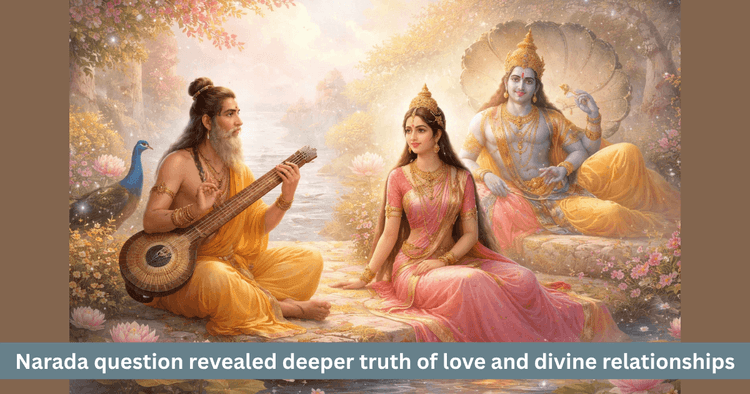
Table of Contents
Narada Muni was not limited to giving knowledge alone. He was the kind of sage who knew how to ask the right question at the right moment. His questions were never merely casual. They became instruments through which hidden emotions, deeper truths and the real nature of relationships came into the open. One such beautiful and subtle episode is connected with Lakshmi and Lord Vishnu. Outwardly it appears light and sweet, yet within it lies a profound teaching about love, devotion and divine relationship.
In traditional sacred stories, this event is associated with Vaikuntha, the divine abode where Lakshmi and Vishnu dwell in perfect harmony. The atmosphere there is described as peaceful, radiant and balanced. In that setting, Narada Muni raises a question that sounds simple on the surface, yet carries great depth within it. He asks Lakshmi who it is that Lord Vishnu loves the most. This single question becomes the center of the entire episode.
Why was this question so simple and yet so profound
At first glance, this seems like an ordinary curiosity. Anyone may think that Lakshmi, being the eternal consort of Vishnu, must obviously know the answer. But Narada’s purpose was not to obtain a predictable response. He wanted to reveal the nature of love itself, the place of devotion and the deeper meaning of divine relationship.
That is why the question is so powerful. The moment love is asked about, one cannot remain only at the level of outer relation. Love brings in nearness, surrender, inward bond and spiritual depth. Narada knew that this one question would open a truth that could not be explained so beautifully through direct teaching alone.
Within this question were hidden several deeper dimensions:
- The difference between love and possessiveness
- The nature of divine relationship
- The meaning of nearness and devotion
- The truth that divine love is beyond comparison
How does the atmosphere of Vaikuntha deepen this episode
Vaikuntha is not merely a divine realm. It is a symbol of harmony, stillness and perfect spiritual balance. The relationship of Vishnu and Lakshmi represents not only companionship but also preservation, grace, beauty and sacred order. When Narada raises this question in such a setting, it no longer remains a casual exchange. It becomes a doorway into the spiritual understanding of love.
This episode also teaches us that some of the deepest questions arise precisely where everything outwardly seems complete. Even within perfection, new dimensions of truth may be revealed. This is Narada’s way. He does not disturb harmony without purpose. He uncovers the deeper truth hidden within it.
What may have been Lakshmi’s natural feeling
Lakshmi is the eternal consort of Lord Vishnu. She is always seated beside Him. She represents grace, prosperity, beauty and auspiciousness. It is therefore completely natural that the feeling may arise that she holds the most intimate and unique place in Vishnu’s heart. This is not ego in a harsh sense. It is the natural experience of nearness.
That is what makes this episode so sweet. There is no bitterness here. There is only the gentle dignity of relationship. Lakshmi’s feeling may be understood as this, the one who is always with the Lord, who serves Him, who shares in His every action, surely occupies the highest intimacy.
Lakshmi’s side may be understood through the following:
| Aspect | Inner meaning |
|---|---|
| Eternal presence beside Vishnu | Fulness of nearness |
| Loving service | Living form of devotion |
| Participation in every divine act | Unbroken sacred bond |
| Position as consort | Unique and incomparable place |
Why was this gentle disagreement not a real conflict
The story says that the question gradually took the form of a gentle dispute. It is important to understand that this was not conflict in the ordinary worldly sense. There was no bitterness, no sharp rivalry and no burning ego. It was a conversation through which different dimensions of love were being brought forward.
Lakshmi’s feeling arose from sacred nearness. Narada was not trying to diminish that. He was only drawing attention to the truth that the love of Lord Vishnu is not confined to a single private relationship. It is vast enough to hold Lakshmi in complete fullness and yet remain open in compassion toward all true devotees.
That is why this may be called a sweet dispute. It was a dialogue that expanded the meaning of love.
Why did Narada take the question still deeper
Narada’s nature is never to leave truth at the surface. If a feeling has arisen, he wishes to reveal the deeper principle behind it. In this episode too, he wanted to show that Lord Vishnu’s love is not limited by one relationship. It is infinite. It is complete toward Lakshmi and can also be complete toward every devotee.
Here Narada reveals a very subtle spiritual principle. Human love is often limited. If one gives more to one, one seems to give less to another. But divine love does not function in that way. In it, making space for one does not reduce the space available for another.
The indication Narada offers may be understood like this:
- The heart of God is not limited like the human heart
- Divine love is not confined to one bond
- Nearness and universality can coexist
- The consort and the devotee can both be fully cherished in different ways
How did Lord Vishnu clarify the situation
When the conversation reached its beautiful depth, Lord Vishnu Himself clarified the truth. He explained that His love is not bound within one limited relation. He loves Lakshmi fully, and He also loves His true devotees fully. Every soul that remembers Him with sincerity is dear to Him.
The beauty of this response lies in the fact that He did not reduce Lakshmi’s place. Nor did He lower the place of the devotee. Instead, He expanded the understanding of love. This is the greatest characteristic of divine love. It does not choose one by rejecting another.
The love of Lord Vishnu may be understood as follows:
| Relationship | Its nature |
|---|---|
| With Lakshmi | Eternal nearness and divine companionship |
| With devotees | Grace and loving acceptance |
| With the world | Preservation and care |
| With each sincere soul | Loving response according to remembrance |
Why is there no comparison in the final teaching
This is the deepest and most beautiful point in the story. The question begins with comparison but the answer does not end in comparison. It ends in expansion. That is the spiritual nature of love. Where human beings compare, the Divine expands. Where the human mind asks who is loved more, the divine answer reveals that every sincere heart can be truly loved.
Lakshmi’s place remains unique. It does not become smaller. The devotee’s place is also true. It too is not diminished. This is the wonder of divine love. It can be complete toward one and still remain complete toward many.
This story teaches us:
- The highest form of love is beyond comparison
- Possessiveness may limit love
- Surrender makes love expansive
- Divine love does not shrink. It overflows
How did Narada’s question act like a mirror
Narada’s question was not mere curiosity. It was a mirror. In it, Lakshmi’s natural feeling became visible, the place of the devotee became clear and the universal nature of Vishnu’s love was revealed. This is Narada’s gift. He asks questions that allow hidden truths to be seen.
Many times in life, profound truth does not emerge through lecture but through one living question. Narada does this again and again. He does not create confusion. He creates clarity. In this episode too, his question was not meant to disturb but to bring the true nature of love into view.
How does this story reveal the difference between possessiveness and surrender
This story also teaches that one’s relation to God is not rooted in possessiveness. Wherever possessiveness appears, comparison and expectation may quietly arise. But where surrender is present, peace and expansion enter the relationship.
Lakshmi’s feeling here was not harsh possessiveness. Yet through this very situation the story teaches us that the love of God cannot be enclosed within a private claim. The devotee’s relation with God grows through surrender, not through ownership. And ultimately Lakshmi’s own relation too stands in this sacred surrender.
The lesson may be understood through the following:
- Possessiveness may create comparison
- Surrender creates peace
- The deeper form of love lies not in ownership but in union
- The way to divine relation opens through sincerity of heart
Why is this episode so relevant in life today
Even today people want to know how important they are to others. They compare, measure and often begin to see love as private possession. This creates insecurity, expectation and pain in relationships. This story challenges that tendency in a very gentle but deep way.
It teaches that true love is not known by placing one above another. True love is known by its capacity to expand. Love that only wants to possess remains limited. Love that makes room for the being of another becomes more mature. And divine love, above all, includes all without reducing any.
For life today, the main teachings of the episode are:
- Love is not a matter of comparison
- Surrender is more lasting than expectation
- One being loved does not mean another is loved less
- Understanding divine love can bring balance to human relationships
Where love is no longer limited, its secret is revealed
In the end, this gentle exchange between Narada and Lakshmi teaches that the secret of love lies not in possession but in expansion. The love of God is never imprisoned within one bond. It is complete in Lakshmi, complete in the devotee and complete in every heart that turns toward Him with sincerity.
That is why Narada’s question is so precious. It takes the understanding of love beyond limitation and opens it into the divine dimension. The story reveals that even a simple question can become the doorway to a deep truth. Its most beautiful teaching is this, true love does not imprison. It flows.
FAQs
What did Narada Muni ask Lakshmi
He asked whom Lord Vishnu loves the most.
Was this really a harsh conflict
No. It was a gentle and beautiful dialogue that opened the deeper meaning of love.
What was Lakshmi’s natural feeling
Her natural feeling was that as the eternal consort of Vishnu, she held a uniquely intimate place in His love.
What did Lord Vishnu clarify
He explained that His love is not limited to one relation. He loves Lakshmi fully and also loves every true devotee fully.
What is the greatest teaching of this story
It teaches that true love is known not through comparison but through expansion and surrender.
Get your accurate Kundali
Generate KundaliDid you like it?
Author

Pt. Suvrat Sharma (63)
Experience: 20
Consults About: Family Planning, Career
Clients In: Punjab, Haryana, Delhi
Share this article with friends and family
About ZODIAQ
ZODIAQ is an online Vedic Astrology platform. It connects clients seeking astrological advice to experienced astrologers with deep knowledge. Our users also generate kundali and perform kundali milan for free. ZODIAQ also offers services to the Astrologers. Astrologers utilize various offerings by ZODIAQ to serve their clients effectively.
If you are a User
Consult with experienced astrologers and seek their guidance. You can also order handwritten Janm Patrika report with life prediction prepared by experienced astrologers. Generate accurate Kundali, perform Kundali Matching and check horoscope and muhurat. Utilize our online library for all the necessary astrological and spiritual information.
If you are an Astrologer
Create accurate kundali for your clients and perform Kundali Matching for up to 5 people at a time. Write comprehensive Janm Patrika report for your clients with ZODIAQ. Check client details anytime by saving it in client directory. Become more productive by tracking how many clients you guide every day.
WELCOME TO
ZODIAQ
Right Decisions at the right time with ZODIAQ
