Narada and the Mahati Veena: Music of the Cosmic Sound
By Pt. Abhishek Sharma
Exploring the spiritual essence of Narada’s divine veena and the power of cosmic sound and devotion
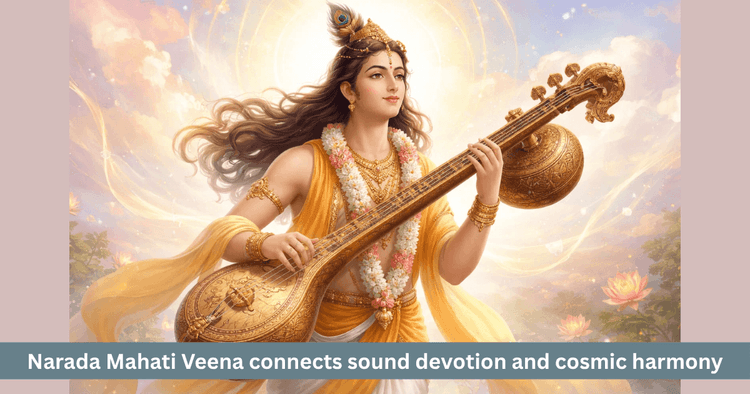
Table of Contents
Whenever Narada Muni is remembered, the image of a veena naturally appears in the mind. The instrument in his hands is not a decorative detail. It is an inseparable part of his personality, his practice and his inner state. This divine veena is known as Mahati, and that name itself carries deep spiritual meaning.
In the Narada Samhita, this veena is not presented as an ordinary instrument. It is described as a divine medium. For this reason, the story of the Mahati Veena is not merely a story of music. It is also a story of sound, nada, devotion, inner purity and cosmic rhythm. When Narada touches it, what emerges is not merely arrangement of notes. It becomes an expansion of consciousness.
Why is the Mahati Veena considered so special
The greatness of the Mahati Veena lies not only in its divine name but in its spiritual meaning. An ordinary instrument is played through technical skill but Mahati is described in a way that suggests it almost plays by itself. This does not simply indicate miracle. It points to a deeper truth. When the consciousness of the seeker becomes fully pure, balanced and immersed in the Divine, every expression flowing from such a being naturally turns into music.
That was the state of Narada Muni. His mind was so refined, his speech so disciplined and his heart so absorbed in the Lord that the sounds emerging from him were no longer mere sounds. They became living vibration. Mahati is the symbolic presence of that vibration.
Its special nature may be understood through the following:
- It is not merely an instrument but a medium of sadhana
- It symbolizes the union of music and devotion
- It points toward sound arising from purified consciousness
- It expresses inner harmony more than outer skill
Did the Mahati Veena really play by itself
The tradition says that the Mahati Veena plays by itself. If this is read only at the level of miracle, its spiritual meaning becomes smaller. The deeper indication is that there was no separation between Narada’s consciousness and the instrument. The player and the played were not two isolated realities. They had become one continuous current of devotion.
When the seeker and the means of practice no longer remain separate, action becomes effortless. One no longer sees strain. One sees only flow. This is what is indicated by saying that the Mahati Veena played on its own. Here music moves beyond technique and becomes the natural sound of consciousness.
This may be understood in the following way:
| Element | Ordinary condition | In the case of Narada and Mahati |
|---|---|---|
| Instrument | Outer tool | Extension of consciousness |
| Musician | Skill centered | Devotion centered |
| Sound | Performance | Flow of sacred vibration |
| Music | Art | Practice and realization |
Why is the link between Narayana japa and the veena so deep
Narada Muni did not merely play the veena. He played it while chanting Narayana Narayana. This is the most beautiful center of the whole symbolism. For him, music was not a means of impressing an audience. It was an expression of love, surrender and continuous remembrance of the Divine. Name and sound were not separate within him. The Name awakened feeling, and the sound gave that feeling expansion.
When music remains only art, it may reach the ears. When music joins the Divine Name, it reaches the heart. And when music becomes one with devotion, it may touch the soul. The music of Narada Muni belongs to this deepest level.
That is why his music may be understood through the following qualities:
- It carried remembrance of God
- It flowed from devotion
- It held not only melody but inner vibration
- It had the capacity to transform the listener inwardly
How does the principle of nada connect with this story
In Indian spiritual thought, the universe is often understood as grounded not only in form but also in nada, sacred sound vibration. This subtle vibration is associated with the very basis of creation. It is the original movement from which existence unfolds. When a seeker goes deeply inward, one may begin to sense not only outer sound but also that subtle underlying vibration.
The Mahati Veena becomes a symbol of that very nada. It shows that Narada’s music was not merely melodic expression. It was also a way of connecting with cosmic rhythm. What was heard outwardly as the sound of the veena may inwardly be understood as an echo of that original vibration from which creation is sustained.
The principle of nada may be understood briefly in the following way:
- Nada is linked with the subtle basis of creation
- Mahati may be seen as a symbol of that sacred vibration
- Narada’s music works at both outer and inner levels
- Sound joined with devotion can lift consciousness
Is music only for entertainment or can it also be spiritual practice
This story gives a very clear answer. Music is not only a means of entertainment. It can also become sadhana. The difference lies in the intention. If music is only for display, its effect remains limited. If it is only for fame, it may strengthen ego. But if it is joined with devotion and inner purity, then that same music may become meditation, healing and soul contact.
This is why the music of Narada Muni is so unique. Playing the veena was not performance for him. It was a living dialogue with the Lord. This teaches us that any art, when joined with spiritual practice, changes in essence.
Music can become sadhana when it carries these elements:
- Pure feeling
- Expression free from ego
- Concentration
- Surrender
- Inner connection
What arises when art and spiritual practice meet
When art and spiritual discipline meet, expression no longer remains only outward. It begins to carry inner experience. The Mahati Veena of Narada Muni is a supreme example of this union. In his hands, the veena does not merely produce music. It creates a spiritual atmosphere. It does not only impress. It has the power to take the listener inward.
A very important point is visible here. When art is separated from spiritual depth, it may still be attractive but it is not transformative. When spiritual depth joins art, beauty becomes a carrier of realization. That is why the remembrance of Mahati is not only remembrance of musical beauty. It is also remembrance of a refined state of consciousness.
What may be the inner meaning of the Mahati Veena
There is another very deep meaning of the Mahati Veena. It may also symbolize the state in which a person establishes balance, peace and rhythm within. When such harmony arises inwardly, every action begins to take on beauty. Then not only one’s music but one’s speech, movement, thought and conduct also become more harmonious. This is the inner mystery of Mahati.
From this viewpoint, Mahati is not only an instrument in Narada’s hand. It is the symbol of an inner state where mind, speech and consciousness have become aligned. In such a condition, every note of life begins to carry sweetness.
This inner symbolism may be understood in the following way:
| Inner state | Outer expression |
|---|---|
| Peace in mind | Sweetness in speech |
| Balance in consciousness | Beauty in action |
| Depth of devotion | Soul touching music |
| Connection with sacred sound | Rhythm in life |
Why is this story so relevant today
Today many people see music only as profession, entertainment or hobby. There is nothing wrong in that but if music is understood only at that level, then much of its depth remains hidden. This story reminds us that music can calm the mind, bring consciousness inward and reconnect a person with one’s original subtle center.
In a life that has become noisy, restless and mentally scattered, this teaching becomes even more important. If music is approached with the right feeling, it does not remain an object of consumption. It can become meditation, healing, inner dialogue and remembrance of the Divine.
For present life, this story offers the following teachings:
- Do not reduce music only to consumption
- Sound has a profound effect on the mind
- Pure music can calm inner restlessness
- Music joined with devotion touches the soul more deeply
Where sound begins to touch the soul
In the end, the story of Narada Muni and the Mahati Veena teaches that true music is that which does not merely please the ears but touches the soul. It does not only entertain. It reconnects. It does not only create melody. It also touches inner silence. It is not merely heard. It is experienced.
This is the secret of the Mahati Veena. It shows that when sound becomes joined with devotion, when art becomes practice and when the mind is touched by cosmic vibration, music becomes divine. And such music can return a human being to one’s original consciousness.
FAQs
What is the Mahati Veena
The Mahati Veena is the divine veena associated with Narada Muni and symbolizes his devotion, practice and connection with sacred sound.
Did the Mahati Veena really play by itself
The deeper meaning is that Narada’s consciousness was so pure and balanced that his expression naturally became music.
Why is Narada’s music called spiritual practice
Because his music was joined with the Divine Name, devotion and surrender. It was not mere performance.
How is nada connected with this story
Mahati is understood as a symbol of the subtle cosmic sound called nada, which is linked with the deeper rhythm of creation.
What is the greatest teaching of this story
It teaches that true art is that which can touch the soul and reconnect a person with the original depth of consciousness.
Get your accurate Kundali
Generate KundaliDid you like it?
Author

Pt. Abhishek Sharma (63)
Experience: 20
Consults About: Family Planning, Career
Clients In: Punjab, Haryana, Delhi
Share this article with friends and family
About ZODIAQ
ZODIAQ is an online Vedic Astrology platform. It connects clients seeking astrological advice to experienced astrologers with deep knowledge. Our users also generate kundali and perform kundali milan for free. ZODIAQ also offers services to the Astrologers. Astrologers utilize various offerings by ZODIAQ to serve their clients effectively.
If you are a User
Consult with experienced astrologers and seek their guidance. You can also order handwritten Janm Patrika report with life prediction prepared by experienced astrologers. Generate accurate Kundali, perform Kundali Matching and check horoscope and muhurat. Utilize our online library for all the necessary astrological and spiritual information.
If you are an Astrologer
Create accurate kundali for your clients and perform Kundali Matching for up to 5 people at a time. Write comprehensive Janm Patrika report for your clients with ZODIAQ. Check client details anytime by saving it in client directory. Become more productive by tracking how many clients you guide every day.
WELCOME TO
ZODIAQ
Right Decisions at the right time with ZODIAQ
