Brahma’s Manasa Putra: The Deeper Meaning of Narada’s Birth
By Pt. Narendra Sharma
Understanding consciousness, wisdom and spiritual purpose through Narada Muni’s unique origin
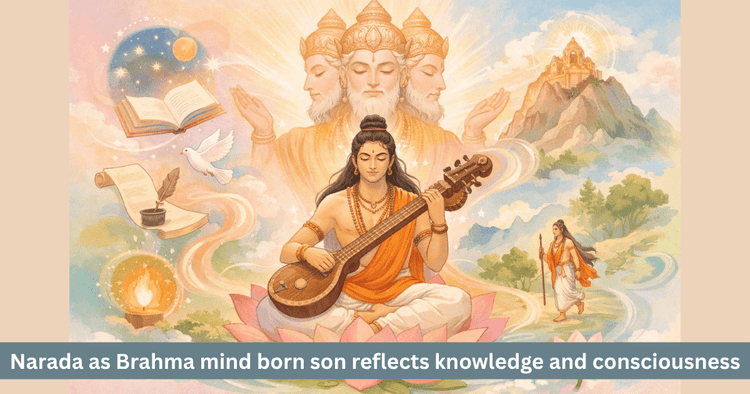
Table of Contents
In the spiritual tradition of India, Narada Muni is one of the most familiar and yet most unusual figures. He is not merely a celestial messenger, not merely a veena bearing sage and not merely a singer of devotion. Within him there appears a remarkable union of wisdom, inner freedom, inquiry, devotion and the search for truth. That is why his origin too is not described as an ordinary human birth. He is described as one of the Manasa Putra of Brahma. This is not only a statement about how he came into being. It is also the key to understanding his temperament, purpose and spiritual role.
In texts such as the Manusmriti and the Bhagavata Purana, Narada is counted among the important Manasa Putra of Brahma. The phrase Manasa Putra may be transliterated as Manasa Putra, which means mind born son or son born from the mind. This idea does not merely suggest a non physical origin. Its deeper meaning is that Narada is linked with mind, consciousness, insight and inner purpose rather than only with bodily lineage. In that sense, he does not merely belong to creation. He belongs to the intelligence behind creation.
Why does the idea of Manasa Putra matter so much
When a great being is called a Manasa Putra, it is not merely a mythic detail. It indicates that the source of that being is more deeply connected with consciousness than with biology. Brahma is known as the creator. To arise from his mind suggests that Narada is tied not simply to the external world but to the level of thought, vision, wisdom and living awareness from which creation itself is imagined.
This is why Narada’s life is not limited to one place, one family, one world or one formal duty. He moves through the three worlds, speaks to devas, warns asuras, guides kings, inspires devotees and appears in the midst of crucial events whenever a deeper truth must be brought forward. The subtle nature of his birth explains the unusual fluidity of his life.
The deeper indications of being a Manasa Putra may be understood through these points:
- His origin is connected more with consciousness than the physical body
- His life is linked with the flow of wisdom
- He is not bound to one limited role
- His nature is deeply independent and subtle from the beginning
What is the spiritual meaning of being born from Brahma’s mind
This question is central because it reveals the root of Narada’s nature. If one is born from the mind of Brahma, then one is connected not only to the outer structure of creation but to the intelligence and awareness from which creation first arose. This means Narada is related less to matter and more to meaning. He is not only one who exists but one who understands purpose.
That is why his life does not appear static. He is not a sage fixed in one place. He moves, asks, awakens, reveals, questions and redirects. The subtle reason behind this living movement is that his source lies in consciousness itself.
This may be understood in a simple way through the following table:
| Aspect | Ordinary birth | Meaning of Manasa Putra |
|---|---|---|
| Origin | Physical process | Emergence from consciousness |
| Purpose | Survival within life | Spread of wisdom and direction |
| Nature | Limited role | Broad and independent role |
| Life current | Familial or social center | Universal and spiritual work |
Why was Narada’s temperament so different
A very interesting point is often made about Narada. He is regarded as a beloved son of Brahma, yet in a certain sense he is also called rebellious. This rebellion is not negative defiance. It is the sign of an awakened freedom that does not follow a path merely because it is expected. It wants to know the deeper truth before accepting direction.
According to the story, when Brahma assigned his mind born sons the work of expanding creation, Narada did not show the expected interest in that task. His heart moved more toward devotion, contemplation and spiritual truth. Instead of increasing the world, he chose to understand its essence. This choice was unusual but it was not careless. It was deeply aligned with his inner nature.
That is the point at which Narada’s distinctive temperament becomes visible.
Was Narada Muni being disobedient
This question may arise naturally. If Brahma assigned a task and Narada did not embrace it, was this a rejection of divine order. The answer is subtle. Narada’s difference was not rooted in disrespect. It was rooted in fidelity to his deeper nature. He did not resist simply to oppose. He chose differently because his consciousness was calling him toward another dharma.
This distinction is essential. What looks like rebellion outwardly may inwardly be faithfulness to truth. In Narada’s case this is exactly what happened. He did not want merely to fulfill expectation. He wanted to live the role for which his being had emerged.
The main qualities of this inner independence were:
- Distance from blind conformity
- Capacity to hear the inner call
- The urge to understand before accepting
- Giving priority to spiritual purpose over outer expectation
Why did he choose the path of devotion instead of creation
Here the beautiful direction of Narada’s life becomes fully visible. Brahma was thinking in terms of the expansion of creation. That is the dharma of the creator. But Narada turned toward the expansion of consciousness. This too is a great dharma. One path multiplies life outwardly. The other deepens life inwardly through devotion and remembrance of the Divine.
This does not mean he rejected Brahma’s purpose as wrong. It means that every soul may have a distinct svadharma, one’s own inner law of being. For one soul creation is central. For another governance. For another austerity. For another devotion. Narada’s svadharma was to spread the Divine Name, wisdom, devotion and the search for truth across the worlds.
That is why he later came to be known as Devarshi, Devarshi, meaning divine sage. His life was no longer that of a limited being with a single task. It became the life of a moving consciousness serving the whole cosmos.
What is the positive meaning of rebellion here
In today’s language, rebellion is often understood negatively. But in the context of Narada, rebellion means awakened discernment. It means not walking a path merely because all others expect it. It means asking, understanding, testing and then accepting. This is why Narada’s so called rebellion is not destructive. It is creative.
This positive form of rebellion works on three levels:
- It does not accept tradition blindly but through understanding
- It does not treat duty as external pressure alone but relates it to inner truth
- It chooses a life path according to one’s own deeper nature
Narada’s story teaches that true knowledge does not lie only in obedience to rules but also in understanding the deeper purpose behind them.
Why may Narada be called a seeker
Narada is not only wise. He is also a seeker. This is visible throughout his life. He does not remain in one place giving fixed discourse. He moves, observes, asks, enters situations and recognizes the inner state of those he meets. Wherever awakening is needed, he becomes active.
This moving, searching quality is deeply connected with his being a Manasa Putra. What is born from mind or consciousness cannot remain confined to rigid structures. It moves like thought, like insight, like inspiration. It enters like a question and leaves behind direction like an answer. Narada’s entire personality may be understood in this way.
The major forms of his seeking nature include:
- He moves through many realms
- He speaks with all kinds of beings
- He raises questions, not only answers them
- He sees life as a living journey, not a fixed structure
How did he come to be known as Devarshi
Narada is called Devarshi. This title is not merely honorific. It indicates his spiritual position. He is a rishi because he is a seer of truth. He is a Devarshi because his awareness is not confined to earthly life. He moves among divine and human realms alike. He becomes a bridge between worlds. He carries wisdom and devotion into places where both are needed.
He attained this place because he remained true to his inner nature. Had he followed outer expectation alone, he may have been remembered only as an obedient son. But he listened to the call within and moved in that direction. That is what made him extraordinary.
What does this story teach us about life
This episode is not only a story about Narada’s origin. It also raises a living question for every human being. Must every person walk the path expected by others. Or should one choose the path to which one’s own soul is inwardly called. That question remains as alive today as it was in ancient times.
Narada’s story teaches that every person may have a distinct dharma. For some, family becomes central. For some, knowledge. For some, service. For some, contemplation. If a person chooses life only according to pressure, comparison or expectation, then outward success may still lead to inward emptiness.
The major teachings of this episode include:
- Recognition of svadharma is essential
- One should listen deeply to the inner call
- True wisdom involves independent discernment
- Once real purpose is known, direction becomes clear
Why is this episode so relevant today
Today many people do not choose their life direction from within. They choose based on family pressure, social comparison, reputation and outer success. After some time they feel that they are fulfilling expectation, yet drifting away from themselves. In such a time the story of Narada becomes deeply meaningful.
It reminds us that listening to the inner voice is not self indulgence when it is rooted in truth, awareness and discipline. On the contrary, that listening may be what connects a human being to one’s true purpose. Narada chose not the easiest path but the path of inner truth.
For the modern person this story says:
- Recognize your actual nature
- Accept traditions through understanding
- Do not lose your life merely fulfilling outer expectation
- If a higher inner call is present, listen to it
Where true purpose is recognized, freedom begins
Ultimately Narada’s life teaches that real freedom does not lie in impulse but in recognizing one’s true purpose. The person who knows one’s own dharma is the one who becomes truly free. Such a person may stand apart from the crowd without becoming inwardly lonely, because the foundation of life is truth.
This is the deepest meaning of Narada’s origin as one of Brahma’s Manasa Putra and of his unusual nature. He was born from mind, and therefore linked to consciousness. He moved beyond expectation, and therefore came closer to his inner dharma. He refused to remain confined to one limited role, and therefore became available to the whole cosmos. That is why his life is not only a sacred narrative. It is also a profound model of self recognition.
FAQs
Why is Narada Muni called a Manasa Putra
Because he is described as arising from the mind of Brahma rather than through ordinary physical birth.
What is the deeper meaning of being a Manasa Putra
It means his origin is connected with consciousness, wisdom, thought and spiritual purpose.
Why is Narada sometimes described as rebellious
Because he did not follow outer expectation mechanically but chose the path of devotion and spiritual truth according to his nature.
How did he attain the position of Devarshi
By recognizing his svadharma and spreading wisdom and devotion across the worlds, he came to be established as a divine sage.
What is the greatest teaching of this story
It teaches that true wisdom and freedom give a person the power to recognize one’s real purpose in life.
Get your accurate Kundali
Generate KundaliDid you like it?
Author

Pt. Narendra Sharma (63)
Experience: 20
Consults About: Family Planning, Career
Clients In: Punjab, Haryana, Delhi
Share this article with friends and family
About ZODIAQ
ZODIAQ is an online Vedic Astrology platform. It connects clients seeking astrological advice to experienced astrologers with deep knowledge. Our users also generate kundali and perform kundali milan for free. ZODIAQ also offers services to the Astrologers. Astrologers utilize various offerings by ZODIAQ to serve their clients effectively.
If you are a User
Consult with experienced astrologers and seek their guidance. You can also order handwritten Janm Patrika report with life prediction prepared by experienced astrologers. Generate accurate Kundali, perform Kundali Matching and check horoscope and muhurat. Utilize our online library for all the necessary astrological and spiritual information.
If you are an Astrologer
Create accurate kundali for your clients and perform Kundali Matching for up to 5 people at a time. Write comprehensive Janm Patrika report for your clients with ZODIAQ. Check client details anytime by saving it in client directory. Become more productive by tracking how many clients you guide every day.
WELCOME TO
ZODIAQ
Right Decisions at the right time with ZODIAQ
