When Narada Muni Became a Woman: The Depth of Experiencing Maya
By Pt. Narendra Sharma
The extraordinary experience of Narada Muni to understand the nature of maya
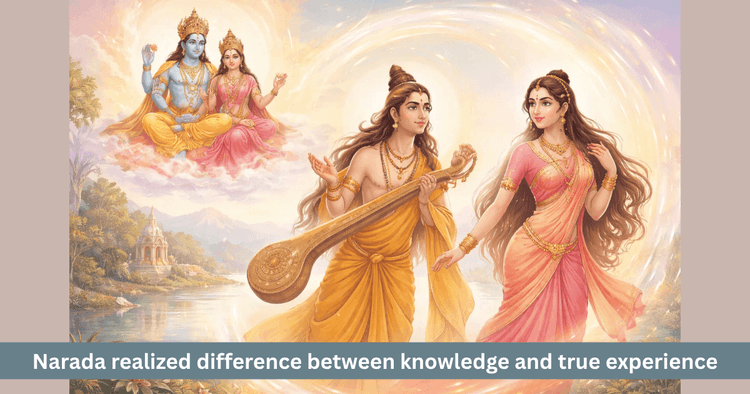
Table of Contents
Narada Muni is usually regarded as a symbol of wisdom, devotion and renunciation. He moves through many realms, links devas, sages and seekers together and constantly remembers the Divine Name. Yet there is an extraordinary episode in his life that reveals a profound spiritual truth. It teaches that knowing something in principle is not the same as experiencing it from within. In this episode, Narada does not merely ask about maya. He lives through it.
This narrative is associated with the Matsya Purana and the Devi Bhagavata Purana, where Narada Muni expresses the desire to understand the Lord’s maya. His question is not superficial. He wants to know what this power truly is, the very power that can draw even great ascetics and wise beings into confusion, attachment and forgetfulness. This is why the story becomes more than a sacred tale. It becomes a profound spiritual teaching on identity, experience and remembrance.
Why did Narada Muni wish to understand maya
Narada Muni was not a sage satisfied with verbal explanation alone. His nature was deeply inquisitive. He wanted to understand why maya is so powerful that even the wise may become affected by it. If the world is temporary, why does it feel so compelling. If the soul is eternal, why does the mind become so deeply entangled in passing experiences.
This was a very deep question, and such a question cannot always be answered through philosophy alone. Some truths must be lived before they can be known. Maya is one of those truths. It cannot be fully understood from outside. One must enter its field, lose orientation within it and then emerge from it to understand its force. That is why Lord Vishnu did not answer Narada immediately.
Narada’s inquiry may be understood through the following points:
- He wanted to know the real force of maya
- He wished to understand why even the wise could be influenced by it
- He was not asking for theory alone but for experiential truth
- His question came from the authentic hunger of a seeker
Why did Lord Vishnu not answer at once
According to the story, when Narada asked Lord Vishnu what maya truly is, the Lord smiled. This smile was not an evasion. It was the smile of compassion that knows some truths must be shown rather than spoken. He told Narada that in time he would experience it for himself.
Both the silence and the smile of Vishnu are meaningful here. If the Lord had merely said that maya is attachment, forgetfulness or illusion, Narada might have understood intellectually but he would not yet have known it. The Lord knew that even a sage like Narada must undergo a state where identity changes, memory becomes covered, emotion takes over and life’s center shifts into temporary relationships. Only then would the answer become complete.
For this reason, the Lord did not postpone the answer. He transformed the answer into a living experience.
What happened by the lake
After some time, Lord Vishnu took Narada Muni to a beautiful forest. The atmosphere was serene, nature was pure and there was a calm and shining lake there. Even this setting carries meaning. Maya does not always come through noise or obvious disturbance. Many times it comes in a form that is beautiful, gentle and inviting. It is not only fearsome. It may also be deeply attractive.
The Lord asked Narada to bathe in that lake. Narada entered the water without hesitation. The moment he dipped into it, his entire form changed. He became a beautiful woman. In the story, her name is given as Damayanti. But this was not only an outward change of body. A still deeper change took place in memory. He forgot that he was Narada Muni. He no longer remembered his prior identity. He began to experience himself as an ordinary woman.
At this point the deepest phase of the narrative begins. The first movement of maya is that it gently leads a being away from memory of the real Self.
What was life like in the form of Damayanti
Now Narada had entered not only a new body but an entirely new mode of experience. After some time, she was married to a king. She entered palace life, family life, relationship and worldly involvement. Children were born, the household expanded and life unfolded in all its familiar movements. The story does not merely narrate events. It immerses the listener in the fullness of lived existence.
This new life was not made only of comfort. It contained love, attachment, expectation, care, fear, security, fragility and the anxiety of possible loss**. The same Narada who had once moved through worlds singing the Divine Name was now fully absorbed in the emotional and relational world of ordinary human life. This is precisely how maya works. It does not always bind by falseness. It binds by creating an experience that feels completely real.
The condition may be understood through the following:
| Experience | Its form within maya | Inner effect |
|---|---|---|
| Love | Depth of relationship | Birth of attachment |
| Family | Belonging | Shift of identity |
| Happiness | Expansion of life | Illusion of permanence |
| Fear | Anxiety of losing | Inner insecurity |
| Sorrow | Shock of loss | Deepening of self forgetfulness |
Why did sorrow make the experience so intense
The turning point of the story arrives when Damayanti’s life is struck by immense loss. Through war, tragedy or sudden destruction, her husband and children are lost. The pain becomes unbearable and she is completely shattered. This is the most human and moving moment of the narrative. Here Narada, who once spoke of renunciation and truth, is now drowning in grief like any ordinary human being.
This is essential to the teaching. The Lord did not want Narada to see that maya is only attraction. He also wanted him to know that maya is equally powerful in the form of sorrow. Once we begin to identify something as ours, its loss becomes more than an outer event. It shakes the very structure of the inner world. That is why Narada was shaken so deeply.
Sorrow here is not merely an emotional event. It becomes the experience of maya’s complete hold.
How did Narada regain his true identity
When grief reached its peak, the story brings Damayanti again to the same lake. This return is deeply symbolic. The place where forgetfulness began becomes the place where remembrance returns. As soon as she enters the water again, the form changes and Narada Muni reappears.
At that very moment, Lord Vishnu appears and asks, Narada, how did you find maya.
This question is not playful in a superficial sense. The entire experience was the answer Narada had asked for. Now no intellectual explanation was needed. He had realized that maya is not merely an illusion that can be defined from the outside. It is a total experience that can pull a being inward, cover memory, alter identity and bind one through both pleasure and sorrow.
What is the real meaning of maya in this story
The greatest spiritual teaching of this episode is that maya is not simply falsehood. If it were merely false, it would not affect consciousness so deeply. Maya here means taking the temporary to be ultimate, mistaking a role for one’s true identity and becoming so absorbed in passing experience that self remembrance is lost. It includes joy and pain, love and separation, and above all it contains the power of forgetfulness.
That is why merely hearing that the world is impermanent is not enough. Until a person can remain inwardly anchored while moving through experience, knowledge remains incomplete. The experience of Narada Muni reveals the distance between conceptual knowledge and realized wisdom.
Maya may be understood through this story in the following ways:
- Maya does not deny experience, it intensifies it
- Maya covers remembrance of the true Self
- Maya makes the temporary feel final
- To move beyond maya is not to reject life but to recover true identity within it
Does this story say that emotions are wrong
No. The story does not call emotions false or wrong. It does not say that love, attachment, grief or tenderness are evil. It says only that they are temporary. They are part of lived existence but they are not the final truth of the soul. If a person mistakes them for the whole of identity, then one becomes trapped in maya. If one lives through them while preserving awareness of one’s deeper nature, then the same experiences can become part of spiritual growth.
This is a very subtle teaching. It does not ask us to run away from life. It also does not ask us to reject relationship. It asks us to live, to feel, to pass through joy and sorrow, yet still not lose touch with the witness, the Self and the real identity within.
What does this story teach us today
Modern people also live in many forms of maya. For some, identity is tied to position. For others, to relationship, wealth, achievement, grief or failure. We begin to mistake our roles for our true self. Then when those roles change, we collapse inwardly.
The story of Narada Muni remains deeply relevant because it teaches that:
- Happiness is not permanent
- Sorrow is also not permanent
- Identity is deeper than role
- True knowledge is that which does not forget itself amidst experience
In life today, this narrative invites awareness. We must live experience fully but we must not disappear inside it.
When experience completes knowledge
The greatest beauty of the story is that Narada’s wisdom became deeper after the experience. Earlier he knew about maya. Now he had lived through it. Earlier he had doctrine. Now he had realization. That is why this is not merely a story of transformation. It is a profound spiritual teaching that true knowledge is that which can pass through the fire of experience and still remain steady.
Narada Muni became a woman, knew love, knew grief, knew forgetfulness and then returned to self remembrance. This entire journey is the journey of understanding maya. And its greatest message is that true wisdom is not afraid of experience, is not lost inside experience and ultimately restores the awareness of one’s real identity.
FAQs
How is it said that Narada Muni became a woman
According to the story, Lord Vishnu asked him to bathe in a lake, and upon entering it his form changed into that of a woman.
What name is given to that woman in the story
The name given in the narrative is Damayanti.
Did his memory also change along with the form
Yes. He forgot that he was Narada Muni and began to experience himself as an ordinary woman.
What is the main meaning of maya in this episode
Maya here means becoming so deeply absorbed in temporary experiences that one forgets one’s true identity.
What is the greatest teaching of this story
It teaches that theoretical knowledge alone is not enough. True wisdom remains steady even in the midst of lived experience.
Get your accurate Kundali
Generate KundaliDid you like it?
Author

Pt. Narendra Sharma (63)
Experience: 20
Consults About: Family Planning, Career
Clients In: Punjab, Haryana, Delhi
Share this article with friends and family
About ZODIAQ
ZODIAQ is an online Vedic Astrology platform. It connects clients seeking astrological advice to experienced astrologers with deep knowledge. Our users also generate kundali and perform kundali milan for free. ZODIAQ also offers services to the Astrologers. Astrologers utilize various offerings by ZODIAQ to serve their clients effectively.
If you are a User
Consult with experienced astrologers and seek their guidance. You can also order handwritten Janm Patrika report with life prediction prepared by experienced astrologers. Generate accurate Kundali, perform Kundali Matching and check horoscope and muhurat. Utilize our online library for all the necessary astrological and spiritual information.
If you are an Astrologer
Create accurate kundali for your clients and perform Kundali Matching for up to 5 people at a time. Write comprehensive Janm Patrika report for your clients with ZODIAQ. Check client details anytime by saving it in client directory. Become more productive by tracking how many clients you guide every day.
WELCOME TO
ZODIAQ
Right Decisions at the right time with ZODIAQ
