Narada Muni and the Test of Maya: When Knowledge Was Drowned in Delusion
By Pt. Nilesh Sharma
The profound test of Narada Muni’s ego and truth through Lord Vishnu’s divine illusion of maya
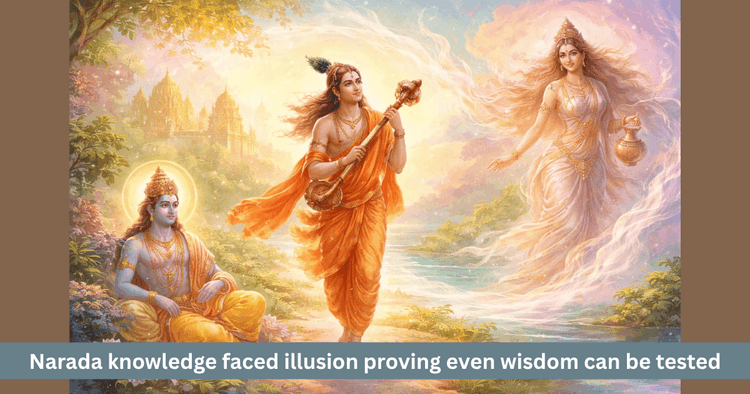
Table of Contents
The life of Narada Muni does not remain limited like the lives of ordinary sages. He is a divine being who moves across the three worlds carrying devotion, wisdom and truth. His detachment was so deep that he was considered beyond the attractions of worldly life. For this very reason, a time came when he became convinced that he was completely free from the Lord’s maya. That conviction grew so strong that he told Lord Vishnu that he could never be trapped in divine illusion. This was not a simple statement. It was a subtle challenge, and hidden within it was not only knowledge but also a slight touch of ego.
This episode, described in the Varaha Purana, shows that maya does not test only the ignorant. It also tests those who begin to believe that they stand above it. Lord Vishnu did not answer Narada directly. He only smiled, indicating silently that experience itself would provide the answer. After some time, He led Narada to a beautiful and peaceful forest. There was a pure lake there, and the entire atmosphere was full of serenity and charm. Vishnu asked Narada to wait for a while and said that He would go to bring water. Outwardly the moment looked ordinary but in truth it was here that the play of maya began.
Why did Lord Vishnu not respond immediately
When Narada declared that he could never fall into maya, Lord Vishnu did not argue. He did not lecture him either. He only smiled. That smile was not casual. It carried compassion and a silent teaching. The Lord knew that some truths cannot be fully understood through words. They must be lived.
This is the first great signal in the story. God does not always answer through explanation, because explanation may satisfy the mind but experience transforms consciousness. Vishnu chose to teach Narada through the path that would have the deepest effect.
This point may be understood in simple form:
- Some truths are not merely heard but lived
- Knowledge of maya is not complete until it is experienced
- The smile of the Lord can itself be a silent teaching
- Where ego is subtle, the lesson too becomes subtle
Why was the forest and lake scene so important
After some time, Lord Vishnu led Narada into a very beautiful forest. There was a clear lake, pleasing surroundings and a deeply peaceful atmosphere. He told Narada to remain there for a while and said that He would return after bringing water. Outwardly this was an entirely ordinary scene. But in reality it was the exact place where the movement of maya began.
This part of the story teaches that maya does not always enter in a frightening form. It often arrives through beauty, ease, gentleness and attraction. It does not storm the mind in an obvious way. It enters softly and gradually. Narada stood beside the lake, and from that moment the center of his awareness began to turn outward.
How did maya begin to work so gradually
At first Narada’s mind was steady, collected and centered in the Lord. But slowly the outer beauty of the setting began to draw his awareness outward. This change did not happen all at once. That is one of the deepest powers of maya. It does not always seize the mind suddenly. It often draws it little by little.
Soon Narada saw a very beautiful woman. She was not merely a visual object in the story. She marked the point at which maya entered. Narada became attracted to her. Conversation arose. Conversation turned into relationship. Relationship turned into life. This sequence shows that human beings rarely fall into illusion in one large movement. They enter it through many small attractions, one after another.
This gradual process of maya may be understood as follows:
| Stage | What appears outwardly | What happens inwardly |
|---|---|---|
| Beautiful scene | Natural attraction | The center of attention moves outward |
| Conversation | Harmless contact | Emotional involvement begins |
| Relationship | Normal human bond | Identity begins to change |
| Attachment | Family and happiness | Memory of true self becomes veiled |
How did Narada become so deeply absorbed in that life
The story says that Narada married that woman, built a family and began living like an ordinary householder. He experienced joy, relationship, belonging and the full range of ordinary human life. Most importantly, during that whole experience he completely forgot who he truly was. This is the deepest point in the story.
Maya does not merely attract. It covers identity. A person forgets one’s original nature and begins to believe that the temporary role one has entered is the whole truth. Narada, who was a divine sage, a symbol of detachment and knowledge, began living fully as though that worldly identity were ultimate reality. This is the profound force of maya.
The story therefore teaches that maya is not only in outer objects. It exists in that forgetfulness through which the temporary is treated as final truth.
What is the deepest point in this entire experience
The deepest truth of this episode is that while a person is within maya, one usually does not know that one is in maya. If one constantly remembered that it was illusion, maya would remain incomplete. Its power lies precisely in making the experience feel absolutely real.
This is what happened to Narada. His wisdom, detachment and self knowledge seemed to disappear beneath the weight of the lived experience. He was not merely seeing the illusion. He was living it. He was not merely involved. He was absorbed. That is why this story does not reveal the weakness of knowledge itself. It reveals the danger of ego hidden within knowledge.
How did sorrow break the illusion
Time passed and eventually Narada experienced deep sorrow in that life. This sorrow was not merely an external event. It shook his consciousness from within. When the very structure of life begins to collapse, a person first begins to question the reality that had been treated as final.
This is how sorrow becomes the turning point in the story. The life that Narada had taken to be everything suddenly broke. In that moment of inner rupture, everything changed. He found himself once again standing in the same place where Lord Vishnu had left him. The woman was gone. The family was gone. The entire life he had lived was gone.
From this comes a profound teaching. Sorrow is not always only suffering. At times it becomes the doorway to awakening.
Why was Vishnu’s question so profound
When Narada looked up, Lord Vishnu was standing before him with the same serene smile. He asked only one simple question, “Narada, how did maya feel?” The question is short, yet it contains the essence of the whole story.
This was not mockery. It was a compassionate mirror. Vishnu did not create the experience to humiliate Narada. He did so to teach him that maya cannot be lightly dismissed. If knowledge is not joined with humility, even knowledge may become a subtle doorway into illusion.
This question contains three deep teachings:
- To know about maya and to be beyond maya are not the same
- Knowledge without experience remains incomplete
- Without humility, knowledge does not remain stable
What is the deepest spiritual meaning of this episode
The deepest meaning of this story is that ego may arise not only in ignorance but also in knowledge. Sometimes it enters even more subtly in the life of a wise person. One begins to feel, now I understand everything, now I am safe, now no illusion can touch me. It is at that very point that the door of maya opens.
Narada did not stumble because he lacked knowledge. His test arose from the subtle ego that made him believe he was beyond illusion. That is why this story is not only about maya. It is also about the absolute necessity of humility.
This may be seen more clearly through the following table:
| State | What it appears to be | Actual spiritual condition |
|---|---|---|
| Knowledge | Stability and power | Light if joined with humility |
| Ego within knowledge | Confidence | Beginning of subtle downfall |
| Experience of maya | Outer attraction | Covering of true identity |
| Awakening | Pain or inner rupture | Birth of deeper understanding |
In what forms does maya work today
This story is not limited to an ancient forest, a lake or a divine play. Maya still works today, only its forms have changed. It is not confined to beauty and sensual attraction. It also works through identity, success, praise, ego, ideas, relationships, social image, ambition and the story a person builds about oneself.
Modern human beings too often feel that they have understood everything. They begin to believe they are beyond confusion. Yet life again and again reveals that there is still much within that can be shaken by circumstance. This is what makes the story deeply relevant even now.
For modern life, this story teaches:
- Maya is not only in outer objects but also in inner identity
- Success too may become illusion if humility is absent
- Sorrow may become not only pain but a doorway to awareness
- A true seeker never claims to be beyond all testing
What is true knowledge
Ultimately this story teaches that true knowledge is not merely to declare the world unreal. True knowledge is to remain inwardly awake while living in the world, to remain humble amidst attraction and not to lose the memory of one’s real nature within changing roles. That is the difficult path, and that is real spiritual maturity.
This episode of Narada teaches that the essence of wisdom lies in awareness free from pride. The answer is not to run away from maya but to remain conscious even in the midst of it. Where humility remains, knowledge is protected. Where knowledge becomes a claim, the test of maya comes near.
Where humility remains, knowledge becomes steady
The story of Narada Muni and the challenge of maya teaches very deeply that no seeker, however advanced, should abandon humility. Experience, austerity, wisdom and detachment are all precious but the moment a person feels that nothing remains to be learned, subtle illusion may begin.
The heart of the story is this, maya tests not only the ignorant but also the wise. And true wisdom is that which leaves a person more humble, more aware and more dependent on the Divine after every experience. That is the true light of this episode.
FAQs
What did Narada Muni tell Lord Vishnu
He said that he could never be trapped in the Lord’s maya.
Why did Lord Vishnu not answer immediately
Because this question required experience, not merely explanation.
How did maya bind Narada
Through gradual attraction, conversation, relationship and identity, until he forgot his true nature and lived a complete worldly life.
When did Narada realize the truth
He realized it when the entire experience suddenly vanished and Lord Vishnu asked him, “Narada, how did maya feel?”
What is the greatest teaching of this story
It teaches that humility is essential even in knowledge, because subtle ego becomes the greatest doorway through which maya enters.
Get your accurate Kundali
Generate KundaliDid you like it?
Author

Pt. Nilesh Sharma (63)
Experience: 20
Consults About: Family Planning, Career
Clients In: Punjab, Haryana, Delhi
Share this article with friends and family
About ZODIAQ
ZODIAQ is an online Vedic Astrology platform. It connects clients seeking astrological advice to experienced astrologers with deep knowledge. Our users also generate kundali and perform kundali milan for free. ZODIAQ also offers services to the Astrologers. Astrologers utilize various offerings by ZODIAQ to serve their clients effectively.
If you are a User
Consult with experienced astrologers and seek their guidance. You can also order handwritten Janm Patrika report with life prediction prepared by experienced astrologers. Generate accurate Kundali, perform Kundali Matching and check horoscope and muhurat. Utilize our online library for all the necessary astrological and spiritual information.
If you are an Astrologer
Create accurate kundali for your clients and perform Kundali Matching for up to 5 people at a time. Write comprehensive Janm Patrika report for your clients with ZODIAQ. Check client details anytime by saving it in client directory. Become more productive by tracking how many clients you guide every day.
WELCOME TO
ZODIAQ
Right Decisions at the right time with ZODIAQ
