Narada and Ravana: When One Question Revealed the Limits of Pride
By Pt. Amitabh Sharma
When a simple suggestion exposed the illusion of absolute power
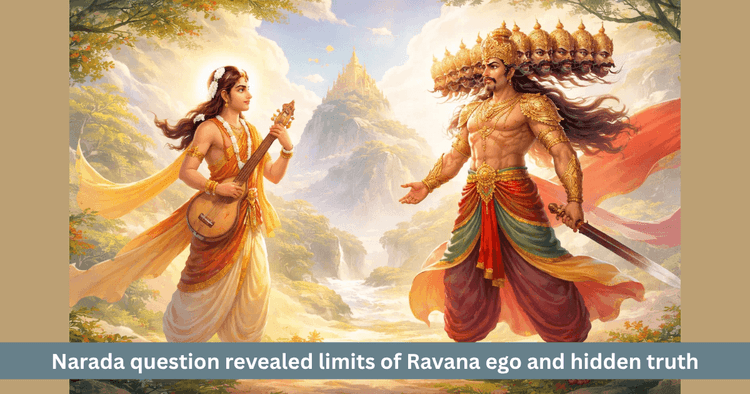
Table of Contents
Narada Muni was never limited to the role of a sage who only gives knowledge. Again and again he appears in situations where hidden truth must be brought to the surface. His purpose is not to destroy a person but to break the pride that carries a person away from reality. This truth becomes very clear in a well known episode associated with Ravana, found in some descriptions of the Uttara Kanda of the Ramayana. In this story, Narada does not curse Ravana, nor does he give him a long sermon, yet through one suggestion he brings Ravana face to face with the limits of his own power.
At that time Ravana stood at the peak of his strength and glory. He had defeated many celestial beings, extended his influence across many realms and become convinced that there was no one greater than him in all creation. Power, when joined with wisdom, protects. But when power joins with self intoxication, it blinds. This is exactly what had begun to happen within Ravana. His strength was no longer merely strength. It had become pride.
How did Ravana’s confidence become arrogance
Ravana was no ordinary warrior. He was learned, accomplished and possessed immense power. Yet one of life’s deepest ironies is that the very qualities that raise a person may, once balance is lost, become the cause of downfall. Ravana’s might first gave him stature. Then it became attachment. Finally it began to cloud his perception. He started believing that no one could stand before him.
When a person begins to feel that nothing remains to be learned and no one remains greater, that is often the beginning of inner imbalance. Ravana had reached such a state. He was no longer merely aware of his strength. He had begun to worship his own strength. That is where outward victory contains the seed of inward defeat.
The signs of Ravana’s condition were:
- He had become deeply proud of his power
- He could no longer see his own limits
- He believed no one in creation could equal him
- His strength had come under the control of ego rather than wisdom
Why did Narada Muni not advise him directly
This is the most important point in the story. Narada knew that an arrogant person rarely accepts direct advice. One who is intoxicated by one’s own power listens very little and tries constantly to prove oneself. If Narada had openly told Ravana that his pride was dangerous, Ravana may have laughed it off or become even more hardened.
A true guide not only knows the truth but also knows how the truth must be delivered. Narada did exactly that. He did not lecture Ravana. He created a direction in which Ravana would collide with his own limitation. This is a higher form of teaching. When a person learns through direct experience, the lesson enters much more deeply.
Narada’s method in this episode may be understood as follows:
| Situation | Usual method | Narada’s method |
|---|---|---|
| Arrogant person | Direct advice | Leading toward experience |
| Pride in strength | Reasoning | Holding up a challenge as a mirror |
| Opportunity for learning | Instruction | Self realization through event |
| Result | Temporary reaction | Deep and lasting inner impact |
What was hidden behind Narada’s praise
The story says that Narada met Ravana and praised his valor. At first this sounds like simple conversation but in truth it was part of a deeper strategy. Narada understood the condition of Ravana’s mind. By praising him, he allowed Ravana’s hidden arrogance to rise even more clearly to the surface. When ego receives more air, it often rushes more quickly toward its own breaking point. Narada let this pride reveal itself completely.
Then in an apparently casual way he suggested that if Ravana truly wished to test his strength, he should fight Vali. This was no ordinary suggestion. It struck directly at the point where Ravana’s pride was most alive. Narada knew Ravana would not be able to resist such a challenge.
Why did the name of Vali immediately provoke Ravana
Vali was renowned for immense strength. There was also a belief that whoever fought him lost half of one’s power to him. This was not merely a tale of physical might. It was a statement about the extraordinary force associated with Vali. When Ravana heard this, his pride reacted immediately. He could not tolerate the thought that someone might be stronger than him.
This shows one of the fundamental marks of arrogance. A proud person cannot calmly hear of another’s greatness. The mind reacts at once. It compares, resists and becomes eager to prove itself. Ravana did the same. He did not hear Narada’s words as information. He heard them as a challenge to his supremacy.
The emotions working behind Ravana’s reaction were:
- The urge to prove himself superior
- The inability to accept another’s greatness
- Immediate reaction to challenge
- Loss of judgment through ego
What was the turning point in the meeting between Vali and Ravana
When Ravana finally reached Vali, the latter was not even standing prepared for battle. He was engaged in his ordinary activity. This detail is deeply symbolic. Ravana arrived burning with challenge and pride, while Vali stood in complete ease. That contrast alone reveals the difference between the two. One was trying to prove power. The other did not need to prove anything.
Ravana challenged him to battle. But the story says that Vali caught him effortlessly and held him under his arm. This was not only astonishing. It was profoundly symbolic. Ravana, who believed himself to be the mightiest being alive, became completely helpless within a moment before another’s natural strength.
Vali did not merely defeat Ravana. He broke his pride
The most striking part of the story is that Vali carried Ravana around in that condition while continuing his own routine. Ravana could neither fight, nor display power, nor preserve his dignity. This was not merely physical defeat. If Ravana had lost in battle, he could perhaps have treated it as one warrior’s defeat. But here the humiliation was much deeper. He did not even receive the dignity of a real contest.
This is what truly breaks pride. Sometimes defeat does not come through weapons but through an experience that completely shatters expectation. Ravana must have imagined a great battle in which he would display his full power and emerge victorious. Instead, he was given no such opportunity. That became his greatest humiliation.
The subtle meaning of this episode may be understood through the following table:
| Ravana’s expectation | Actual event | Inner result |
|---|---|---|
| Fierce battle | Effortless capture | Blow to self intoxication |
| Display of power | Total helplessness | Awareness of limitation |
| Victory | Humiliating defeat | Breaking of pride |
| Feeling invincible | Becoming insignificant before another | Encounter with reality |
What did Ravana learn from this experience
When Vali finally released him, Ravana was not only physically free. He had also been inwardly wounded by a profound realization. For the first time he experienced that his strength was not absolute. There were indeed powers in creation far beyond his own. This understanding did not come from scripture or discourse. It came through direct experience.
This is the greatest teaching of the story. A person may think many things about oneself but life can reveal the truth through a single event. The image Ravana had built within himself was shattered by the encounter with Vali. This was the very center of Narada’s design.
Why is Narada Muni’s guidance so unique here
Narada did not create this situation to destroy Ravana. His purpose was not punishment. He wished to expose that blind point within Ravana from which his downfall had begun. That was the place where pride had already separated him from reality. If one is shown truth at such a point, there is still a chance to learn. This is what Narada made possible.
He did not act out of hostility. He simply gave one suggestion, one direction and one opening. The rest was done by experience itself. This is the sign of true guidance. A real teacher does not always hand over answers directly. Sometimes the teacher leads the seeker to the experience from which the answer becomes unavoidable.
Narada’s role may be understood through these points:
- He recognized Ravana’s mental condition
- He chose experience instead of direct sermon
- He brought Ravana face to face with his own limit
- He used experience to make the lesson permanent
Why is this story just as relevant today
Today one may not see Ravana’s physical might in the same form, yet the egoic pattern seen in him appears again and again in life. Through success, talent, wealth, influence, status or knowledge, a person may begin to feel that no one can challenge, correct or surpass them. That is often the moment when life brings some form of Vali before them.
That Vali may appear as another person, a hard circumstance, a failure, a disease or an unexpected event that reveals limitation. In this sense the story is not merely ancient narrative. It is a living truth even today.
The major teachings this episode offers for present life are:
- Power without humility leads toward downfall
- Every person has limits
- Experience often teaches more deeply than advice
- A true guide brings a person face to face with reality
Where awareness of limitation begins, true wisdom begins
Ultimately this episode of Ravana and Narada teaches that real wisdom begins when a person recognizes one’s limitation. One who sees oneself as limitless lives in illusion. One who knows strength and still remains humble becomes stable. Pride does not truly raise a person. It only creates the feeling of height. And when that illusion breaks, if the person is fortunate, the breaking itself may become the beginning of wisdom.
This is one of Narada Muni’s great gifts. He does not merely speak truth. He places before a person such a mirror that the person may see oneself clearly. With Ravana too, this is what he did. And the deepest message of the story is that sometimes one simple question, asked at the right moment, can make a great arrogance confront its own limit.
FAQs
Why did Narada Muni not advise Ravana directly
Because an arrogant person rarely accepts direct advice. Narada therefore chose the path of experience.
Whom did Narada ask Ravana to challenge
He suggested that Ravana test his power by fighting Vali.
What was Ravana’s greatest defeat before Vali
His greatest defeat was that he did not even receive the dignity of a true battle and became completely helpless at once.
What was Narada Muni’s greatest role in this story
He brought Ravana face to face with his own limitation through experience rather than argument.
What is the deepest teaching of this episode
It teaches that recognition of one’s limit through experience can become far deeper and more lasting than any direct instruction.
Get your accurate Kundali
Generate KundaliDid you like it?
Author
Pt. Amitabh Sharma (56 Years)
Experience: 20
Consults About: Family Planning, Career
Clients In: Punjab, Haryana, Delhi
Share this article with friends and family
About ZODIAQ
ZODIAQ is an online Vedic Astrology platform. It connects clients seeking astrological advice to experienced astrologers with deep knowledge. Our users also generate kundali and perform kundali milan for free. ZODIAQ also offers services to the Astrologers. Astrologers utilize various offerings by ZODIAQ to serve their clients effectively.
If you are a User
Consult with experienced astrologers and seek their guidance. You can also order handwritten Janm Patrika report with life prediction prepared by experienced astrologers. Generate accurate Kundali, perform Kundali Matching and check horoscope and muhurat. Utilize our online library for all the necessary astrological and spiritual information.
If you are an Astrologer
Create accurate kundali for your clients and perform Kundali Matching for up to 5 people at a time. Write comprehensive Janm Patrika report for your clients with ZODIAQ. Check client details anytime by saving it in client directory. Become more productive by tracking how many clients you guide every day.
WELCOME TO
ZODIAQ
Right Decisions at the right time with ZODIAQ
