How Narada Gave the Name of Rama to Valmiki and Transformed Ratnakara
By Aparna Patni
The divine counsel that turned a bandit into Sage Valmiki through the power of Rama Naam
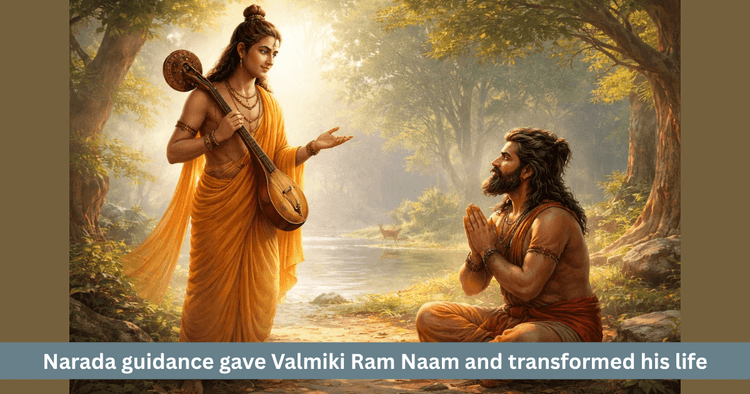
Table of Contents
In the Indian spiritual tradition, some episodes are not merely stories. They become living proof that a human life can change direction completely at any moment. One such deeply transformative episode is the story of the bandit Ratnakara, who later became the great sage Valmiki. This transformation was not the result of sudden miracle alone. At its center stood a sacred meeting in which one awakened sage recognized the hidden divinity within a fallen man. That sage was Narada Muni.
Narada is often remembered as a divine wanderer but one of his deepest qualities is that he is a guide who can raise a person from exactly the place where that person has fallen. He does not merely preach. He awakens questions. He does not merely give information. He turns consciousness. That is why the story of Ratnakara and Narada is not simply the story of a criminal becoming good. It is a journey of the Divine Name, guidance, awakening and inner transformation.
Who was Ratnakara and what kind of life did he live
According to the version associated with the Adhyatma Ramayana, Ratnakara was a bandit who robbed travelers in the forest. His life was filled with violence, fear and crime. He was not merely a petty thief. He had shaped his whole way of living around harming others for his own survival and gain.
Yet the first deep point of the story is this, that no person is completely defined by present action alone. Outwardly Ratnakara was a robber. Inwardly he still carried a consciousness that only needed the right question, the right touch and the right direction. Narada Muni recognized that possibility.
The initial state of Ratnakara’s life may be understood through the following points:
- His life was based on crime
- He had normalized violence within himself
- He had no deep moral awareness of his actions
- He believed that what he did for his family was justified
How did the meeting with Narada happen
One day in the forest, Ratnakara encountered Narada Muni. Following his habitual nature, he attempted to rob him as well. The beauty of the episode begins here. Where another person might have become afraid, Narada remained completely calm, steady and fearless. He did not resist, did not curse and did not react with anger. He simply asked a question.
This is the unique quality of Narada. He knew that punishment may not transform every human being but a true question can shake someone from within. The question he placed before Ratnakara appeared simple but it struck at the very root of his life.
He asked whether the people for whom Ratnakara was committing all these sins would also be willing to share the consequences of those sins.
This question was powerful because it forced Ratnakara to face personal responsibility for the first time.
Why did this question become so transformative
At first Ratnakara did not find the question difficult. He assumed that since he was committing these acts for his family, surely his family would share the burden of the sin as well. But this confidence was part of his illusion. He was living under the assumption that wrongdoing done in the name of love and duty could somehow become acceptable.
Narada’s question was not only moral. It was existential. It asked whether one can truly distribute the consequences of adharma, unrighteous action, merely because it was done in the name of others. This was the first moment in which Ratnakara was pushed to examine his life from within rather than from the outside.
The power of the question may be understood in the following way:
| Question | Outer meaning | Inner effect |
|---|---|---|
| Will your family share your sin | Test of responsibility | Breaking of illusion |
| Are you alone accountable | Moral challenge | Awakening of conscience |
| Does love justify wrongdoing | Examination of relationship | Distinction between dharma and adharma |
What answer did his family give
When Ratnakara went to his family and asked whether they would share the consequences of his sinful deeds, he received a deeply shocking answer. His family clearly said that they could accept the food, safety and support he brought but they would not bear the fruits of his sins. At that moment something broke within him.
This is the turning point of the story. As long as a person remains protected by illusion, that person rarely sees the direction of life clearly. But when truth appears, the entire inner structure can begin to shake. This is what happened to Ratnakara. For the first time he realized that those for whom he had committed such great wrongdoing would not stand with him in its consequences.
This answer was not merely disappointment. It was awakening.
What changed within Ratnakara
When Ratnakara returned to Narada Muni, he was no longer the same man. Outwardly he was the same but inwardly his vision had changed. There was now pain within him, a break in his old certainty and also the beginning of a new search. He asked Narada for guidance. This is the moment when the mind of the criminal bends into the posture of a disciple.
Narada did not reject him as sinful or unworthy. He did not tell him that liberation was impossible. This is the mark of true compassion. He recognized the hidden possibility within Ratnakara at exactly the moment it began to awaken, and he gave him a means that would transform history itself.
Why did Narada give him the path of the Name Rama
Narada instructed Ratnakara to chant the name Rama. This was not just a sound. It was a sacred Name carrying the power to purify consciousness, redirect the mind and transform the inner being. But the next part of the story is even more extraordinary, because Ratnakara had lived such an impure and unrefined life that he could not even pronounce the name Rama properly.
Here the guiding intelligence of Narada becomes visible. He understood that if a seeker cannot utter the pure Name directly, then the seeker must be lifted from exactly the point where he stands. So he gave a simple method. He told Ratnakara to repeat Mara Mara. Repeated continuously, this would naturally reverse into Rama Rama.
This is one of the most beautiful spiritual details in the entire story. The Divine Name can reveal itself not only through purity already achieved but also through a broken life ready to turn. If direction is right, even what begins in reverse can lead straight to the Divine.
What does the secret of Mara becoming Rama reveal
This is not merely a linguistic device. It carries a deep teaching on spiritual practice. It means that even if a person is not yet fully prepared, that person should not be denied the path. One must be lifted from the very place where one stands. This is exactly what Narada did. He did not demand an ideal starting point. He made Ratnakara’s present condition itself the basis of practice.
This mystery may be understood through the following points:
- Spiritual practice may begin not from purity but from honest effort
- A true guru can transform even an impure life into a path
- The Divine Name finds its way if the heart is ready to change
- Even a reversed sound may become true awakening under right guidance
How did Ratnakara’s austerity become so deep
Ratnakara accepted that chant and made it his life. He sat down and continuously repeated Mara Mara. Over time, the sound itself began to transform into Rama. As the chant changed, his consciousness changed with it. The man who had once lived in violence became absorbed in meditation. The one who had obstructed the path of others now entered the inward path.
His austerity became so deep that he entered a state of complete absorption. It is said that termites built an anthill around him. This is why he later came to be known as Valmiki, a name connected with Valmika, an anthill.
This austerity was not simply the passing of time. It was a process of inward death and rebirth.
| Earlier state | Means of transformation | New state |
|---|---|---|
| Violence | Chanting | Peace |
| Crime | Meditation | Inner awakening |
| Ignorance | The Divine Name | Transformed consciousness |
| Bandit | Austerity | Sage |
What is the real meaning of Ratnakara becoming Valmiki
When he finally emerged from the anthill after many years, he was no longer the old Ratnakara. Not only had his name changed, his entire being had changed. He had become Maharshi Valmiki. This is the moment that makes the story immortal. The bandit who once robbed travelers became the composer of the great epic Ramayana.
This was not merely miracle. It was the fruit of a true question, a true guide, a true Name and unwavering practice. That is why this story gives hope. It says that no human being is finally lost if the capacity to awaken still remains within.
What was the greatest quality of Narada Muni in this story
The most extraordinary quality of Narada in this entire episode is that he did not see Ratnakara merely as a criminal. He saw the hidden possibility of a sage within him. This is the vision of a true guide. Such a guide sees beyond the present fall and recognizes the future hidden inside the person.
Narada did not do the following:
- He did not punish Ratnakara immediately
- He did not reject him
- He did not merely lecture and walk away
- He gave a path suited to Ratnakara’s actual condition
That is why his one counsel became history changing.
What does this story teach for our time
Even today this episode remains deeply relevant. Many people go astray. Some through ignorance, some through circumstances, some through bad company, some through greed. In such cases, society often responds first with punishment or rejection. But this story teaches that the right direction, the right question and the right word can often be more transformative than punishment alone.
This story teaches us today that:
- No fallen person is beyond change
- Right guidance can change the direction of life
- The Divine Name, practice and holy company can revive consciousness
- A true guide can awaken the hidden divinity in anyone
When one right word changes history
The deepest message of this story is that words are not merely sound. A right word spoken at the right moment can turn the course of a human life. Narada Muni did not merely give Ratnakara the name Rama. He gave him the doorway to a new identity. He did not speak to the bandit alone. He spoke to the sage hidden within the bandit.
That is why the story of Ratnakara becoming Valmiki is not merely a religious episode. It is one of the greatest declarations of human possibility. It tells us that a person may fall, wander, commit wrongdoing but if truth is faced and the right path is taken, the same consciousness may one day compose an epic.
In the end, the story teaches that a true question, a true guru, a true Name and a true practice can transform any life completely. That is the enduring miracle of the one counsel from Narada that changed history.
FAQs
Who was Ratnakara
Ratnakara was a bandit who robbed travelers in the forest and lived a life of violence and crime.
What question did Narada Muni ask him
He asked whether the people for whom Ratnakara committed sins would also share the fruits of those sins.
How did the family’s answer transform Ratnakara
When his family refused to share the burden of his sins, he became aware for the first time of his personal responsibility.
Why did Narada tell him to chant Mara instead of Rama
Because Ratnakara was unable to utter the name Rama directly, Narada gave him a form of practice suited to his condition, which gradually turned into Rama.
What is the greatest teaching of this story
It teaches that right guidance, the Divine Name and sincere practice can completely transform even the most fallen life.
Get your accurate Kundali
Generate KundaliDid you like it?
Author

Aparna Patni (63)
Experience: 20
Consults About: Family Planning, Career
Clients In: Punjab, Haryana, Delhi
Share this article with friends and family
About ZODIAQ
ZODIAQ is an online Vedic Astrology platform. It connects clients seeking astrological advice to experienced astrologers with deep knowledge. Our users also generate kundali and perform kundali milan for free. ZODIAQ also offers services to the Astrologers. Astrologers utilize various offerings by ZODIAQ to serve their clients effectively.
If you are a User
Consult with experienced astrologers and seek their guidance. You can also order handwritten Janm Patrika report with life prediction prepared by experienced astrologers. Generate accurate Kundali, perform Kundali Matching and check horoscope and muhurat. Utilize our online library for all the necessary astrological and spiritual information.
If you are an Astrologer
Create accurate kundali for your clients and perform Kundali Matching for up to 5 people at a time. Write comprehensive Janm Patrika report for your clients with ZODIAQ. Check client details anytime by saving it in client directory. Become more productive by tracking how many clients you guide every day.
WELCOME TO
ZODIAQ
Right Decisions at the right time with ZODIAQ
