Narada and Vishwamohini: A Monkey Like Face and a Deep Spiritual Lesson
By Pt. Nilesh Sharma
The story of Narada Muni’s ego, illusion, and ultimate awakening
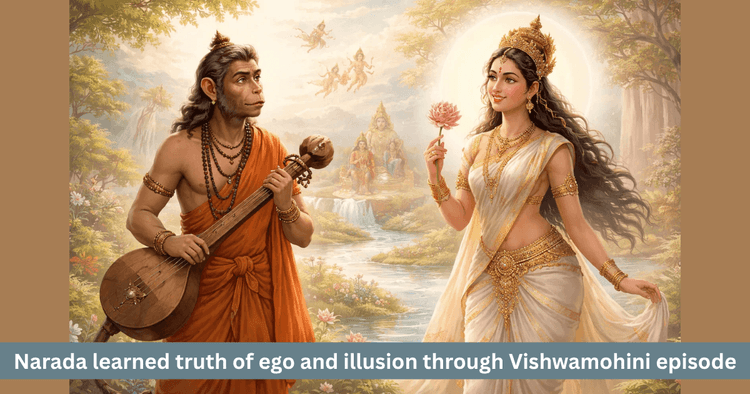
Table of Contents
Narada Muni is generally remembered as a living symbol of devotion, renunciation and wisdom. He moves through different realms, carries sacred dialogue between devas, sages and seekers and remains immersed in the remembrance of the Divine Name. Yet there are episodes in his life that reveal an important truth. Even where there is knowledge, subtle attraction and hidden ego may still enter. One such profound episode is the story of Vishwamohini, in which Narada receives a deep spiritual lesson through experience.
This famous narrative appears in the Bala Kanda of the Ramcharitmanas. At first glance, it may seem like a story of attraction, embarrassment and divine play. But when studied carefully, it becomes a mirror for the inner life of every seeker. It contains desire, fascination, self delusion, divine intervention, anger and finally awakening. That is why it is not merely an entertaining episode. It is a deeply reflective spiritual teaching.
What arose within Narada when he saw Vishwamohini
According to the story, Narada Muni saw a princess named Vishwamohini, whose beauty and charm were so extraordinary that within him there arose the desire to marry her. This is the first major turning point of the narrative, because it reveals that even one who walks the path of renunciation is not beyond inner examination.
This was not merely a passing appreciation of beauty. The attraction became deep enough that Narada began to imagine a different direction for his life. This is how moha, attachment born of enchantment, often begins. It first appears as admiration, then becomes possibility and finally turns into inward insistence.
For a seeker, this is one of the most important lessons of the story. Until one is tested, one may not fully know the subtle attractions hidden in the heart. Even in the case of Narada, such a feeling arose, and that makes the story even more relevant for ordinary human life.
Was this only attraction or did subtle ego also enter
A closer reading of the episode makes it clear that the story is not about attraction alone. It also contains subtle ego. Narada began to think that if he could appear beautiful enough, he would be chosen in the swayamvara, the ceremony of self choice. At this point, simple attraction begins to turn into self delusion.
This is a subtle danger on the spiritual path. Attraction and ego often move together. A person becomes attached to someone or something, then starts to feel inwardly entitled to attain it and slowly moves away from clear discrimination. This is exactly what happened here.
The episode reveals the following:
- Attraction without discrimination can become attachment
- Subtle ego often enters together with attachment
- The seeker then begins to think in desire centered patterns
- The deepest danger is not outer temptation but inner self delusion
Why did Narada go to Lord Vishnu
Narada Muni knew that to succeed in the swayamvara he would need to appear beautiful and attractive. He wanted the princess to choose him at first sight. therefore he went to Lord Vishnu and prayed to receive the form of Hari. This becomes the most fascinating and spiritually significant point in the story.
Outwardly the prayer may sound devotional but the inner intention is different. He is not asking for the divine form in order to draw closer to God. He is asking for it so that he may succeed in winning the princess. This reveals a subtle but very important truth. Sometimes we also pray not for what is spiritually right for us but for what may satisfy our attachment.
This remains deeply relevant even today. Many times prayer may outwardly appear devotional while inwardly it is directed by desire.
Why does the double meaning of the word Hari make this story so profound
Here divine play unfolds in a beautiful and transformative way. The word Hari has more than one meaning. One meaning is Lord Vishnu Himself. Another meaning can also point toward a vanara, a monkey. Narada asked for the form of Hari but the Lord fulfilled the prayer at another level. He gave Narada a monkey like face.
This is not merely a clever wordplay. It contains deep spiritual intention. Vishnu did not do this to humiliate Narada. He did it to protect him. The Lord knew that this attraction could draw Narada away from his true path. therefore He arranged an experience through which attachment would break, ego would shatter and Narada would return to his essential dharmic role.
The divine play can be understood through the following:
| Element | Outer event | Deeper meaning |
|---|---|---|
| Request for Hari form | Desire for beauty | Prayer influenced by attachment |
| Monkey like face | Cause of ridicule | Divine means of breaking ego |
| Failure in the swayamvara | Embarrassment | Protection from deeper fall |
| Vishnu’s intervention | Play | Returning the seeker to the right path |
Why did Narada continue to believe he had become beautiful
One of the most psychologically powerful aspects of the story is that Narada himself remained unaware that his face had become monkey like. He believed that he had become highly attractive. This lifts the story far above a humorous incident. It reveals that attachment clouds self perception.
When the mind is absorbed in desire, one stops seeing oneself clearly. One begins to think, I am right, I am worthy, I will certainly succeed and my desire will surely be fulfilled. But the outer world does not always confirm this inner fantasy. That is why when Narada entered the swayamvara, people laughed. The response of the world began to break the inner illusion that had formed in his mind.
This episode becomes a mirror for every seeker. Many times a person begins to see oneself not as one really is but as one wishes to be seen under the influence of desire.
What happened in the swayamvara and why did the humiliation become decisive
When Narada Muni entered the swayamvara filled with confidence, he expected Vishwamohini to choose him. But as soon as people saw him, the atmosphere changed. There was no admiration, only laughter. The princess did not choose him. In the end, Lord Vishnu Himself appeared in another form and was chosen instead.
This was not merely failure. It was the moment of ego collapse. As long as one remains under inner attachment, one cannot see reality. But when the world refuses to support that attachment, a bitter experience may become the beginning of awakening.
This humiliation was decisive because:
- It broke Narada’s self delusion
- It revealed the intensity of his inner desire
- It showed him how far he had moved from his true path
- The divine play forced him to see the hidden weakness within
Why did Narada become angry
When Narada came to know that his face had been monkey like and that he had become a subject of public laughter, intense anger arose in him. He felt that Lord Vishnu had deceived him. In that emotional state, he even pronounced a curse. This too is an important part of the story, because it shows that when attachment is broken, it is often followed first by shame, anger and blame.
This is a very human sequence of inner reaction. When we live in illusion and someone breaks it, gratitude does not arise immediately. First comes hurt. Then comes anger. Later, slowly, understanding begins.
Narada’s anger matters because it makes the story deeply human. Here the sage is not standing above experience. He too is moving through it.
Why was all this actually for Narada’s protection
Gradually Narada understood that Lord Vishnu had not done this to insult him. The entire play had been arranged for his protection. If Narada had gone further into the attraction of Vishwamohini, he might have drifted away from his essential nature, his renunciation and his role as a divine sage. Through a small humiliation, the Lord protected him from a much greater deviation.
This is the deepest spiritual center of the story. Many times the Divine does not grant our desires because they would harm us. Sometimes we are allowed to fail so that we may return to our true path. Sometimes we are stopped because the Divine can see the future direction of our desire more clearly than we can.
Seen from this angle:
- Failure is not always loss
- Humiliation is not always destruction
- Being stopped may actually mean being protected
- Divine compassion may sometimes appear through painful experience
What does this story teach about attraction and spiritual life
The story of Narada and Vishwamohini is extremely important for the spiritual path. It shows that even in the presence of wisdom, devotion and renunciation, one must remain alert toward inner movements. A seeker truly falls only when one begins to believe that one is already beyond testing.
This narrative teaches that:
- Attraction enters in subtle ways
- A seeker can also become affected by attachment if not alert
- Outer prayer matters less than the inner intention behind it
- The Divine often guides us not according to desire but according to our deeper welfare
Why is this story so relevant in life today
Modern life also surrounds us with many forms of Vishwamohini. For some it is beauty. For some it is status, fame, approval, wealth or emotional fantasy. We too get caught in attractions and begin to think that obtaining them will transform our life. Later we may discover that it was only moha, delusive attachment.
This story remains relevant today because it teaches:
- Not every attraction is right for us
- Not every fulfilled desire is truly beneficial
- Sometimes rejection itself is a form of protection
- The true path is the one where we remain connected with our essential purpose
When humiliation becomes awakening
The greatest message of the entire story is that divine play does not always move according to our wish but it ultimately moves toward our welfare. Narada’s monkey like face was not merely a comic detail. It was the means by which his attachment was broken. It was not humiliation in the deepest sense. It was awakening. It was not defeat. It was protection. It was not failure. It was a return to the path.
In the end, the story of Narada and Vishwamohini teaches that the true path is the one in which a person remains connected to one’s essential purpose, spiritual identity and deeper dharma. Outer attractions will continue to arise, the mind will waver, desire will appear, illusion will form but the one who recognizes the divine warning in time returns before losing the way. That is the deepest life lesson of this episode.
FAQs
Who was Vishwamohini
According to the story, she was an extraordinarily beautiful princess who awakened the desire for marriage in Narada Muni.
What did Narada Muni ask from Lord Vishnu
He prayed for the form of Hari so that he might succeed in the swayamvara.
Why did his face become monkey like
One meaning of Hari can also indicate vanara, monkey. Through divine play, Vishnu gave him such a form so that his attachment might be broken.
Why did Lord Vishnu do this
Not to insult Narada but to protect him from a deeper deviation and to break the subtle ego that had entered.
What is the greatest teaching of this story
It teaches that not every attraction is beneficial, and at times failure or rejection itself may be a form of divine protection.
Get your accurate Kundali
Generate KundaliDid you like it?
Author

Pt. Nilesh Sharma (63)
Experience: 20
Consults About: Family Planning, Career
Clients In: Punjab, Haryana, Delhi
Share this article with friends and family
About ZODIAQ
ZODIAQ is an online Vedic Astrology platform. It connects clients seeking astrological advice to experienced astrologers with deep knowledge. Our users also generate kundali and perform kundali milan for free. ZODIAQ also offers services to the Astrologers. Astrologers utilize various offerings by ZODIAQ to serve their clients effectively.
If you are a User
Consult with experienced astrologers and seek their guidance. You can also order handwritten Janm Patrika report with life prediction prepared by experienced astrologers. Generate accurate Kundali, perform Kundali Matching and check horoscope and muhurat. Utilize our online library for all the necessary astrological and spiritual information.
If you are an Astrologer
Create accurate kundali for your clients and perform Kundali Matching for up to 5 people at a time. Write comprehensive Janm Patrika report for your clients with ZODIAQ. Check client details anytime by saving it in client directory. Become more productive by tracking how many clients you guide every day.
WELCOME TO
ZODIAQ
Right Decisions at the right time with ZODIAQ
