Narada’s Vision at Shishupala’s Birth: The Prophecy of a Predestined End
By Pt. Sanjeev Sharma
How Narada Muni revealed the hidden karmic destiny behind Shishupala’s birth in the Mahabharata Sabha Parva
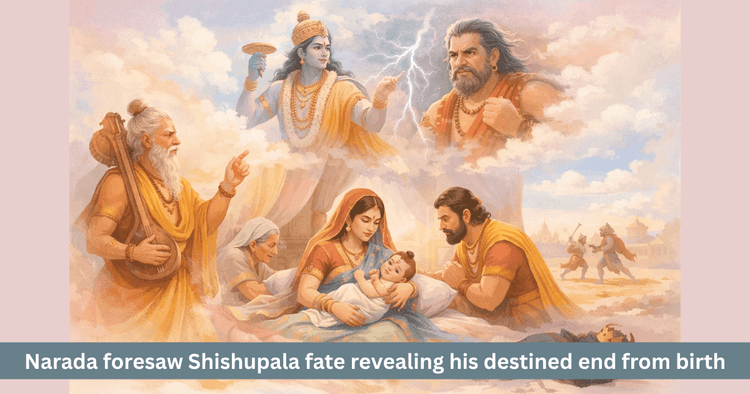
Table of Contents
Narada Muni possessed a rare quality. He was not merely a witness to events. He could also reveal the hidden truth behind them. That is why in many important episodes his role is not limited to carrying messages. He becomes a guide who interprets the deeper pattern of what is unfolding.
One such significant episode is connected with the birth of Shishupala, and it is described in the Sabha Parva of the Mahabharata. At first glance it appears to be a strange birth narrative but inwardly it is the beginning of a life already marked by prophecy, karmic consequence and divine justice. Narada’s presence in this story is crucial because he helps others understand that what appears unusual on the surface is in fact part of a larger design.
Why was the birth of Shishupala considered so unusual
When Shishupala was born, he did not appear like an ordinary child. He had extra arms and an additional eye. Those who saw him were filled with fear and astonishment. Birth is usually an occasion of joy but here the very first moments of life brought anxiety and uncertainty.
In the traditional spiritual imagination, such an unusual birth is not seen merely as a bodily oddity. It is often understood as a sign of deeper karma. Shishupala’s body itself seemed to indicate that his life would not move along an ordinary line. There was imbalance present from the beginning, and that imbalance would later be linked with his nature, his actions and his end.
This unusual birth may be understood through the following points:
- His body was not like that of ordinary infants
- The extra arms and extra eye created fear
- Anxiety about his future arose from the moment of birth
- The event suggested a deeper karmic pattern behind his life
What did the heavenly voice declare
At that moment, a heavenly voice was heard. It declared that the person in whose lap the child’s extra limbs would disappear would be the one who would later kill him. This was not merely a prediction. It was the outline of a life whose ending had already been signaled at its beginning.
The heavenly announcement made two things clear at once. First, the child’s form was not meant to remain as it was. Second, his death was already connected with a particular person. This makes the story deeply serious. Human beings generally think of life as open and unknown but here the direction of the ending was revealed at birth itself.
The effect of this heavenly voice was profound because:
- It linked the birth directly with destiny
- It bound Shishupala’s future end to a specific person
- It created both fear and a search for that person
- It indicated that this life was moving within a larger karmic current
Why was Shishupala’s mother so distressed
For any mother, hearing at the birth of her child that his death is destined to come at the hands of a particular person would be deeply painful. Shishupala’s mother too became overwhelmed with fear and anxiety. Her immediate impulse was to discover who that person would be and somehow protect her son from him.
At this point the story becomes intensely human. Destiny may be great but the heart of a mother first seeks protection for her child. She does not begin with philosophy. She begins with care. That is why this episode is not only about divine law but also about maternal tenderness.
Her distress came from the following impulses:
- A strong desire to protect her son
- The wish to somehow prevent the prophecy
- Anxiety to identify the foretold person
- The deeply human urge to struggle against fate
Why does Narada Muni’s role become so important here
This is the point at which Narada Muni becomes especially important. He does not merely repeat the prophecy. He explains its meaning. He helps others understand that this is not an ordinary event but one bound to karma, destiny and divine design.
Narada’s special quality is that he sees not only the visible event but also the invisible structure behind it. He does not leave people with fear alone. He offers interpretation, so that truth may be understood rather than merely feared. In the episode of Shishupala’s birth, this role makes him more than a messenger. It makes him a true guide.
His role here may be understood as follows:
| Event | Ordinary view | Narada’s insight |
|---|---|---|
| Strange birth | Fear and omen | Manifestation of karma |
| Heavenly voice | Anxiety about the future | Sign of destined unfolding |
| Mother’s distress | Emotional fear | Need to understand truth |
| Future death | Tragedy | Movement toward divine justice |
What does the placing of the child in many laps reveal
According to the story, the child Shishupala was placed in the laps of different people so that it might be known whose touch would cause his extra limbs to disappear. This was not merely an attempt to test a prophecy. It was also a human effort to understand and confront destiny. Every time the child was placed in someone’s lap and nothing happened, hope remained alive and fear deepened.
But when the child was finally placed in the lap of Shri Krishna, his extra arms and extra eye disappeared at once. That was the decisive moment. The meaning of the heavenly voice became clear. It was now known to all that Shri Krishna would one day be the cause of Shishupala’s death.
This moment is significant in many ways:
- Destiny became visible and unmistakable
- The relation between Krishna and Shishupala was established at birth itself
- Prophecy moved from words into direct reality
- It became clear that this life was not ordinary
What does the disappearance of the extra limbs in Krishna’s lap signify
This event is not only physical. It also holds deep symbolic meaning. The disappearance of the extra limbs in Krishna’s lap shows that the touch of the Divine both reveals imbalance and brings it under order. Yet at the same time, it also marks the very point from which the future end becomes connected.
Krishna here is not only the future slayer. He is the representative of divine justice that first knows, then gives time and finally acts when the limit is crossed. That is why the relationship between Krishna and Shishupala is not simply one of opposition. It is a deeper karmic bond beginning from birth itself.
Is this only a story of destiny or also of karma
This episode is not only about destiny. It also clearly contains the principle of karma. The end of Shishupala may have been indicated from the beginning but that does not mean his own actions were irrelevant. On the contrary, his later conduct is what gradually ripens the foretold end into actuality. Destiny may mark the direction but karma activates it.
Later in life, Shishupala repeatedly insults Krishna, behaves arrogantly and commits grave offenses. If there had only been prophecy and no action, the story would have remained incomplete. The narrative makes it clear that his death does not come merely because it was foretold but also because his actions repeatedly confirmed that outcome.
This may be understood in the following way:
- Destiny marked the direction of the end
- Karma made that direction active
- Prophecy gave the indication
- Conduct made the result inevitable
Why is the promise taken by Shishupala’s mother so important
One of the most tender parts of the story is that Shishupala’s mother took a promise from Shri Krishna that He would forgive 100 offenses of her son. This is not only an act of maternal pleading. It also reveals an important principle of divine justice, the principle of opportunity. Krishna kept that promise. He tolerated many insults, many offenses and repeated acts of disrespect from Shishupala. Again and again He allowed room for the possibility of change.
This is what makes the story even deeper. God is not shown here as one who punishes instantly. First comes opportunity, then forbearance, then patience, and only after the final boundary is crossed does justice manifest. This justice is not born of anger. It arises after compassion has already exhausted its chances.
The importance of this promise may be understood through these points:
- Krishna did not punish immediately
- Shishupala was given many opportunities to change
- Divine patience and compassion were fully extended
- When the limit was crossed, justice became necessary
How long did Krishna endure Shishupala’s offenses
The story tells us that Krishna endured many of Shishupala’s offenses. In assemblies, before kings and in public settings, Shishupala repeatedly insulted Him and crossed the line of dignity. Yet Krishna did not react at once. He honored the promise He had made.
A great spiritual principle appears here. God does not bring justice in haste. The Divine grants time. The Divine gives the person the opportunity to return, to turn inward and to stop. But if a person mistakes compassion for weakness and continues to cross every limit, then justice certainly appears.
Why can Narada’s knowledge here be called so subtle
Narada Muni is not merely someone who reports an event. He understands cause, result and hidden law together. In the episode of Shishupala’s birth, he does not simply encourage fear or passive submission to fate. He helps people see that this is part of a larger process where karma and destiny are both shaping the direction of life.
This is why Narada’s wisdom is not merely informative. It is vision based. He can see the truth behind the visible. He does not wait until the end to understand a pattern. He reads the pattern from its beginning. This is what makes him different from a simple messenger.
His insight teaches us:
- Every event has a cause behind it
- Every cause moves toward some result
- The visible alone is never enough
- True wisdom sees event, cause and fruit together
What does this story teach us today
This story remains highly relevant even now. In modern life people often treat events as mere accident. It may seem as though everything happens randomly. But this episode reminds us that many things in life also emerge from deeper currents of cause and consequence. This does not mean that everything should be reduced to fate. It means that actions carry seriousness.
For present life, this episode gives the following teachings:
- The fruits of actions eventually arrive
- Receiving opportunities does not mean consequences disappear
- God is compassionate but God is also just
- Life often unfolds through deeper causation rather than accident alone
Where truth inevitably comes to light
The final message of the prophecy at Shishupala’s birth and Narada’s clear vision is this, truth does not remain hidden forever. A life whose direction was marked from its very beginning eventually moved toward the end already signaled. Destiny pointed toward it, karma reinforced it and justice completed it.
This story also teaches that in the divine order there is not only punishment. There is time, opportunity, patience, compassion and finally justice. The story of Shishupala is not merely a story of fear. It is a story of understanding. And Narada Muni’s role is to bring that understanding into the light.
FAQs
What was unusual at the time of Shishupala’s birth
He was born with extra arms and an additional eye, which filled everyone with fear and astonishment.
What was declared in the heavenly voice
It was said that the person in whose lap the extra limbs disappeared would be the one who would later kill him.
In whose lap did Shishupala’s extra limbs disappear
They disappeared when he was placed in the lap of Shri Krishna.
What promise did Shishupala’s mother obtain from Krishna
She obtained the promise that Shri Krishna would forgive 100 offenses of Shishupala.
What is the greatest teaching of this story
It teaches that karma and destiny together shape the direction of life, and that God gives opportunities for correction before justice appears.
Get your accurate Kundali
Generate KundaliDid you like it?
Author

Pt. Sanjeev Sharma (63)
Experience: 20
Consults About: Family Planning, Career
Clients In: Punjab, Haryana, Delhi
Share this article with friends and family
About ZODIAQ
ZODIAQ is an online Vedic Astrology platform. It connects clients seeking astrological advice to experienced astrologers with deep knowledge. Our users also generate kundali and perform kundali milan for free. ZODIAQ also offers services to the Astrologers. Astrologers utilize various offerings by ZODIAQ to serve their clients effectively.
If you are a User
Consult with experienced astrologers and seek their guidance. You can also order handwritten Janm Patrika report with life prediction prepared by experienced astrologers. Generate accurate Kundali, perform Kundali Matching and check horoscope and muhurat. Utilize our online library for all the necessary astrological and spiritual information.
If you are an Astrologer
Create accurate kundali for your clients and perform Kundali Matching for up to 5 people at a time. Write comprehensive Janm Patrika report for your clients with ZODIAQ. Check client details anytime by saving it in client directory. Become more productive by tracking how many clients you guide every day.
WELCOME TO
ZODIAQ
Right Decisions at the right time with ZODIAQ
