Adi Shankaracharya and Narasimha: When Devotion Itself Became Protection
By Pt. Nilesh Sharma
The mystery of devotion, grace, and divine protection in the connection between Shankaracharya and Narasimha
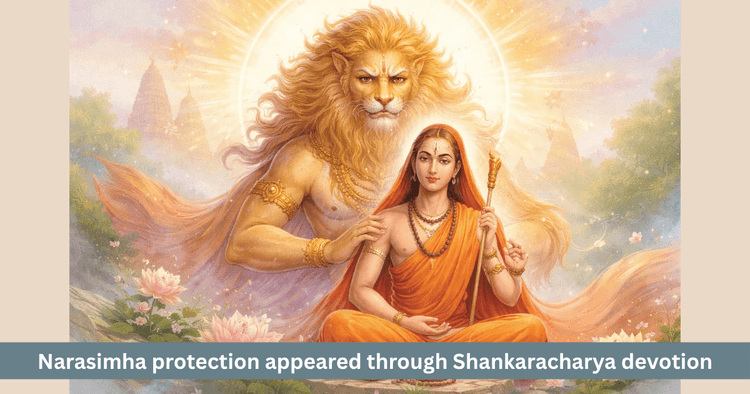
Table of Contents
In the Indian spiritual tradition, Adi Shankaracharya is revered not merely as a great philosopher but as a luminous master who re established knowledge, discipline and sacred awareness across Bharat. He is remembered as a towering light of Advaita Vedanta, yet many episodes connected with his life are not limited to philosophical discourse. They reveal layers of devotion, the guru disciple bond, divine grace and unseen protection that touch the heart deeply. Among these profound episodes, one of the most striking is associated with Lord Narasimha.
This is not merely a story of danger and rescue. It also reveals the subtle truth that where genuine devotion, complete surrender and divine refuge come together, devotion no longer remains a passive feeling. It becomes an active force. That is why the episode of Shankaracharya and Narasimha is remembered with special reverence in the spiritual memory of India.
Why does the life of Adi Shankaracharya make this episode so important
The personality of Adi Shankaracharya was not confined to intellectual brilliance. He is remembered as a rare symbol of renunciation, knowledge, fearlessness and realization of the Self. For him, the body was not the final truth. He stood rooted in the continuity of the Self and the indivisible nature of Brahman. This is why when a moment of danger appears in the life of such a master, it does not remain an ordinary incident. It becomes a revelation that knowledge and devotion are not opposed to one another. Where there is knowledge, surrender may also exist. Where there is renunciation, divine protection may also descend.
To understand this background, a few points are important:
- Shankaracharya is revered not only as a philosopher but as a realized sage
- For him, the body was a means of sadhana, spiritual practice, not the final identity
- He did not react to danger in the way an ordinary person would
- That is why the events of his life carry deep spiritual meaning
How did the episode with the Kapalika begin
According to the traditional account, there came a time when Adi Shankaracharya was seated at a place along with his disciples. At that moment, a Kapalika practitioner arrived there. Some practitioners associated with the Kapalika path were known for intense and unusual forms of sadhana. Their methods were often very different from the general Vedic discipline. therefore the arrival of such a person was not considered ordinary.
It is said that the Kapalika formed the intention of using Shankaracharya as a sacrificial offering for his spiritual practice. He did not use direct force at once. Instead, through cleverness, he shaped the situation in such a way that Shankaracharya agreed to go with him. Outwardly this appears astonishing, yet inwardly it reveals the depth of Shankaracharya’s detachment.
Why did Shankaracharya not resist
It is natural to ask why Shankaracharya did not resist if danger was present. At this point, the depth of his inner state becomes visible. He did not consider the body to be the final form of the Self. For him, the body was transient but truth was not. This is why even in such a moment he did not become inwardly disturbed.
This detachment was not weakness. It was the result of great realization, where the individual no longer identifies existence only with the physical frame. His calmness shows that he was not frightened by the circumstance. There was surrender within him, not helplessness but freedom from bodily attachment.
This inner state may be understood in the following way:
- Shankaracharya’s calmness rested upon Self realization
- For him, the body was an instrument, not the essence of identity
- Even in danger his inner balance did not break
- His surrender revealed profound fearlessness
How did Padmapada become aware of this event
The most astonishing part of the episode unfolds when Padmapada, one of Shankaracharya’s foremost disciples, becomes inwardly aware of the danger. The relationship between guru and disciple does not remain confined to outer teaching alone. Where there is true devotion and complete surrender, a subtle inner connection also comes into being. That is what is said to have happened in the case of Padmapada.
As soon as he became aware of the event, he hurried there at once. This was not only the love of a disciple for his guru. It was the sign of a living inner bond in which devotion becomes awakened consciousness. This inner awakening of Padmapada is one of the most powerful parts of the narrative, because here divine intervention and guru grace begin to flow together.
What does it mean that the power of Narasimha manifested through Padmapada
It is said that the moment Padmapada reached the place, the power of Lord Narasimha became active within him. His form changed. A remarkable radiance appeared in his eyes. He was no longer only an ordinary disciple. A fierce protective consciousness awakened within him and brought the crisis to an end.
This event should not be viewed merely as an outer display of force. Its deeper indication is that when the devotion of the disciple is complete and the loyalty to the guru is pure, that very devotion can become the medium of divine force. The manifestation of Narasimha through Padmapada is understood as a sign of this truth.
Some deeper indications of this manifestation are:
| Aspect | Outer event | Spiritual meaning |
|---|---|---|
| Padmapada | Arrival of the disciple | Awakening of devotion |
| Narasimha power | Fierce protective radiance | Divine intervention |
| Kapalika being stopped | End of crisis | Protective force of devotion |
| Protection of the guru | Physical rescue | Union of guru grace and disciple loyalty |
Why is this not merely a rescue story but a transformation of devotion
At an outer level, this may appear to be the story of a disciple protecting his guru. But its meaning is much deeper. Here devotion does not remain limited to humility or soft service. It becomes an active protective force. This is the point where devotion and spiritual heroism join one another.
Devotion is often associated only with gentleness, yet this episode teaches that genuine devotion can awaken strength, intensity and protection when the situation demands it. The manifestation of Narasimha through Padmapada is a powerful example of living devotion.
This episode teaches the following:
- True devotion is not passive
- In moments of need, devotion can awaken the radiance of protection
- Complete loyalty to the guru draws divine grace
- Where surrender is true, devotion can become शक्ति, spiritual power
What is the importance of this event in Shankara Vijayam
This event is described in Shankara Vijayam, where it is seen not merely as an astonishing incident but as a remarkable expression of spiritual protection. Through such episodes, the text reveals that even on the highest path of knowledge, there remains a place for devotion and grace.
The account makes clear that where the guru principle is alive, moments of crisis are not met only through outer means. Unseen assistance may also descend. In Shankara Vijayam, this episode stands as an elevated example of the subtle bond between guru and disciple.
Why is Lakshmi Narasimha Karavalamba Stotram associated with this episode
Another highly important aspect connected with this event is the Lakshmi Narasimha Karavalamba Stotram. In the traditional understanding, this incident deepened the experience of Narasimha as divine refuge, protector and rescuer. From that inner ground, this stotram is associated with the episode.
The word Karavalamba means extending the hand in support. This is not merely a prayer for protection. It is a plea for that divine touch which lifts the struggling seeker upward by holding the hand. This is why the stotram is seen not merely as poetry but as the cry of a heart seeking refuge.
A few points help to understand the feeling of this stotram:
- It is not merely a composition of words but an expression of complete surrender
- It prays for protection, support and guidance from the Lord
- The feeling of Karavalamba reflects compassionate uplift through divine support
- It is a rare union of devotion, freedom from fear and refuge
What does this union of guru devotion and divine grace teach us
The greatest message of this entire episode is that genuine devotion and surrender never go in vain. When the heart of the disciple is pure, when trust in the guru is complete and when the inner bond is living, then in the moment of crisis some unseen force may indeed create the way of protection. The form in which that help appears is not always known beforehand, yet its arrival is not impossible.
The episode of Shankaracharya, Padmapada and Narasimha reveals that where devotion is deep, grace does not remain distant. Guru grace and divine grace may be experienced not as separate streams but as one flow.
Is God limited only to temples and worship
This story offers another beautiful insight. God is not confined only to temples, images or formal worship. Divine presence may also become active wherever there is living loyalty, pure devotion and sincere surrender. The awakening of Narasimha through Padmapada reveals exactly this truth.
For this reason, the episode also teaches that divine presence may be experienced not only in sacred places but also in living relationships, deep devotion and pure loyalty. Where devotion is true, divine protection does not remain mere imagination.
Why does this episode offer such reassurance even today
In the present age, people pass through many forms of uncertainty, fear, inner pressure and hidden crisis. In such times, this story offers deep reassurance. It teaches that if true faith remains alive in the heart, and if a person remains sincere toward the guru, the Divine or the truth itself, then that person is not as alone inwardly as outward circumstances may suggest.
This narrative does not remove all fear in a superficial way but it gives assurance. It teaches that protection does not always mean only outer rescue. Sometimes protection comes as courage. Sometimes it comes as help at the right moment. Sometimes it arises as awakened inner strength.
Where devotion itself becomes protection
In the end, it becomes clear that the episode of Adi Shankaracharya and Narasimha is not only a historical event. It is a profound spiritual teaching. It reveals that when devotion is genuine, it does not remain a passive feeling. In times of need, it can take the form of protection, courage and divine intervention.
This is the greatest power of the narrative. Here there is the disciple’s faith, the glory of the guru, the protective force of Narasimha and the compassion of Karavalamba. It teaches that where guru loyalty, faith in God and sincere surrender are present together, devotion can truly take the form of protection.
FAQs
What does the Kapalika episode related to Adi Shankaracharya teach
It teaches that even in a moment of crisis Shankaracharya remained calm and detached, and divine protection worked in an unexpected way.
What does it mean that the power of Narasimha manifested through Padmapada
It indicates the union of guru devotion, disciple loyalty and divine grace, where devotion itself becomes a force of protection.
What is the significance of this event in Shankara Vijayam
It is described as a remarkable example of guru grace, divine protection and the devotion of the disciple in the life of Shankaracharya.
What does Lakshmi Narasimha Karavalamba Stotram mean
Karavalamba means giving support by holding the hand. The stotram is a deep prayer for protection, refuge and guidance.
What lesson does this story offer for life today
It teaches that genuine devotion and surrender keep a person from being inwardly alone, and in times of crisis they may open the way to divine help.
Get your accurate Kundali
Generate KundaliDid you like it?
Author

Pt. Nilesh Sharma (63)
Experience: 20
Consults About: Family Planning, Career
Clients In: Punjab, Haryana, Delhi
Share this article with friends and family
About ZODIAQ
ZODIAQ is an online Vedic Astrology platform. It connects clients seeking astrological advice to experienced astrologers with deep knowledge. Our users also generate kundali and perform kundali milan for free. ZODIAQ also offers services to the Astrologers. Astrologers utilize various offerings by ZODIAQ to serve their clients effectively.
If you are a User
Consult with experienced astrologers and seek their guidance. You can also order handwritten Janm Patrika report with life prediction prepared by experienced astrologers. Generate accurate Kundali, perform Kundali Matching and check horoscope and muhurat. Utilize our online library for all the necessary astrological and spiritual information.
If you are an Astrologer
Create accurate kundali for your clients and perform Kundali Matching for up to 5 people at a time. Write comprehensive Janm Patrika report for your clients with ZODIAQ. Check client details anytime by saving it in client directory. Become more productive by tracking how many clients you guide every day.
WELCOME TO
ZODIAQ
Right Decisions at the right time with ZODIAQ
