Chenchu Lakshmi and Narasimha: Divine Love in Forest
By Pt. Sanjeev Sharma
When the Divine Enters the Forest and Becomes Love
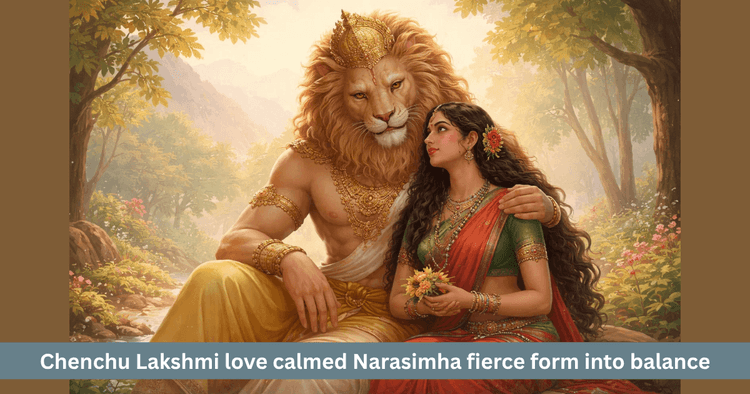
Table of Contents
The form of Lord Narasimha is remembered as fierce, radiant and divinely powerful, yet there is also a deeply human, tender and affectionate dimension of this form that is known to far fewer people. In the tribal traditions of Andhra Pradesh, a very beautiful and emotionally rich narrative is found in which Narasimha is connected with a maiden of the Chenchu tribe, who is remembered as Chenchu Lakshmi.
This is not merely a marriage story. It symbolizes a much deeper truth, that the Divine does not remain confined to royal palaces, celestial realms or formal places of worship. The Divine can descend into the forest, move among nature, dwell in ordinary life and reveal itself equally through simplicity, tenderness and living relationship. For this reason, the story of Chenchu Lakshmi and Narasimha becomes important at spiritual, cultural and social levels together.
Why does this story become especially important after the fierce form of Narasimha
After the destruction of Hiranyakashipu, the fierce energy of Narasimha was said to be overwhelmingly intense. His force was so powerful that even the devas were unable to approach Him. This was not mere anger. It was the peak manifestation of divine energy that had arisen for the protection of dharma. When such force remains unsoftened even after its work is complete, another kind of divine presence becomes necessary in order to restore balance.
It is at this point that the story of Chenchu Lakshmi becomes especially meaningful. It teaches that where fear remains at a distance, love moves closer in order to understand. Where grandeur may hesitate, simplicity may step forward. That is the deepest beauty of this episode.
A few essential points help explain this condition:
- The fierceness of Narasimha was the energy of divine protection
- Even the devas hesitated to come near such intensity
- The next movement in the narrative becomes one of peace and softening
- Here the presence of Chenchu Lakshmi becomes the form of a deeper balance
Why does the Chenchu tribe appear in this narrative
The Chenchu tribe is regarded as an ancient tribal community connected with the forest regions of Andhra Pradesh. It is associated with a life close to nature, simplicity of living and a strong relationship with the surrounding world. When Narasimha is linked with a maiden of such a tribe, the meaning of the story widens even further.
The point is not merely that the Lord entered the forest. The deeper suggestion is that divinity is not confined to one social order, one class, one ritual culture or one grand form of sacredness. Wherever there is true feeling, simplicity and purity of heart, divine presence can manifest.
The Chenchu tradition brings forward the following meanings:
| Aspect | Outer form | Deeper indication |
|---|---|---|
| Forest life | Simplicity and closeness to nature | Naturalness and purity |
| Tribal maiden | Innocent human heart | Love without fear |
| Arrival of Narasimha | The Divine entering the forest | Union of divinity with lived human life |
Why is Narasimha said to have come into the forest
In folk traditions, it is said that after the destruction of Hiranyakashipu, Narasimha wandered into the forest region where the Chenchu tribe lived. Outwardly this is a movement of place but inwardly it carries much deeper meaning. When divine force leaves the battlefield and enters the forest, it is not merely a geographical transition. It also signals a movement from fierceness toward nature, from intensity toward simplicity and from cosmic force toward inward calming.
In the Indian tradition, the forest is never only a collection of trees. It is also the realm of tapas, simplicity, natural truth and unadorned sacredness. For this reason, Narasimha’s arrival in the forest suggests that divine force may finally come to rest within the lap of nature.
What was special about Chenchu Lakshmi
According to the tradition, Narasimha encountered a maiden who was remarkably simple, innocent and brave. There was no display in her, no fear based shrinking and no outer show. She did not merely see the fierce form of Narasimha and recoil in terror. Instead, she tried to understand the intensity, the pain and the need for peace that existed within that fierce form.
This is what makes her extraordinary. Ordinarily people move away from what appears intense or frightening. But the heart of Chenchu Lakshmi does not withdraw. It moves toward understanding. That is the true nature of love. Love does not accept only beauty. It also recognizes imbalance hidden within fierceness.
The form of Chenchu Lakshmi reveals these qualities clearly:
- Purity of heart
- Fearlessness
- Natural affection
- Approaching without display
- The ability to recognize compassion hidden within intensity
Why is Chenchu Lakshmi regarded as a form of Lakshmi
In local tradition, the tribal maiden came to be known as Chenchu Lakshmi. This is not merely a title of honor. It reflects a deeper understanding that Goddess Lakshmi is not revealed only in splendor, royal beauty and prosperity. She may also appear through simplicity, tenderness, peace, love and natural femininity.
When the Chenchu maiden is recognized as Lakshmi, the narrative offers an important spiritual message:
- Divinity is present not only in wealth but also in simplicity
- The force that calms the Divine is linked with compassionate feminine presence
- Tribal life is also sacred and worthy of divine acceptance
- Lakshmi does not mean abundance alone but also the compassion that soothes
That is why the story of Chenchu Lakshmi becomes a wider interpretation of the divine feminine principle itself.
How do folk Ramayana traditions and tribal songs keep this episode alive
This episode is preserved in folk Ramayana traditions and in various tribal songs and narratives. There it is not merely mentioned but sung, retold and remembered across generations. This makes the story especially significant. When a sacred narrative remains alive in living folk memory, it shows that it was not only read but deeply received by the people.
Within these folk traditions, the union of Narasimha and Chenchu Lakshmi becomes more than a divine event. It becomes a celebration of love, acceptance and the sacredness of forest life. These living narratives preserve the feeling that divine love and divine acceptance are not restricted by formal structure.
What is the deeper spiritual meaning of this story
The story of Chenchu Lakshmi and Narasimha teaches that the force capable of calming the Divine is not ritual alone but also innocent love. Where even the devas stand at a distance, a simple heart comes near. This does not mean that the devas loved less. It means that in this narrative, what brings peace is not grandeur but natural affection.
The spiritual meaning of this episode may be understood through the following:
- The Divine is present in simplicity as much as in splendor
- A pure heart can transform fierceness into peace
- Love succeeds where fear cannot
- Divine union may arise not only through ritual but also through natural feeling
Is this story also important socially
Yes, this story is important socially as well. It shows that divinity does not belong to one class, one community, one geography or one refined cultural setting. If Narasimha enters the forest, accepts the love of a tribal maiden and lives within that relationship, then the message is very clear. Divine presence belongs everywhere.
This narrative also teaches the following:
- Tribal communities should not be viewed as spiritually inferior
- A life close to nature can carry deep sacred value
- The love of God is beyond social distinction
- Wherever the heart is pure, there divine presence is welcome
What lesson does this episode offer for life
If this story is connected with life, it teaches that true relationships are not built by outer form, status or display. They are built through inner feeling. Many times in life we move away from anyone who appears intense, disturbed or emotionally burdened. But Chenchu Lakshmi teaches that understanding, tenderness and fearless nearness can sometimes do what distance and fear never can.
This life teaching is very important:
- Love is not only for gentle moments
- True relationship recognizes the pain hidden within fierceness
- A simple heart has great power to transform
- Naturalness itself can become spiritual strength
Why does this tradition remain alive in Andhra Pradesh even today
In some regions of Andhra Pradesh, Chenchu Lakshmi is still worshipped with reverence today. This is not merely a memory of the past. It is a living tradition that joins local devotion, tribal identity and divine narrative together. When a tradition remains not only in books but in the lives of people, its cultural and spiritual importance grows even more.
A few reasons explain why this tradition remains alive:
- The narrative is deeply rooted in local memory
- Tribal communities see it as part of their sacred identity
- The bond of Narasimha and Chenchu Lakshmi has become a symbol of love and peace
- It allows people to feel that the Divine is close to their own life
When love brings balance to fierce power
The deepest message of this entire episode is that when power reaches its peak, it must be balanced by love. That love may come in any form. It may come through temple grace, through the speech of sages or through the heart of a simple maiden of the forest. Its work remains the same. It gives direction to intensity, peace to force and tenderness to divine power.
The story of Chenchu Lakshmi and Narasimha teaches exactly this, that true divinity reveals itself where there is simplicity, love, naturalness and fearless nearness. This is the spiritual essence of the episode, and this is also its lasting message for life.
FAQs
Who is regarded as Chenchu Lakshmi
In local and tribal traditions, a maiden of the Chenchu tribe is remembered as Chenchu Lakshmi and regarded as a form of Lakshmi.
Why is Narasimha said to have come into the forest in this story
The journey into the forest is associated with the calming of His fierce energy after the destruction of Hiranyakashipu.
Why is Chenchu Lakshmi regarded as a form of Lakshmi
Because in her were seen simplicity, compassion, love and the feminine divine force that could bring peace to fierceness.
Is this only a folk story
It is certainly a folk narrative but it carries profound spiritual, social and cultural meaning.
What is the greatest teaching of this episode
It teaches that true divinity reveals itself where there is love, innocence and naturalness.
Get your accurate Kundali
Generate KundaliDid you like it?
Author

Pt. Sanjeev Sharma (63)
Experience: 20
Consults About: Family Planning, Career
Clients In: Punjab, Haryana, Delhi
Share this article with friends and family
About ZODIAQ
ZODIAQ is an online Vedic Astrology platform. It connects clients seeking astrological advice to experienced astrologers with deep knowledge. Our users also generate kundali and perform kundali milan for free. ZODIAQ also offers services to the Astrologers. Astrologers utilize various offerings by ZODIAQ to serve their clients effectively.
If you are a User
Consult with experienced astrologers and seek their guidance. You can also order handwritten Janm Patrika report with life prediction prepared by experienced astrologers. Generate accurate Kundali, perform Kundali Matching and check horoscope and muhurat. Utilize our online library for all the necessary astrological and spiritual information.
If you are an Astrologer
Create accurate kundali for your clients and perform Kundali Matching for up to 5 people at a time. Write comprehensive Janm Patrika report for your clients with ZODIAQ. Check client details anytime by saving it in client directory. Become more productive by tracking how many clients you guide every day.
WELCOME TO
ZODIAQ
Right Decisions at the right time with ZODIAQ
