The Secret of Godhuli Bela: Divine Power in Sandhi Kala
By Pt. Narendra Sharma
The deeper spiritual meaning of twilight timing in Narasimha avatara
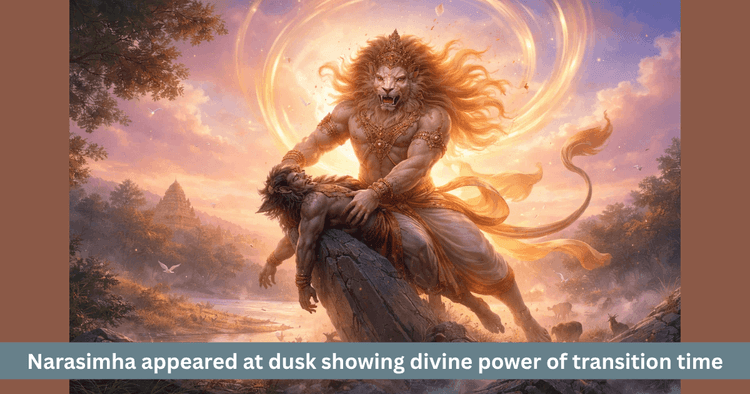
Table of Contents
The time of Lord Narasimha’s avatara, divine descent, is regarded as unique not only because He ended a tyrant like Hiranyakashipu but also because His manifestation took place at a moment that was deeply meaningful in terms of time, place and circumstance. One of the most profound dimensions of this narrative is that Lord Narasimha did not appear in full day and not in full night. He manifested during Godhuli Bela, the dusk hour, which is also called Sandhi Kala, the meeting time of two states. This is the point at which the story no longer remains merely the destruction of an asura but becomes a deep philosophy of time, consciousness and transformation.
In the Indian tradition, the time of dusk has always been considered deeply sacred. When the sun moves toward setting, when the final touch of light still lingers on the earth and when darkness slowly begins to spread, a subtle condition arises that is neither complete brightness nor complete darkness. This is the threshold where outer nature changes and the inner mind may also shift. For this reason, the manifestation of Narasimha at this very moment is understood as a profound divine indication.
Why is Godhuli Bela considered so special
Godhuli Bela does not refer only to the dust raised as cows return home. It names that hour in which the day moves toward its end and the night begins to arise. Within this meeting there is both softness and a deep hidden meaning. The movement of the world seems to alter slightly at this time. Outer light diminishes, yet inner awareness may become more alive.
For this reason, the Indian spiritual tradition did not treat it merely as a natural time. It was regarded as a moment of energetic transition. One state is departing, another is being born and the interval between them becomes especially sensitive.
To understand the significance of this time, a few points are worth noting:
- It is neither complete day nor complete night
- It is the meeting point of two states
- Nature itself appears to undergo subtle change at this time
- The mind may become more receptive and quiet
Sandhi Kala means more than a change of time
The word sandhi means union. Wherever two boundaries meet, there is sandhi. For this reason, Sandhi Kala should not be understood only as an hour on a clock. It is a condition in which the old and the new, light and darkness, outer and inner, stillness and change all remain present together. That is why it is regarded as a highly powerful time.
In both astrology and spiritual practice, Sandhi Kala is given special importance. It is understood that at such a time subtle changes become more active. Older influences begin to loosen and new possibility is born. If the mind remains aware, it can perceive much within itself that would otherwise be ignored in ordinary hours.
A deeper indication of Sandhi Kala may be understood through the following:
| Element | Ordinary meaning | Spiritual indication |
|---|---|---|
| Day | Light and activity | Outer action and clarity |
| Night | Darkness and rest | Return toward the inner |
| Sandhi Kala | Time between the two | Transition and new direction |
| Godhuli Bela | Subtle hour of evening | Sensitive awakening of mind |
What does it reveal that Lord Narasimha manifested at this time
Through his boons, Hiranyakashipu had tried to secure himself from death in every ordinary way. He should not die by day and not by night. Not indoors and not outdoors. Not by man and not by beast. Not by weapon and not by instrument. He believed he had bound all the possibilities between life and death. Yet divine power reveals itself precisely where limited intelligence reaches its boundary.
The manifestation of Lord Narasimha during dusk reveals this truth. It was a time that was both within and beyond Hiranyakashipu’s conditions. Neither day nor night. Neither one fixed state nor another. It was at this subtle point that divine justice found its way.
This event makes the following clear:
- Divine power is not confined by ordinary categories
- Where a person assumes absolute security, limitation may be revealed
- Sandhi Kala can become the doorway to transformation
- Truth often manifests from a subtle point between rigid boundaries
How does Bhagavata Purana give meaning to this choice of time
In the Bhagavata Purana, this episode is not presented only as an event but as one carrying profound dharmic meaning. The manifestation of Narasimha, the fall of Hiranyakashipu and the protection of Prahlada together reveal that divine order does not act only through force. It acts with extremely subtle balance.
The selection of time is part of that same balance. The Lord chose the moment that stood beyond all fixed conditions. This teaches that the manifestation of truth does not always arise in a straight and obvious way. Many times the greatest transformations occur in moments that outwardly seem uncertain but inwardly are exact.
Can Godhuli Bela also become a time of change within a person
If this episode is not limited only to the Puranic narrative, it also reveals a deep relation to daily human life. Morning and evening are both regarded as Sandhi Kala, and tradition has considered these times ideal for meditation, japa, repeated sacred remembrance, worship and self reflection. The reason is that during these hours the mind may become relatively more quiet, soft and receptive.
In the middle of the day, the mind is often caught in outward activity. In deep night, it may move toward fatigue or heaviness. But dusk stands between the two. Outer activity becomes gentler and inner sensitivity may awaken naturally. This is why Godhuli Bela is regarded not only as a natural scene but as a spiritual opportunity.
Tradition has emphasized the following in order to use this time well:
- Sitting in silence for a few moments
- Bringing attention to the breath
- Remembering the Divine or performing mantra japa
- Letting the movement of the day settle within
What does sandhi mean when life itself feels confused
Many times in life a person enters a phase where it becomes difficult to know whether one is still in the old or already in the new. One condition is ending and another is not yet clear. The mind experiences uncertainty, outer circumstances are changing and inner steadiness is not easy to find. This is also a Sandhi Kala of life.
The manifestation of Narasimha at Godhuli Bela teaches that such moments are not merely confusing. They are transformative. When an old structure is dissolving, the possibility of a new one is being born. For this reason, sandhi should not be seen only as crisis. It may also be the doorway through which a new direction enters.
Life’s sandhi phases remind us:
- Not every uncertainty is meaningless
- Transformation often comes through unstable intermediate periods
- Endings and beginnings remain connected
- A patient mind can recognize the hidden direction within sandhi
Why is the connection between Godhuli Bela and spiritual practice so deep
Indian spiritual practice understood through deep experience that Sandhi Kala is favorable for subtler states of mind. At this time outer noise may soften, the colors of nature change and the human being may turn inward more naturally. That is why both the morning and evening observances were given such value.
Godhuli Bela is especially significant because it forms a bridge between the fatigue of the day and the silence of the coming night. If a person remains somewhat aware at this hour, inner tension may loosen, restlessness may reduce and the mind may move toward balance. This is why practice during this time has long been considered a means for creating stability in life.
What does the avatara of Narasimha teach us about transformation
The avatara of Narasimha clearly shows that divine transformation appears where the outer arrangement has reached its limit. Hiranyakashipu believed he had secured everything. Yet the very moment arose that lay beyond all his calculations. This is the law of transformation. The more the human mind seeks absolute control, the more life teaches that the final power stands beyond that control.
The secret of Godhuli Bela teaches that change does not always arrive with noise. It is often born in the subtle moments where two states are touching each other. If the mind is awake, it can perceive direction, meaning and divine indication within such moments.
The lasting spiritual message of Godhuli Bela
In the end, it becomes clear that Godhuli Bela is not merely one part of the day. It is a profound spiritual opportunity. It teaches that where two states meet, transformation is born. Narasimha appearing at this time shows that divine force becomes active in those subtle moments where ordinary sight notices only uncertainty but awakened consciousness recognizes a new possibility.
This is the lasting beauty of the episode. Every ending hides a beginning. Before darkness settles, light offers its final touch. Every sandhi contains a possibility. And for every aware mind, Godhuli Bela remains a reminder that if there is faith, patience and awareness within, then transformation need not be feared. It may become the sign of a divine direction.
FAQs
Why is Godhuli Bela called Sandhi Kala
Because it is the time between day and night, where two states meet one another.
Why is the manifestation of Lord Narasimha at this time important
Because it was neither day nor night, and therefore it stood beyond the ordinary conditions protected by Hiranyakashipu’s boons.
Is Sandhi Kala considered suitable for spiritual practice
Yes. At this time the mind may become quieter and more receptive, which is why it is considered favorable for japa, meditation and worship.
Is Godhuli Bela only a natural time of day
No. It is also a spiritual opportunity in which transition of energy and inner awareness may become more active.
What lesson does this episode offer in life
It teaches that transformation is often born between two states, and the time of sandhi can become the sign of a new direction.
Get your accurate Kundali
Generate KundaliDid you like it?
Author

Pt. Narendra Sharma (63)
Experience: 20
Consults About: Family Planning, Career
Clients In: Punjab, Haryana, Delhi
Share this article with friends and family
About ZODIAQ
ZODIAQ is an online Vedic Astrology platform. It connects clients seeking astrological advice to experienced astrologers with deep knowledge. Our users also generate kundali and perform kundali milan for free. ZODIAQ also offers services to the Astrologers. Astrologers utilize various offerings by ZODIAQ to serve their clients effectively.
If you are a User
Consult with experienced astrologers and seek their guidance. You can also order handwritten Janm Patrika report with life prediction prepared by experienced astrologers. Generate accurate Kundali, perform Kundali Matching and check horoscope and muhurat. Utilize our online library for all the necessary astrological and spiritual information.
If you are an Astrologer
Create accurate kundali for your clients and perform Kundali Matching for up to 5 people at a time. Write comprehensive Janm Patrika report for your clients with ZODIAQ. Check client details anytime by saving it in client directory. Become more productive by tracking how many clients you guide every day.
WELCOME TO
ZODIAQ
Right Decisions at the right time with ZODIAQ
