The Secret of Hiranyakashipu’s Navel: Amrita, Ego and His End
By Pt. Narendra Sharma
The deeper meaning of Hiranyakashipu’s downfall through the symbolism of hidden amrita and ego in his navel
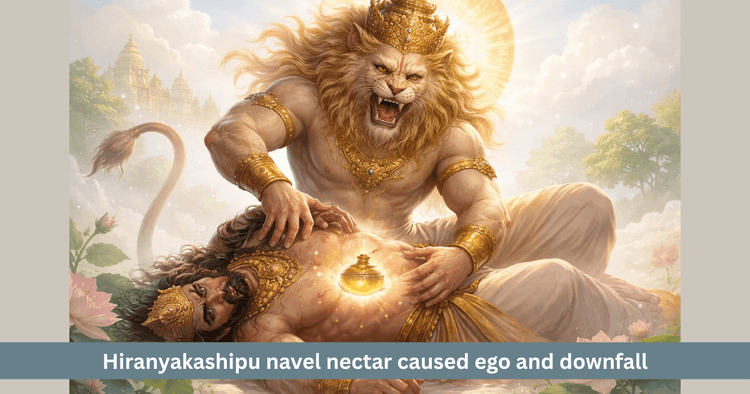
Table of Contents
The account of Narasimha and Hiranyakashipu is not viewed in the Indian spiritual tradition merely as the story of a divine battle. It is also the story of a moment when ego rises to its highest point and dharma appears in a form beyond ordinary understanding in order to stop it. Along with this episode, there is also a widely known traditional belief that Hiranyakashipu had hidden amrita, the nectar of immortality, in his navel. Because of this, he considered himself nearly invincible and became convinced that his end was no longer possible.
This belief makes the narrative deeper, because the conflict no longer remains only about outer strength. It also becomes a question of where a being places its security, where it hides its power and how that hidden foundation can eventually become the cause of downfall. That is why the episode of Hiranyakashipu’s navel is not merely an interesting detail. It is also a symbolic indication that explains the relationship between life, power and destruction in a profound way.
Why did Hiranyakashipu become so fearless
Hiranyakashipu had performed severe austerities and received such boons that they created in him the belief that his end had become almost impossible. The effect of those boons was not limited to his body. Their deepest effect was upon his mind. When someone begins to feel repeatedly that nothing can touch him, that feeling slowly grows beyond strength and becomes arrogance.
The same happened within Hiranyakashipu. He did not relate his power to dharma. He turned it into a tool of personal domination. He assumed that he alone had become the final truth. That is why he made opposition to God a part of his own authority. For him, devotion became a crime and humility became weakness.
A few points help explain this state clearly:
• Severe austerity gave him extraordinary power
• The boons created in him the illusion of invincibility
• Power remained but humility disappeared, so ego increased
• Opposition to God became the clearest sign of his inner imbalance
What does the belief about amrita in the navel suggest
A popular traditional belief connected with this account says that Hiranyakashipu had preserved amrita within his navel. Because of this nectar, he drew repeated strength to remain alive and felt that no one could truly destroy him. This belief does not appear with equal detail in every text, yet it has remained highly influential in traditional retellings and oral narration.
Its value is not limited to the idea that a daitya hid nectar inside his body. It is more meaningful than that. The navel is regarded as a center of life. At birth, it is connected with nourishment. In both bodily and symbolic terms, the navel is seen as a center of life energy. If amrita is hidden there, it means that Hiranyakashipu placed his security in the most central point of his existence.
Seen symbolically, this belief opens several layers of meaning:
• The navel becomes a sign of the center of life
• Amrita becomes a symbol of hidden protection and inner power
• Hiranyakashipu’s confidence rested upon that concealed foundation
• Once that center was broken, his entire force collapsed with it
How did Lord Narasimha use understanding, not only force
When Lord Narasimha appeared, he did not merely display fierce force. The depth of this episode lies in the fact that he acted with full understanding of the situation. He did not simply prolong the confrontation in blind fury. He struck at the very point where Hiranyakashipu’s hidden dependence was located.
The narrative says that Narasimha placed Hiranyakashipu upon his thighs and tore open his navel. This scene is not only intense. It is also deeply meaningful. It shows that the end of evil cannot come only through outward power. Its core support must be understood. The place where its deepest dependence lies is also the place where its end is hidden.
This is the most remarkable aspect of the episode:
• Narasimha’s action was not mere force
• He recognized the hidden weakness of the enemy
• The right decision at the right point became decisive
• In victory, wisdom, dharma and balance moved together
Is this navel episode only a physical detail
If this account is read only as an outer battle, then the navel may appear to be merely a bodily point. But when the story is seen at a deeper level, it becomes a vast symbol. The navel here is not only a part of the body. It represents that hidden center where a being stores its greatest security, deepest pride or most secret dependence.
For Hiranyakashipu, that center was his amrita, his imagined invulnerability and not confidence in the healthy sense but excessive self certainty shaped by ego. He assumed that his strength had risen above dharma order and truth. But that very illusion became the cause of his destruction. When the navel was broken, not only the body was broken. His delusion broke with it.
So this episode teaches that:
• Every being has a center upon which it depends the most
• If that center fills with ego, it becomes danger rather than strength
• What appears to be security can also become the doorway to downfall
What does the Seventh Skandha of Bhagavata Purana indicate here
This whole episode is powerfully described in the Seventh Skandha of the Bhagavata Purana. There the narrative does not remain limited to the destruction of a daitya. It makes clear that the end of Hiranyakashipu was necessary for the restoration of dharma. Prahlada’s devotion, Hiranyakashipu’s cruelty and Narasimha’s manifestation together point toward the larger truth that when adharma, unrighteousness crosses its limit, divine intervention surely comes.
If the belief regarding amrita in the navel is read within this larger framework, its meaning becomes clearer. No matter how great Hiranyakashipu’s outer power appeared, the inner basis of that power stood opposed to dharma. Therefore his end was only a matter of time. When power becomes devoid of dharma, it may appear strong for long but it cannot remain permanent.
Why does the connection between ego and amrita feel so deep
This episode is powerful not only because it speaks of amrita but also because the desire for immortality and ego appear closely linked within it. Hiranyakashipu’s greatest mistake was not that he desired power. His mistake was that he treated power as an eternal right. He began to think that no law now applied to him.
Here the story gives a profound psychological indication. When a person begins to treat success, protection, position or knowledge as something that places him above all others, that very achievement becomes like a hidden amrita within. Outwardly it appears to be strength but inwardly it is nourishing ego.
This relationship may be understood simply in the following way:
| Element | Outer meaning | Inner indication |
|---|---|---|
| Amrita | Means of preserving life | Illusion of security |
| Navel | Center of the body | Hidden foundation of existence |
| Boon | Extraordinary power | Risk of forgetting one’s limits |
| End | Destruction of the body | Fall of ego |
What does Narasimha’s victory teach us
Lord Narasimha’s victory matters not only because he ended a wicked force. It also matters because it reveals the subtle intelligence of dharma. He demonstrated that the right response is the one that understands the root of the situation. Outer reaction alone is never enough. The source from which the problem arises must be recognized.
The same truth applies in life today. Many people keep struggling with visible difficulties but never reach their root causes. They try to change outer results while ignoring inner delusion, fear, pride or imbalance. This episode of Narasimha teaches that real transformation comes only when the center of the problem is seen clearly.
Some lasting teachings emerge here:
• In every conflict, not only strength but right understanding is required
• Victory must rest not only on force but also on discernment
• The hidden center within must be recognized first
• Dharma is not only punishment. It is also balanced judgment
How should this indication of Hiranyakashipu’s navel be understood today
This narrative remains just as relevant now. People today do not hide amrita in the navel but they often hide their security in wealth, status, influence, image, control or achievement. Gradually that very thing becomes identity, and then identity becomes pride. When pride grows, imbalance begins. When imbalance grows, judgment becomes distorted.
That is why this episode is also a mirror for modern life. It reminds us that outer security may be useful but if it becomes the cause of ego, it ceases to be beneficial. Real strength does not lie in outer protection alone. It lies in awareness, humility and inner balance.
Where trust becomes greatest, the deepest test also appears
Hiranyakashipu placed his greatest security in the place he trusted the most. This makes the narrative deeply human as well. Human beings also place their greatest hope, deepest pride and strongest trust upon some single foundation. But life repeatedly teaches that if that foundation is not connected with dharma, balance and humility, it can become the cause of crisis.
So the purpose of this account is not to create fear. Its purpose is to awaken reflection. A person must look within and ask where security is truly being sought. If it is sought only in outer things, it will not remain stable. If it is rooted in truth, dharma and inner balance, that alone will provide lasting steadiness.
The larger message hidden at the end
In the end, it becomes clear that the amrita hidden in Hiranyakashipu’s navel is not merely a narrative detail. It is a deep indication that whatever a person considers to be the greatest source of strength can, if filled with ego, become the very cause of destruction. Lord Narasimha’s strike was not only upon the body. It was upon the illusion that had taken Hiranyakashipu away from truth.
That is why this episode is not meant merely to be heard. It is meant to be contemplated inwardly. Power is good, protection is necessary and achievement has value. But if the center of all these becomes empty of humility, downfall does not remain far away. The story of Narasimha and Hiranyakashipu ultimately reveals this truth, that before dharma, ego cannot stand for long.
FAQs
Is the belief that Hiranyakashipu had amrita in his navel very famous
Yes, this belief is very well known in traditional retellings and popular explanations, although it does not appear with equal detail in every text.
Why is the navel considered so important in this story
The navel is regarded as a center of life. Therefore the belief of amrita in the navel becomes a symbol of the central basis of power.
Why did Lord Narasimha target Hiranyakashipu’s navel
According to the traditional account, that was the point where his hidden protection was located. Therefore the strike there became decisive.
What is the connection of the Seventh Skandha of Bhagavata Purana with this episode
The Seventh Skandha contains the extended narrative of Hiranyakashipu, Prahlada and Narasimha, explaining the entire episode as a conflict between dharma and ego.
What lesson should be taken from this story in present life
The lesson is that inner balance, humility and right understanding are more important than outer strength. Those alone provide lasting protection.
Get your accurate Kundali
Generate KundaliDid you like it?
Author

Pt. Narendra Sharma (63)
Experience: 20
Consults About: Family Planning, Career
Clients In: Punjab, Haryana, Delhi
Share this article with friends and family
About ZODIAQ
ZODIAQ is an online Vedic Astrology platform. It connects clients seeking astrological advice to experienced astrologers with deep knowledge. Our users also generate kundali and perform kundali milan for free. ZODIAQ also offers services to the Astrologers. Astrologers utilize various offerings by ZODIAQ to serve their clients effectively.
If you are a User
Consult with experienced astrologers and seek their guidance. You can also order handwritten Janm Patrika report with life prediction prepared by experienced astrologers. Generate accurate Kundali, perform Kundali Matching and check horoscope and muhurat. Utilize our online library for all the necessary astrological and spiritual information.
If you are an Astrologer
Create accurate kundali for your clients and perform Kundali Matching for up to 5 people at a time. Write comprehensive Janm Patrika report for your clients with ZODIAQ. Check client details anytime by saving it in client directory. Become more productive by tracking how many clients you guide every day.
WELCOME TO
ZODIAQ
Right Decisions at the right time with ZODIAQ
