The Second Birth of Jaya and Vijaya
By Pt. Narendra Sharma
The Deeper Purpose Behind Narasimha Avatar
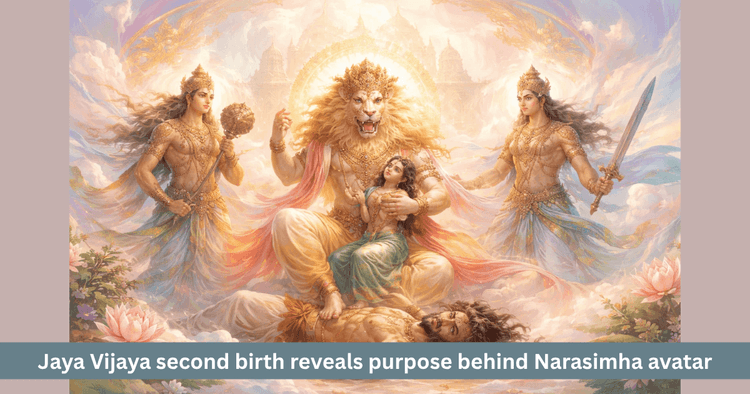
Table of Contents
Lord Narasimha is usually remembered in connection with the destruction of Hiranyakashipu, the protection of Prahlada and the restoration of dharma. This understanding is true but not complete. Behind this avatara, divine descent, there was another extremely subtle and profound purpose connected with the gatekeepers of Vaikuntha, Jaya and Vijaya. When this episode is studied carefully, it becomes clear that the incarnations of the Lord are not merely responses to one visible event. They are often part of a much wider divine arrangement moving at many levels at once.
This dimension of the Narasimha avatara is especially important because it teaches that sometimes what appears outwardly as conflict, downfall or punishment may inwardly contain the path of liberation. The story of Jaya and Vijaya brings this truth before us. Here there is a curse, there is apparent fall, there is opposition and there is battle, yet in the end everything still moves back toward the Lord. That is the deepest spiritual beauty of this episode.
Who were Jaya and Vijaya and why was their position so important
Jaya and Vijaya are described as the gatekeepers of Lord Vishnu in Vaikuntha. They were not ordinary attendants. Their place was one of intimacy, loyalty and divine service. To stand at the threshold of Vaikuntha itself indicates nearness to the Lord. For this reason, any event connected with them does not remain merely personal. It becomes part of divine play.
Their importance also lies in the fact that although they were close to the Lord, they still had to pass through a condition in which they took birth in asura lineages. This is what makes the story so profound. It shows that nearness to God does not always mean exclusion from divine drama. At times, even those nearest to the Lord may pass through a path that ordinary understanding cannot immediately explain.
To understand this background, a few points are important:
- Jaya and Vijaya were the gatekeepers of Vaikuntha
- Their place was considered very near to the Lord
- Their story is not merely a story of curse but of divine play
- Through them, a deeper purpose of the Lord’s avataras becomes visible
How did the episode of the curse begin
According to the traditional account, at one time certain great sages came to Vaikuntha for the darshana, sacred vision, of Lord Vishnu. They were highly elevated seers and ascetics. Yet, for some reason, Jaya and Vijaya stopped them from entering. This was not received as a simple matter of order at the gate. The sages experienced it as an insult. In their view, it was not merely being stopped at an entrance but being obstructed from reaching the Lord.
From the anger of the sages came a decisive turning point. They pronounced a curse that Jaya and Vijaya would take birth for three lives in asura forms. At first sight this appears severe but here the deeper spiritual dimension of the story begins to unfold. Punishment and grace are both present at once. The curse looks like a fall from the outside, yet inwardly it becomes the beginning of return.
This episode makes the following clear:
- Even in divine realms, conduct retains importance
- The anger of the sages becomes part of the order of dharma, righteousness
- The result of the curse appears as a fall but it also contains a hidden path
- Divine play often begins through events that appear harsh outwardly
What choices were placed before Jaya and Vijaya after the curse
After receiving the curse, Jaya and Vijaya prayed to the Lord. They did not wish to remain away from Him for a long time. This is one of the most moving aspects of the story. A fall stands before them, yet their deepest longing is to return to the Lord quickly. At this moment they were given two choices.
One choice was to take 7 births as devotees of the Lord. The other was to take 3 births as opponents of the Lord. Jaya and Vijaya chose the second option. At first this may appear strange but within that decision lies their intense longing and deep yearning for reunion. They did not want long separation. Even if they had to take birth as adversaries, they preferred to return more quickly to the Lord.
The emotional depth of this moment may be understood in the following way:
| Option | Outer form | Inner meaning |
|---|---|---|
| 7 births as devotees | Longer duration | Sweet but extended separation |
| 3 births as opponents | Intense conflict | Quicker return to the Lord |
| Choice of Jaya and Vijaya | Births in opposition | Desire for faster reunion |
In what forms did their first birth occur
As a result of the curse, the first birth of Jaya and Vijaya took place as Hiranyaksha and Hiranyakashipu. Both became immensely powerful, arrogant and opposed to divine order. This is the point where the narrative no longer remains only a story of individual births. It becomes the reason for the appearance of the Lord’s avataras themselves.
Hiranyaksha was slain by the Varaha avatara. Hiranyakashipu was slain by the Narasimha avatara. Thus it becomes clear that the Narasimha avatara was not only for the destruction of a wicked ruler. It was also a necessary stage in the return journey of Jaya and Vijaya. The Lord appeared outwardly as their opponent, yet even that opposition was leading them back toward Him.
This part of the narrative teaches that:
- Birth in asura form was not their final truth
- Even opposition was inwardly part of divine play
- Both Varaha and Narasimha avataras were connected with their return
- The Lord’s blow may also become a form of grace
How does Bhagavata Purana deepen the meaning of this episode
The Bhagavata Purana describes this story in detail, and through it one begins to understand more clearly that the avataras of the Lord do not arise only to solve an immediate problem. They are also part of the long spiritual journey of beings. Characters such as Hiranyakashipu and Hiranyaksha are not merely symbols of evil. Through them are revealed divine play, the fruit of a curse, the process of liberation and the return of the soul toward the Divine.
The Bhagavata Purana shows that divine planning is far wider than the limited vision of the human mind. Where ordinary thinking sees only tyranny and punishment, the Purana reveals purification, liberation and the hidden movement back toward the Lord.
Does this story teach us to see suffering and difficulty differently
Yes. This is one of the greatest life teachings of this episode. Many times in life, events seem purely negative to us. We interpret them as punishment, failure, loss or downfall. But the story of Jaya and Vijaya teaches that the meaning of a difficult event is not always visible immediately. It may in fact be part of a greater transformation, inner purification or final upliftment.
The lives of Hiranyaksha and Hiranyakashipu appear full of adharma and pride, yet the deeper meaning of their story moves toward liberation. This does not mean that adharma was justified. It means that the divine plan is so vast that even opposition and apparent fall may become instruments of return.
This becomes a major teaching for life:
- Not every difficulty is merely punishment
- Not every fall is permanent
- At times struggle becomes the path of hidden transformation
- Limited vision sees only pain, wider vision also sees direction
Is distance from God only outward
This story offers another very beautiful insight. Jaya and Vijaya moved away from the Lord outwardly but inwardly they were still returning toward that Supreme Truth. This means that the final center of the soul remains the Divine. Even if the soul takes the form of opposition in the play of existence, even if it passes through apparent fall, even if it becomes surrounded by ignorance, inwardly its ultimate movement remains toward the Divine source.
This idea is deeply consoling. It teaches that distance from God is not absolutely real. It is more often a distance of experience, not of truth. The direction of the soul continues toward the Supreme.
How deep does the purpose of Narasimha avatara become in this perspective
If the Narasimha avatara is seen only as the killing of Hiranyakashipu, then only one aspect of it is understood. But when the background of Jaya and Vijaya is remembered, the purpose of this avatara becomes far deeper. Here the Lord is not only destroying adharma. He is also moving one of His own attendants forward in the journey of liberation. Outwardly there is punishment but inwardly there is recall.
For this reason, the avatara is not only a story of anger and protection. It is also a story of reunion. It is a story of divine justice and divine compassion together. That is what makes it so extraordinary.
What reassurance does this story offer in life today
Today people pass through many difficulties, broken relationships, failures, inner conflicts and emotional unrest. In such times, the story of Jaya and Vijaya offers deep reassurance. It teaches that not every painful experience should be viewed only as a problem. It may be part of a deeper transformation. It may be the very condition through which something higher is preparing to emerge. It may be the crack through which return becomes possible.
This narrative gives patience. It says that meaning may not become visible immediately but over time a hidden aspect of divine planning may begin to reveal itself. This is why faith should not be abandoned too quickly in times of difficulty.
Where even a curse becomes a path of liberation
In the end, the story of Jaya and Vijaya along with the Narasimha avatara gives a profoundly deep spiritual teaching. The divine plan does not work only on the surface. It works at much deeper levels. There, even a curse may become a means, opposition may become a path of return and death itself may become a step toward liberation. That is the wonder of divine play.
The Narasimha avatara stands as a living example of this truth. Here adharma was destroyed, the devotee was protected and at the same time the return journey of Jaya and Vijaya was advanced. This shows that the work of the Lord functions at many levels at once. The human being sees one layer. The Lord sees the whole.
FAQs
Who were Jaya and Vijaya
They are described as the gatekeepers of Lord Vishnu in Vaikuntha and attendants placed very close to the Lord.
Why were they cursed
They were cursed by sages after preventing them from entering Vaikuntha for the darshana of the Lord.
Why did they choose the path of 3 births
Because they wished to return to the Lord quickly, they chose 3 births as opponents rather than 7 births as devotees.
In what forms did their first birth take place
Their first birth was as Hiranyaksha and Hiranyakashipu. Hiranyaksha was slain by Varaha and Hiranyakashipu by Narasimha.
What is the greatest teaching of this episode
It teaches that what appears outwardly as a difficult event may still contain a deeper divine purpose and a hidden path toward liberation.
Get your accurate Kundali
Generate KundaliDid you like it?
Author

Pt. Narendra Sharma (63)
Experience: 20
Consults About: Family Planning, Career
Clients In: Punjab, Haryana, Delhi
Share this article with friends and family
About ZODIAQ
ZODIAQ is an online Vedic Astrology platform. It connects clients seeking astrological advice to experienced astrologers with deep knowledge. Our users also generate kundali and perform kundali milan for free. ZODIAQ also offers services to the Astrologers. Astrologers utilize various offerings by ZODIAQ to serve their clients effectively.
If you are a User
Consult with experienced astrologers and seek their guidance. You can also order handwritten Janm Patrika report with life prediction prepared by experienced astrologers. Generate accurate Kundali, perform Kundali Matching and check horoscope and muhurat. Utilize our online library for all the necessary astrological and spiritual information.
If you are an Astrologer
Create accurate kundali for your clients and perform Kundali Matching for up to 5 people at a time. Write comprehensive Janm Patrika report for your clients with ZODIAQ. Check client details anytime by saving it in client directory. Become more productive by tracking how many clients you guide every day.
WELCOME TO
ZODIAQ
Right Decisions at the right time with ZODIAQ
