The Claws of Narasimha: The Wondrous Balance of Power and Compassion
By Pt. Abhishek Sharma
How Lord Narasimha’s claws symbolize divine justice and boundless compassion in Hindu spirituality
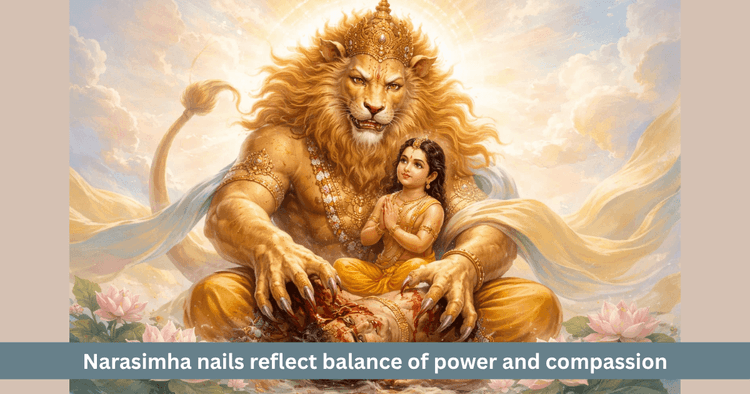
Table of Contents
The form of Lord Narasimha in Indian spiritual tradition is remembered not only for fierceness, radiance and protection but also for a deeply compassionate and tender divine presence. This is why contemplation of Narasimha is not merely contemplation of terrible force. It is also contemplation of a divine balance in which firmness and softness are not opposites but complementary truths. One of the most meaningful ways to understand this balance is through the episode of the claws of Narasimha.
When Hiranyakashipu was destroyed, Lord Narasimha did not use any weapon or formal instrument of war. He ended the life of that immensely powerful asura using only His claws. This single detail lifts the story beyond the level of ordinary battle description and turns it into a profound spiritual symbol. The same claws that became harder than the thunderbolt for the asura became soft like the petals of a lotus for the devotee Prahlada. This is not contradiction. It is the revelation of divine balance.
Why is the episode of Narasimha’s claws so profound
The entire form of Narasimha is based on the truth that when the moment comes for the protection of dharma, even the simplest means can become extraordinary through divine will. Claws are not normally seen as the principal weapon of a warrior. Yet when the time for the destruction of injustice arrived, they became sufficient. That is why the claws of Narasimha are not merely a symbol of physical force. They also represent that power which can draw the necessary means from within itself.
There is another important dimension here. Hiranyakashipu had arranged his protection through boons in such a way that almost every ordinary path of death had been blocked. He was not to die by man or beast, not by day or night, not by weapon or instrument. In such a situation, the claws of Narasimha became not merely a means of attack but a symbol of divine intelligence, the intensity of dharma and unexpected sacred resolution.
A few major indications of this episode may be understood in the following way:
- For the Divine, purpose matters more than outer instrument
- Even the ordinary can become a channel of divine force
- Protection of dharma sometimes appears through unexpected means
- The claws here become not merely bodily features but an extension of divine power
In what way does Vishnu Purana guide us to view this episode
In the Vishnu Purana, the claws of Narasimha are not described merely as part of a battle scene. The deeper feeling is that divine power can become active at any level. When the time comes for the protection of righteousness, the Divine does not depend upon outer weapons. Inner force itself becomes enough.
This is why the importance of the claws becomes so great. They reveal the truth that divine will itself is the highest weapon. If the Divine so chooses, even the simplest element becomes the means of victory for dharma. In this sense, the claws of Narasimha may also be seen as a symbol of divine resolve.
Harder than thunderbolt for the asura, softer than lotus petals for the devotee
The most tender and emotionally powerful part of the story appears here. The same claws that became instruments of destruction for Hiranyakashipu became the touch of affection and protection for Prahlada. This moment is extremely deep, because it shows that the Divine is experienced according to the inner state, feeling and orientation of the one who stands before it.
For the one who stands with ego, adharma and opposition to the Divine, that same power becomes terrible and destructive. But for the one who stands in devotion, surrender and purity of heart, that very power becomes shelter, peace and compassion. This is the deepest secret of the claws of Narasimha.
This transformation may be understood through the following points:
- For the asura, divine force took on a hard and destructive form
- For the devotee, the same power turned into tenderness
- The Divine remains one but its experience changes according to inner feeling
- God can be firm in justice and soft in love at the same time
Does this story teach that the Divine appears according to one’s inner feeling
Yes. This episode presents that truth beautifully. The essential nature of the Divine remains one, yet its experience differs for the devotee, the hostile being, the seeker and the proud person. The sun is one, yet its effect is not the same on the lotus and on stagnant mud. In the same way, Narasimha is one. But for Prahlada He appears as a loving protector, while for Hiranyakashipu He appears as the force of divine judgment.
This teaches us the importance of inner disposition. Relationship with God is not formed through outer appearance. It is formed through inner truth. Where there is devotion, divine power becomes soft. Where there is resistance and arrogance, that same force may be experienced as terrible.
Why is the balance of firmness and softness necessary in life
The symbolism of Narasimha’s claws is not limited to Purāṇic narrative. It also gives deep guidance for life. Many people assume that to be strong one must always be hard. Others assume that softness itself is weakness. This story clearly shows that true strength lies not in hardness alone but in the ability to take the right form according to the need of the moment.
If one is only hard, one cannot remain just. If one is only soft, one cannot protect. But the one who can be firm when required and compassionate when needed is truly mature. The claws of Narasimha teach exactly this balance.
This life lesson may be understood in the following ways:
- To remain hard at all times is not maturity
- To remain soft at all times is also not enough
- Wise balance is the real form of power
- Let there be firmness where justice is needed
- Let there be softness where love is needed
How did the devotion of Prahlada make this fierce force gentle
Prahlada is the heart of the entire narrative. If Hiranyakashipu is the reason that the claws appear in their fierce aspect, Prahlada is the reason that their tenderness becomes visible. The unbroken devotion, fearless faith and pure surrender of Prahlada transformed even the fierce form of Narasimha into one of affection. This is not merely the story of a devotee being saved. It is also proof of the transforming power of devotion itself.
Devotion is not only prayer. It is also the medium through which the Divine is experienced. When the mind is pure, the same force that appears terrifying to others may appear compassionate to the devotee. The consciousness of Prahlada was able to perceive parental tenderness even within the fierceness of Narasimha. This is the highest point of devotion.
Do the claws of Narasimha also symbolize divine justice
Certainly. The claws of Narasimha do not represent force alone. They also represent divine justice. The blow they delivered was not the result of personal rage but of protection of dharma. That is what separates this story from ordinary revenge. Here power is not emotional eruption. It is precise divine response in favor of righteousness.
For this reason, the claws of Narasimha also teach us that there is a difference between power used for dharma and power used for ego. Power that rises for dharma may contain compassion within it. Power used merely for pride becomes destructive.
What is the importance of this episode in the present age
Today, people often understand strength only as outer influence, control, aggression and domination. In this context, the episode of Narasimha’s claws offers a profound alternative. It teaches that power and compassion are not opposites. True power is that which can be clear, decisive and firm when needed, yet remain soft in touch when love calls for it.
This makes the story highly meaningful in present life for the following reasons:
- It redefines what strength truly means
- It teaches that firmness and compassion can coexist
- It shows the balance between decision and sensitivity
- It teaches maturity in responding according to inner truth
Where divinity is both firm and compassionate
The deepest secret of Narasimha’s claws is that divinity is never one sided. It does not only punish, nor does it only console. It is firm in justice and gentle in love. It may become harder than thunderbolt for the asura and softer than lotus petals for the devotee. This is the greatest depth of the story.
In the end, the episode teaches that true divinity and true maturity have a similar form. Let there be force where force is needed. Let there be compassion where love is present. Let there be firmness where adharma appears. Let there be tenderness where surrender is found. This is the spiritual and existential teaching of the claws of Narasimha.
FAQs
How did Narasimha destroy Hiranyakashipu
He did not use any weapon or formal instrument. He ended Hiranyakashipu through His claws.
Why are the claws of Narasimha considered so special
Because though simple in appearance, they became the means of divine resolve and protection of dharma.
How did the same claws become gentle for Prahlada
This is understood as the effect of devotion. The force that was hard for the asura became compassionate for the devotee.
What is the greatest teaching of this episode
It teaches that true strength is that which can be both firm and gentle according to the need of the moment.
Is this only a religious symbol
No. It is also a deep lesson for life that real maturity lies in balancing justice with compassion.
Get your accurate Kundali
Generate KundaliDid you like it?
Author

Pt. Abhishek Sharma (63)
Experience: 20
Consults About: Family Planning, Career
Clients In: Punjab, Haryana, Delhi
Share this article with friends and family
About ZODIAQ
ZODIAQ is an online Vedic Astrology platform. It connects clients seeking astrological advice to experienced astrologers with deep knowledge. Our users also generate kundali and perform kundali milan for free. ZODIAQ also offers services to the Astrologers. Astrologers utilize various offerings by ZODIAQ to serve their clients effectively.
If you are a User
Consult with experienced astrologers and seek their guidance. You can also order handwritten Janm Patrika report with life prediction prepared by experienced astrologers. Generate accurate Kundali, perform Kundali Matching and check horoscope and muhurat. Utilize our online library for all the necessary astrological and spiritual information.
If you are an Astrologer
Create accurate kundali for your clients and perform Kundali Matching for up to 5 people at a time. Write comprehensive Janm Patrika report for your clients with ZODIAQ. Check client details anytime by saving it in client directory. Become more productive by tracking how many clients you guide every day.
WELCOME TO
ZODIAQ
Right Decisions at the right time with ZODIAQ
