Why Narasimha Wore a Garland of Entrails: Symbol, Power and Purification
By Pt. Nilesh Sharma
Not cruelty but deep symbolism reveals the purification message behind this fierce form of Narasimha
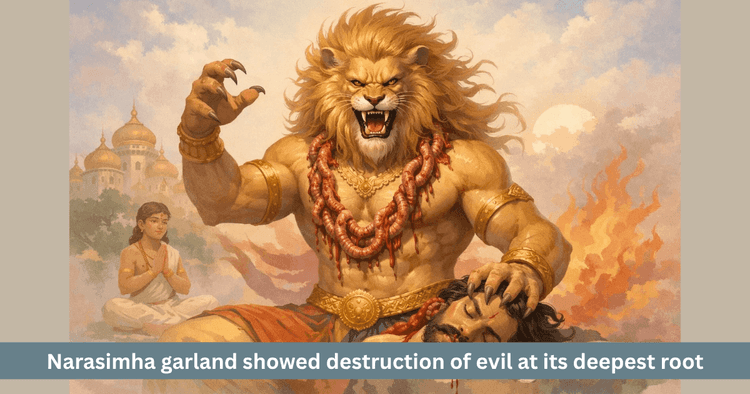
Table of Contents
The form of Lord Narasimha is counted in the Indian spiritual tradition among those rare manifestations in which compassion and fierceness appear together. Outwardly, this form seems intensely powerful, yet inwardly its purpose is only one, the protection of dharma. When Hiranyakashipu was slain, it was not only the end of one asura. It was the final blow to that long standing adharma, unrighteousness, ego and injustice that had disturbed the balance of creation.
Within this episode, one scene especially raises questions in the mind. After slaying Hiranyakashipu, Lord Narasimha takes out his entrails and wears them around his neck. At first glance, this may seem harsh, frightening and unsettling. But when the episode is studied deeply, it becomes clear that this is not a display of meaningless violence. It is a profoundly symbolic act in which evil is not merely defeated but uprooted along with its hidden layers and inner poison.
That is why this episode does not remain a mythic narrative alone. It also reveals the struggle within the human being, the hidden faults within and the process of true purification.
Why is this scene considered so important
The entire episode of the Narasimha avatara, divine descent, rests upon the truth that when unrighteousness crosses its limits, divine force appears in an extraordinary form to stop it. Hiranyakashipu possessed not only power. He also carried such arrogance born of boons that he began to believe that no law, no boundary and no God stood above him.
In such a state, his end could not remain a matter of physical punishment alone. If only the body had been destroyed, the meaning of the narrative would still have remained incomplete. It was necessary that the unrighteousness embedded within him should also be brought to an end. This is why the episode of the garland of entrails is regarded as so significant. It shows that divine power does not strike only the evil that is visible outside. It also exposes and destroys the root hidden within.
To understand this clearly, a few points are worth remembering:
• Hiranyakashipu had become not only a king but a figure of adharma
• His end was not just an outer victory but a sign of the destruction of inner impurity
• Narasimha’s fierce form symbolized not rage but divine responsibility
• The garland of entrails reflects the completeness of the act in which evil was removed from its root
What within Hiranyakashipu had to be removed completely
Hiranyakashipu’s sin was not limited to giving pain to Prahlada or seeing himself as invincible. His greatest problem was that he challenged the order of creation. He did not link his power with dharma. He turned it into the basis of pride. He began to treat himself as the final truth. That is why he was not only wicked outwardly. He had become inwardly corrupted as well.
When a person hides inner faults for so long that those faults begin to appear to him as strength, he becomes more than merely wrong. He becomes dangerous. This is what happened with Hiranyakashipu. His injustice, anger, pride and opposition to God had entered his being so deeply that their removal could not remain superficial.
Here the narrative offers a profound spiritual lesson. Sometimes the real problem is not where it appears to be. Its root lies hidden much deeper within.
What do the entrails symbolize here
Entrails are a part of the body that remains hidden inside. They are not visible outwardly. They remain concealed and function within life processes while staying beyond sight. For this reason, in this episode the entrails do not remain merely a bodily organ. They become symbols of those inner tendencies, hidden faults, suppressed poisons and unseen impurities that a being does not show outwardly, yet carries within.
When Lord Narasimha draws out Hiranyakashipu’s entrails, the meaning becomes that the unrighteousness hidden within has now been fully brought out into the open. It can no longer remain concealed. It can no longer draw power from secrecy. Its covering has been broken.
This symbolism may be understood more clearly in the following way:
| Symbol | Outer meaning | Inner indication |
|---|---|---|
| Entrails | Inner bodily organ | Hidden faults and adharma |
| Drawing them out | Revealing the inside | Exposure of concealed impurity |
| Making them a garland | Bringing under control | Subduing evil after defeating it |
| Fierce form | Intense force | Process of decisive purification |
What is the deeper meaning of wearing them around the neck
It is natural to ask that if Narasimha had already ended adharma, why was there any need to wear the entrails around the neck. At this point the symbolism becomes even clearer. Wearing them around the neck is not a gesture of honor. It is a sign of complete control, victory and subjugation. That adharma which once moved freely and affected the world now stands under divine power.
The neck itself is also a meaningful symbol. It is associated with voice, declaration and expression. In that sense, wearing the entrails around the neck may be understood as a sign that the hidden adharma has now been brought fully under divine control and declared finished.
A few deeper indications emerge here:
• Adharma was not honored. It was subdued
• Hidden impurity came under divine control
• Victory does not mean only striking down the enemy but ending its influence
• The garland shows that evil no longer remains an independent force
How does Vishnu Purana inspire us to see this episode
In Vishnu Purana, this episode is not to be seen merely as an outer battle narrative. It suggests that every action of the Lord is connected with a deeper purpose of dharma. Narasimha’s fierce form, the end of Hiranyakashipu and what follows together show that when adharma takes root deeply, it is not enough merely to stop it. It must be removed from the root.
That is why one should not stop at the outer scene while reading this episode. The spiritual reasoning behind it matters more. The work of the Lord does not arise from impulse. It arises from perfect discernment. Therefore the image of the garland of entrails indicates that the removal of adharma may at times appear severe, yet its aim is always balance and purification.
Is this only a scene of violence or a process of purification
If this scene is seen only outwardly, it may look harsh. But when its inner meaning is understood, it becomes clear that the center of the episode is not violence but purification. Purification does not only mean appearing clean. At times it means bringing out the poison hidden within. Until concealed impurity is brought out, real transformation cannot occur.
The same truth applies to human life. People often cover their faults. They do not accept them. They want everything to appear proper on the surface. But if ego, jealousy, anger, hatred or unrighteous tendencies continue within, outer decoration changes nothing.
So this episode teaches that:
• The first stage of purification is to recognize hidden faults
• The second stage is to bring them out
• The third stage is decisive renunciation of them
• Only then can balance and peace be established in a lasting way
How does this narrative connect with our inner life
This form of Narasimha is not only for one asura of ancient times. It also symbolizes a process that takes place within human beings even today. Every person carries certain feelings that are not shown to the world. Some hurts, some distortions, some insecurities and some negative impulses remain buried within. Over time, those inner things begin to affect behavior, speech and relationships.
In such a state, outer improvement alone is not enough. One must go inward. One must see which tendency is corrupting life. This process is not easy, because looking at one’s inner adharma is always difficult. But this is where true spiritual practice begins.
This narrative applies to inner life in the following ways:
• Inner faults often remain hidden, yet continue to act
• Ignoring them does not make them disappear
• True transformation begins when one faces inner impurity
• In spiritual life, both awareness and firmness are necessary
Can every problem be solved only through gentleness
This story also gives another important teaching. In life, many situations are resolved through gentleness, patience and waiting. Yet there are also situations where clarity, firmness and decisiveness become necessary. The episode of Hiranyakashipu is one such case. Mere persuasion was not enough there, because adharma had already crossed its limit.
For this reason, the form of Narasimha teaches that spirituality does not mean being soft in every situation. True spirituality also knows when to remain compassionate and when to stand firmly against adharma. If some fault within or outside is repeatedly disturbing balance, then taking a firm stand against it may itself become the truest form of compassion.
How do power and purification appear together in this form of Narasimha
At first glance, the form of Narasimha appears to be only a form of strength. But on deeper reflection, one sees that purification, protection and defense of dharma all appear together in it. His anger was not personal. It was for dharma. His fierce form was not for destruction alone but for the restoration of balance. His strike was not born from revenge but from the need to end that adharma which had become dangerous to the world.
This is why the image of the garland of entrails is as profound as it is fierce. It shows that when divine power acts, it does not leave the work half done. It does not merely cover impurity from above. It removes it from the root.
The life teaching hidden at the end
Ultimately, it becomes clear that Lord Narasimha wearing a garland of entrails is not merely a strange or frightening image. It is a deep teaching for life. It tells us that it is not enough to remove adharma from the surface. If its root remains hidden within, it can return again. Real balance arises only when hidden faults are recognized, brought out and then fully removed.
This is the greatest strength of the narrative. It does not speak only of the slaying of an asura. It urges the human being to look within. The faults that remain hidden inside are the ones that influence life most deeply. The distortions that remain buried are the ones that poison existence most powerfully. And the purification that reaches the root is the one that lasts. This form of Narasimha reveals this final truth, that true transformation always begins within and true balance arises only when the root of adharma is fully uprooted.
FAQs
Is Narasimha wearing a garland of entrails only a sign of anger
No. It carries a deep symbolic meaning. It indicates the destruction of adharma from the root and the bringing of hidden impurity under control.
What may the entrails symbolize in this narrative
They symbolize hidden faults, distortions and that adharma which does not remain visible outwardly yet continues to act within.
What does wearing them around the neck mean
It does not mean honor. It means complete control and victory. Adharma has now come under divine power.
Does this episode also apply to our life
Yes. It teaches that hidden negative tendencies cannot be overcome merely by suppression. They must be recognized and removed.
What is the greatest teaching of this story
The greatest teaching is that true purification and lasting balance arise only when evil is removed from its root.
Get your accurate Kundali
Generate KundaliDid you like it?
Author

Pt. Nilesh Sharma (63)
Experience: 20
Consults About: Family Planning, Career
Clients In: Punjab, Haryana, Delhi
Share this article with friends and family
About ZODIAQ
ZODIAQ is an online Vedic Astrology platform. It connects clients seeking astrological advice to experienced astrologers with deep knowledge. Our users also generate kundali and perform kundali milan for free. ZODIAQ also offers services to the Astrologers. Astrologers utilize various offerings by ZODIAQ to serve their clients effectively.
If you are a User
Consult with experienced astrologers and seek their guidance. You can also order handwritten Janm Patrika report with life prediction prepared by experienced astrologers. Generate accurate Kundali, perform Kundali Matching and check horoscope and muhurat. Utilize our online library for all the necessary astrological and spiritual information.
If you are an Astrologer
Create accurate kundali for your clients and perform Kundali Matching for up to 5 people at a time. Write comprehensive Janm Patrika report for your clients with ZODIAQ. Check client details anytime by saving it in client directory. Become more productive by tracking how many clients you guide every day.
WELCOME TO
ZODIAQ
Right Decisions at the right time with ZODIAQ
