Why Panaka Is Offered to Narasimha
By Aparna Patni
The Tradition of Cooling Divine Fierceness
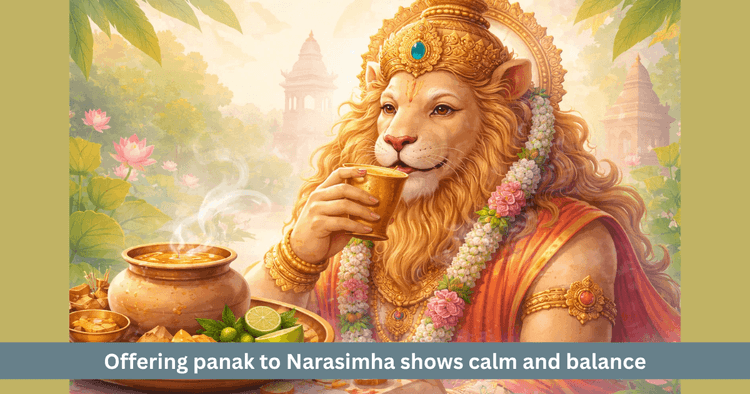
Table of Contents
The form of Lord Narasimha is usually remembered for radiance, fierceness and the protection of dharma. Yet that same form also carries a deeply balanced, peaceful and compassionate dimension. When the avatara of Narasimha is remembered, the mind naturally goes to the fierce moment of Hiranyakashipu’s destruction. But one of the most tender dimensions of this sacred narrative appears after that event, when the need arises to calm the intense force that had manifested for the protection of righteousness. It is here that the worship of Narasimha becomes not only a matter of valor but also one of peace, service and devotional understanding.
In many temples of South India, there continues to be a living tradition of offering Panaka, a cooling drink made with jaggery, to Lord Narasimha. Panaka is not regarded merely as a food offering. Behind it lies a deep devotional sensitivity, a subtle spiritual symbolism and an intimate bond between the devotee and the Lord. This tradition teaches that the power which protects must also be brought into balance, and the energy that destroys adharma must eventually be settled into peace.
Why was it considered necessary to calm Narasimha after the killing of Hiranyakashipu
The destruction of Hiranyakashipu was not merely the end of an enemy. It was the end of accumulated adharma, arrogance and oppression that had challenged devotion and righteousness. The divine force that emerged for such a task was therefore naturally intense, blazing and fierce. The energy of Narasimha is understood not as personal anger but as divine force for the protection of dharma.
For this reason, there arose a traditional understanding that after the destruction of Hiranyakashipu, the body and energy of Lord Narasimha carried great heat. This heat is not understood only in a physical sense. It is also seen as the spiritual intensity that remains after great conflict and righteous destruction. At such a moment, balance is necessary. This is where the tradition of offering Panaka receives its deeper emotional meaning.
A few important insights help explain this:
- Narasimha’s fierceness arose for the protection of dharma
- After the act of destruction, the energy still required calming
- The tradition understood the need to restore peace after intensity
- Panaka became a devotional medium of that peace and balance
Why is the offering of Panaka more than a simple bhoga
If this tradition is seen only as a food offering, then only a part of its meaning becomes visible. In truth, Panaka offering symbolizes a type of devotion in which the devotee does not only ask from the Lord but also tries to understand the Lord’s state. This feeling is very rare and deeply beautiful. It carries not only reverence but also care, tenderness and gratitude toward the divine force that offered protection.
The devotee feels that the power which destroyed adharma and gave protection now also deserves to be settled into peace. In this way, Panaka becomes more than an offering. It becomes a cooling touch of devotion. Here the Lord is not only worshipped but also lovingly served.
This tradition reveals several tender dimensions of devotion:
- The devotee does not only bow but also serves with feeling
- Worship includes both sensitivity and understanding
- What is offered is chosen in harmony with the Lord’s manifested state
- Devotion here becomes not only reverence but a living relationship
Why was Panaka chosen specifically
The selection of Panaka itself is deeply meaningful. In the Indian tradition, jaggery is not seen only as a source of sweetness. It is also associated with nourishment, balance and soothing qualities. When jaggery is mixed with water into a drink, it is understood as something cooling, refreshing and balancing. This is why the offering of Panaka in Narasimha worship becomes meaningful at both the symbolic and emotional levels.
It is also worth noting that after intensity and battle, what is being offered is both sweet and cooling. Sweetness is associated with compassion and affection, while cooling is connected with balance and repose. In this way, Panaka appears to function on two levels. It symbolizes the calming of fierceness and also expresses the sweetness of the devotee’s love.
This may be understood in the following way:
| Element | Outer form | Deeper indication |
|---|---|---|
| Jaggery | Sweet substance | Affection, nourishment and tenderness |
| Water | Cooling flow | Peace, calmness and soothing |
| Panaka | Union of jaggery and water | Compassionate peace after fierceness |
| Offering | Sacred food offering | The devotee’s understanding and loving service |
How do folk tradition and Agama Shastra give meaning to this practice
The tradition of offering Panaka to Narasimha is associated with folk traditions as well as Agama Shastra, where divine worship is not limited to recitation and ritual alone. One also finds the discipline of making offerings appropriate to the deity’s form, mood and energetic nature. This makes it clear that ancient worship was not mechanical ritualism. It also contained subtle understanding, sensitivity and a living awareness of the divine form.
The Agamic view suggests that in worship, outer rules alone are not enough. Appropriate feeling, appropriate timing, appropriate offering and appropriate understanding are equally important. The offering of Panaka to Narasimha is a living example of this tradition, where devotion is joined with spiritual discernment.
Does this tradition teach something for our own life
Yes. This tradition is not limited to temple practice. It also offers deep guidance for life. Human beings too, after going through intense struggle, stress, conflict or inner battle, often carry disturbed energy within. Sometimes it appears as anger, sometimes as exhaustion, sometimes as restlessness and sometimes as inner hardness. In such moments, it is not enough merely to focus on the conflict itself. One must also create space for peace, rest and inner balance afterward.
The tradition of offering Panaka to Narasimha teaches exactly this. Every intensity must eventually be followed by calm. It is not enough to win the battle. The fire within must also be cooled and settled. This teaching is especially relevant today, because many people achieve outer success but fail to restore inner peace.
This tradition offers the following life lessons:
- Every intense experience should be followed by rest and balance
- Inner heat must be softened through sweetness and calm
- To pause after struggle is also part of spiritual maturity
- Love and care are necessary not only for others but also for oneself
Why can devotion be called a path of understanding, not only asking
Very often devotion is seen merely as a means of asking for blessings, removing suffering or fulfilling wishes. But the tradition of offering Panaka to Narasimha reveals a much higher form of devotion. Here the devotee does not only ask the Lord for protection. The devotee also understands that after that fierce protection, the divine energy should be lovingly settled into peace. This is a very elevated expression of worship.
Three important dimensions of devotion become visible here:
- Faith
- Understanding
- Relationship
This is why the practice does not remain merely a religious action. It becomes a very subtle and tender dialogue between the devotee and the Lord, where demand is less and intimacy is greater.
Why is this tradition still so alive in South Indian temples
In many Narasimha temples of South India, the offering of Panaka continues even today with great devotion. The reason behind this is not merely the preservation of custom. It is a living feeling that generations of devotees have carried in their hearts. When Panaka is offered, it is not only a drink that is placed before the deity. A very ancient devotional sensitivity is continued through the act.
A few major reasons lie behind the living nature of this practice:
- The emotional and spiritual foundation of the tradition is very deep
- Devotees connect it with the calming of Narasimha’s fierce energy
- The offering transforms worship into loving service
- It turns ritual into an experience of devotion
Why is the balance of fierceness and peace the real completeness
The final and greatest message of the tradition of offering Panaka to Narasimha is that power is not complete by itself unless it is balanced by peace. Fierceness has its rightful place. It may be necessary for the destruction of adharma, for resistance against injustice and for protection. But the final purpose of such fierceness must be peace. Without peace after power, balance remains incomplete.
That is why this tradition repeatedly reminds us that life is not fulfilled by strength alone. After valor, there must be compassion. After intensity, there must be stillness. After energy, there must be balance. This is the path of fullness.
Where the offering of Panaka turns devotion into living experience
In the end, it becomes clear that the tradition of offering Panaka to Narasimha is not merely a religious act. It is a deep spiritual teaching. It reveals that the force which protects is also lovingly calmed. The fierceness that appears for dharma must finally be established in peace. And the devotee who truly loves does not only worship. Such a devotee also understands, feels and serves.
This is the greatest beauty of the tradition. When power and peace, fierceness and sweetness, protection and service come together, devotion becomes complete. The offering of Panaka to Narasimha stands as a living symbol of that completeness.
FAQs
Why is Panaka offered to Narasimha
According to traditional understanding, after the destruction of Hiranyakashipu, Panaka was offered to cool the intense and fierce divine energy.
Is Panaka only a food offering
No. It is not merely a food offering. It is regarded as a symbol of the devotee’s understanding, loving service and the calming of fierceness.
What is the importance of jaggery and water in Panaka
Jaggery suggests sweetness, nourishment and tenderness, while water symbolizes peace, cooling and calmness.
Is this tradition connected with Agama Shastra as well
Yes. Along with folk tradition, Agama Shastra is also associated with the discipline of specific offerings in Narasimha worship.
What lesson does this tradition offer for life
It teaches that every intensity must be followed by balance, and true devotion includes love, understanding and peace.
Get your accurate Kundali
Generate KundaliDid you like it?
Author

Aparna Patni (63)
Experience: 20
Consults About: Family Planning, Career
Clients In: Punjab, Haryana, Delhi
Share this article with friends and family
About ZODIAQ
ZODIAQ is an online Vedic Astrology platform. It connects clients seeking astrological advice to experienced astrologers with deep knowledge. Our users also generate kundali and perform kundali milan for free. ZODIAQ also offers services to the Astrologers. Astrologers utilize various offerings by ZODIAQ to serve their clients effectively.
If you are a User
Consult with experienced astrologers and seek their guidance. You can also order handwritten Janm Patrika report with life prediction prepared by experienced astrologers. Generate accurate Kundali, perform Kundali Matching and check horoscope and muhurat. Utilize our online library for all the necessary astrological and spiritual information.
If you are an Astrologer
Create accurate kundali for your clients and perform Kundali Matching for up to 5 people at a time. Write comprehensive Janm Patrika report for your clients with ZODIAQ. Check client details anytime by saving it in client directory. Become more productive by tracking how many clients you guide every day.
WELCOME TO
ZODIAQ
Right Decisions at the right time with ZODIAQ
