Narasimha and the Secret of Shunya
By Pt. Suvrat Sharma
Where Ending and Beginning Meet
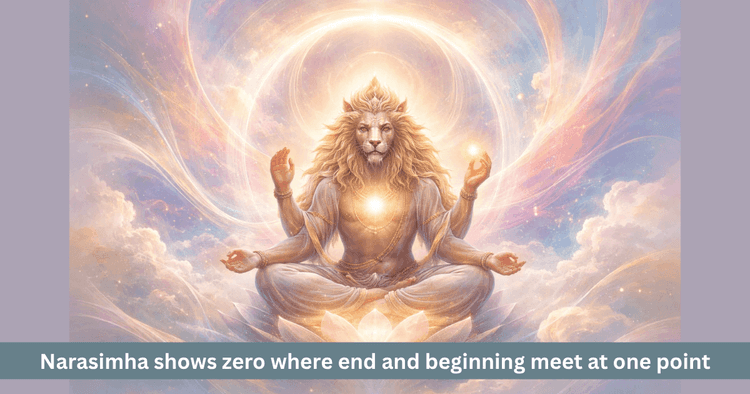
Table of Contents
The form of Lord Narasimha is usually associated with power, fierceness, protection of dharma and immediate justice. Yet Narasimha is not limited to these meanings alone. There is within His presence a very subtle, profound and spiritual dimension that is connected, in Tantric and Upanishadic understanding, with the principle of Shunya, the sacred void. This is the point where Narasimha is no longer seen only as an outer protector but as the lord of that state where all agitation becomes still, where duality loses force and from where a new beginning also becomes possible.
At first this idea may seem difficult, because the ordinary mind sees shunya only as emptiness or absence. But in the Indian philosophical understanding, shunya does not mean useless emptiness. It is the condition in which the noise of the mind comes to rest, the grip of ego loosens, the flow of fear subsides and consciousness becomes established in its own source. When Narasimha is connected with shunya in this way, His form appears in a new light. He does not merely destroy adharma outside. He also removes the very root from which fear, confusion and negativity arise.
Why does shunya not mean mere emptiness
When the word shunya is heard, many people assume that it means nothingness. Yet in Tantra and Vedanta, this is not its deeper meaning. Shunya is the state in which outer and inner movement fall silent. There thought does not continue in the same way, ego does not remain at the center and fear and confusion begin to lose their hold. For this reason, shunya is not regarded as mere absence but as the original stillness.
It is from this point that all movements arise and to this point they may return. Just as the depth of the ocean remains still beneath its waves, shunya is the stable ground behind all mental and energetic disturbance. Once this becomes clear, the relation between Narasimha and shunya also becomes easier to understand.
To understand the meaning of shunya, a few points are helpful:
- Shunya does not mean meaningless emptiness but original peace
- It is a state beyond thought, ego and inner conflict
- Mental and energetic turbulence arises from it
- That same turbulence may return to quietness within it
Why is Narasimha regarded as lord of shunya
In the Tantric tradition, Lord Narasimha is not seen only as the destroyer of external enemies. He is also understood as a consciousness that can quiet negativity at its root within the individual. In this sense, He is called lord of shunya. This does not mean that He is the deity of nothingness but that He grants access to that state in which negative force loses its influence.
When fear, anger, confusion or mental disturbance takes hold of a person, it does not exist only at the surface. It has a root. If only the outer symptoms are suppressed, they may return later in another form. This is why the force of Narasimha is considered so deep. He does not touch only the result. He touches the cause. When the cause is calmed, the effect also begins to dissolve.
What does it mean to return negativity into shunya
It is said that Narasimha dissolves any negative force into shunya. This does not merely mean that He destroys it. The deeper meaning is that He returns that force to its original state of non influence, where its hold comes to an end. This is a subtle spiritual process.
Many times a person suppresses fear, hides anger or ignores confusion, yet those tendencies remain within. They return later in another form. The principle of Narasimha and shunya teaches that real resolution comes when one reaches the very root from which that negativity arises. When that root becomes quiet, the result also gradually disappears.
This may be understood simply in the following way:
| Aspect | Ordinary experience | Vision of shunya |
|---|---|---|
| Fear | Takes hold of the mind | Loosens when the root is understood |
| Anger | Turns into reaction | Becomes quiet when returned to stillness |
| Confusion | Covers clarity | Begins to disappear through awareness |
| Narasimha power | Appears to destroy | Makes the root cause ineffective |
How does Narasimha Tapaniya Upanishad deepen this secret
In the Narasimha Tapaniya Upanishad, Narasimha is not limited to the story of an avatara. He is seen as a deep spiritual consciousness. Here the form of Narasimha rises beyond outer narrative and becomes a subject of inner experience. The insight emerges that divine force does not only end an outer crisis but also establishes such balance in consciousness that disturbances lose their power.
This Upanishadic vision suggests that one aspect of Narasimha sadhana is removal of fear, another is awakening of inner strength and a third is guiding consciousness back toward its source. That return is the movement toward shunya. In this sense, shunya is not death. It is the end of unnecessary turbulence and the arising of pure presence.
Does shunya mean abandoning everything
This is a natural question. When shunya is discussed, some assume that it means withdrawal from life or the rejection of all activity. But here shunya does not mean escape. It means the calming of unnecessary inner entanglement. It is not the absence of outer action. It is the ending of the disordered noise within.
A person may be doing much outwardly and still remain inwardly scattered. Another may be doing less outwardly and yet remain clear and steady inside. Shunya teaches exactly this, that outer activity is less important than inner condition. When the mind is not empty in a dull sense but quiet in a living sense, right understanding can appear more naturally.
In this discipline of shunya, a few insights are especially useful:
- Not every reaction is necessary
- Not every thought is true
- Not every fear is real
- When inner stillness comes, vision becomes clearer
How does the relation between Narasimha and shunya connect with our life
This principle is not limited only to Tantric or Upanishadic reflection. It is equally useful in life today. Modern human beings are surrounded constantly by thoughts, information, stress, fear and mental pressure. The mind remains active all the time, yet not peaceful. In such a condition, the connection between Narasimha and shunya offers a deep direction.
It teaches that not every problem is resolved through more effort, more reaction or more control. Often the greatest resolution lies in going within and seeing where the original instability is. If peace can be brought to the source of the mind, many outer complications may begin to soften by themselves.
At the level of life, this teaching appears in the following ways:
- It is important to look at the root cause rather than only the surface symptom
- Fear is better understood than merely suppressed
- Stillness often comes before right action
- Inner shunya can become the source of outer balance
Is true power found only in action
The teaching of Narasimha and shunya reveals a very deep truth that real power does not exist only in intense action. One form of power is also stillness. The person who is inwardly calm can act rightly at the right moment. The one who is inwardly scattered may possess force, yet that force becomes directionless.
Narasimha in His fierce form reveals the power of action but His relation with shunya teaches that the root of right action must also be inner stability. Power without stillness can become destructive but power joined with stillness becomes transformative.
Why is the relation between shunya and peace so important
When the mind remains continuously disturbed, a person experiences every outer event in an exaggerated way. But when inner peace begins to arise, the same situation appears differently. This is the meaning of shunya, the reduction of unnecessary inner crowding. Shunya does not mean dead emptiness. It means awakened stillness. And from that stillness, clarity is born.
The connection of Narasimha with shunya teaches that the final aim of divine power is not merely destruction but balance. That balance arises only when the root of negativity is quieted, not when the outer expression is merely suppressed for a short while.
Why is this understanding even more necessary today
Today the mind of the human being is busier than ever before. The outer world is fast and the inner world is tangled. Something is always happening. In such a time, the principle of shunya appears almost like a deep medicine. It says that not every answer lies in doing more. Sometimes the answer lies in pausing, in seeing and in becoming quiet.
If a person can create even a small space of shunya within, clarity, patience and balance may begin to grow. Then the force of Narasimha is no longer only protective outside. It becomes the power that also breaks the inner knot of confusion.
Where everything ends and everything begins
In the end, the relation between Narasimha and shunya gives a deeply meaningful life teaching. Whatever appears on the surface has a root. If that root becomes still, the result also changes. This is why shunya is spoken of both as an ending and as a beginning. There the old comes to an end, and from there the new may also be born.
Narasimha is understood as the guardian of this principle. He does not merely remove negativity. He takes it to its source and renders it ineffective. That is true protection. That is true power. And that is the deepest secret of this whole teaching, that when consciousness touches shunya, the grip of fear, confusion and unrest begins to loosen and a new clarity starts to arise in life.
FAQs
Why is Narasimha connected with shunya
Because He is understood as a divine consciousness that takes negativity to its root and quiets it there.
Does shunya mean only emptiness
No. In Indian philosophy, shunya means deep peace, a state free from ego and original inner stability.
What does Narasimha Tapaniya Upanishad indicate about this subject
It points toward seeing Narasimha not only as an avatara but as a deep spiritual principle connected with consciousness and inner balance.
Does shunya mean moving away from life
No. It means calming unnecessary inner disturbance, not escaping life.
What is the daily life teaching of this episode
It teaches that real resolution comes not from suppressing the surface but from understanding and quieting the root cause.
Get your accurate Kundali
Generate KundaliDid you like it?
Author

Pt. Suvrat Sharma (63)
Experience: 20
Consults About: Family Planning, Career
Clients In: Punjab, Haryana, Delhi
Share this article with friends and family
About ZODIAQ
ZODIAQ is an online Vedic Astrology platform. It connects clients seeking astrological advice to experienced astrologers with deep knowledge. Our users also generate kundali and perform kundali milan for free. ZODIAQ also offers services to the Astrologers. Astrologers utilize various offerings by ZODIAQ to serve their clients effectively.
If you are a User
Consult with experienced astrologers and seek their guidance. You can also order handwritten Janm Patrika report with life prediction prepared by experienced astrologers. Generate accurate Kundali, perform Kundali Matching and check horoscope and muhurat. Utilize our online library for all the necessary astrological and spiritual information.
If you are an Astrologer
Create accurate kundali for your clients and perform Kundali Matching for up to 5 people at a time. Write comprehensive Janm Patrika report for your clients with ZODIAQ. Check client details anytime by saving it in client directory. Become more productive by tracking how many clients you guide every day.
WELCOME TO
ZODIAQ
Right Decisions at the right time with ZODIAQ
