Prahlada’s Previous Birth: Unbreakable Devotion Born from an Unintentional Vow
By Pt. Amitabh Sharma
The deeper meaning of Prahlada’s divine devotion connected to karma, impressions, and previous births
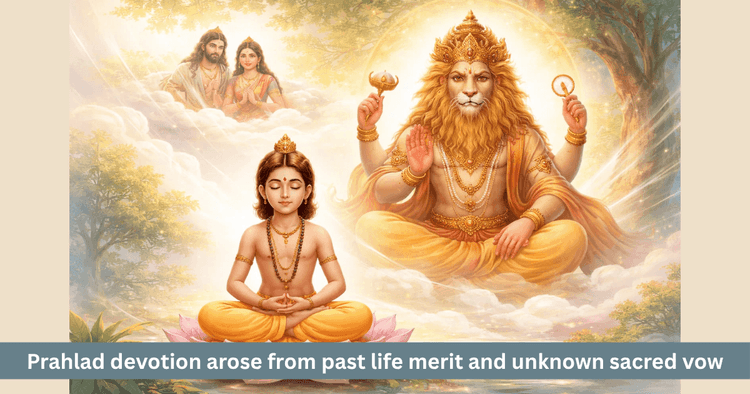
Table of Contents
In the sacred narrative of Lord Narasimha, the name of Prahlada is remembered not merely as that of a devoted child but as a symbol of unshaken faith that does not break even under the harshest conditions. A child born in an asura lineage, surrounded by opposition to God, and yet remaining unwavering in devotion to Lord Vishnu, represents more than a simple religious episode. It points toward a profound spiritual truth. When Prahlada’s devotion is examined carefully, it begins to appear not as something that arose suddenly in one lifetime but as the flowering of a much older spiritual seed. That is why this account is connected not only with his present birth but also with his previous birth, meritorious karma and an unintentional sacred vow.
This makes Prahlada’s story far more than a tale of devotion alone. It becomes a reflection on karma, impressions carried by the soul and the continuity of spiritual tendencies across births.
What is said about Prahlada’s previous birth
According to Narasimha Purana, Prahlada in his previous birth was a Brahmana named Shankha. He was not described as a famous ascetic or a person known for grand sacrifices, yet he was righteous, disciplined and respectful toward dharma. His life may not have been outwardly celebrated but it possessed inner order and reverence. This detail gives the story great depth, because it shows that not every great spiritual result begins with a dramatic outward act.
A moment came in Shankha’s life that changed the direction of his next birth. Outwardly it appeared very small, yet within it was contained a subtle force of karma whose effect continued into another life. This is why the account is remembered not simply as an old birth story but as a powerful illustration of the subtle effect of righteous action.
How did an unintentional Narasimha Chaturdashi vow become so powerful
The narrative says that due to circumstances, Shankha happened to observe the Narasimha Chaturdashi fast. He did not undertake it through a formal resolve. He did not begin the day thinking that a sacred observance connected with Lord Narasimha would bring great spiritual benefit. The situation simply unfolded in such a way that he remained fasting, disciplined and restrained on that holy day. At that time, he may not even have known the spiritual significance of the occasion.
Here the deepest beauty of the story becomes visible. Dharma is not limited to grand rituals alone. At times, even an unintentional act of goodness leaves an indelible mark upon the soul. That is what happened with Shankha. A simple fast, a day of restraint that may have seemed ordinary, later became the cause of such devotion in the next birth that no fear, punishment or pressure could shake it.
To understand this moment clearly, a few points stand out:
- The vow arose from circumstance, not display
- The act seemed small outwardly but its spiritual fruit was deep
- A righteous action in dharma never becomes fruitless
- Even unintentional merit can alter the direction of life
This is why the reader is drawn not only toward Prahlada’s devotion but also toward its hidden spiritual cause.
How did this merit unfold in the next birth
When Shankha was born again, he appeared as Prahlada, the son of the asura king Hiranyakashipu. This itself was a deeply striking situation. On one side was a father intensely opposed to Lord Vishnu. On the other side was a son whose heart was naturally drawn toward that very Lord. Such devotion could not be explained by outer upbringing, because the environment in which Prahlada was raised treated the very remembrance of God as a crime.
Here the role of previous impressions becomes essential. The merit of the unintentional vow did not manifest merely as worldly comfort in the next life. It appeared in a higher form as Bhagavat bhakti, devotion to the Lord. That is why Prahlada’s love for Vishnu did not arise from present surroundings. It was the fruit of impressions already carried by the soul.
This effect may be understood on several levels:
- Birth came through circumstance but devotion arose from within
- The asura lineage was an outer identity but the inner tendency was divine
- The world outside was filled with opposition, yet faith remained luminous within
Why did Prahlada’s devotion not shake even in an asura household
This is perhaps the most astonishing aspect of Prahlada’s life. He was raised in a palace where power, pride and opposition to God were valued. Hiranyakashipu wanted himself to be regarded as supreme. In such a setting, for a child to declare that the highest truth is Lord Vishnu was not merely courage. It was evidence of a deeply rooted spiritual samskara, an inner impression carried across existence.
Prahlada was instructed otherwise. He was threatened. He was punished. Repeated efforts were made to change his mind. Yet devotion that rises from the depths of the soul cannot be erased by external force. This becomes one of the most enduring teachings of the narrative. True faith does not rest finally upon environment. Its deepest foundation lies in the inner self. If the connection within is real, outer resistance cannot destroy it.
Prahlada’s life teaches that:
- Bhakti can become greater than circumstance
- Impressions may remain hidden for a time but they are not erased
- Even in the midst of hostility, remembrance of God can remain alive
- Faith awakened within cannot be permanently suppressed by outer authority
Is this only a story of wonder
At a superficial level, this episode may appear like a story of wonder, because an asura child becoming a supreme devotee seems extraordinary. But when read with deeper attention, it becomes less a tale of wonder and more an explanation of the principles of karma and samskara, inner spiritual impressions. It teaches that the effects carried by the soul do not remain confined to a single birth. Good actions, even small ones and even unintended ones, can leave an impression that later transforms the whole direction of life.
Therefore Prahlada’s account does not merely glorify devotion. It also shows that devotion itself may have a spiritual history behind it. That history may not always appear through visible achievements, yet it becomes evident in inner attraction, natural reverence and spontaneous love for God.
What does Narasimha Purana explain through this episode
Through this episode, Narasimha Purana offers a gentle yet profound teaching. Divine grace does not always require grand sacrifices, complex rituals or widely known austerities. At times, a simple vow, a quiet fast or a natural act of restraint leaves such an impression upon the soul that it continues across births.
This insight is especially important because many people assume that only large religious acts matter. Yet this story shows that the field of dharma is subtle. Feeling, discipline and purity all have their own importance there. An act may appear small to the world but that does not mean its fruit will also be small.
The meaning that emerges from this episode is clear:
- Even small acts in dharma carry importance
- Observing sacred days can leave deep impressions upon the soul
- Divine grace is not limited to grand rituals
- Pure feeling gives spiritual weight to action
What does this narrative mean for life today
When understood in the context of present life, this narrative becomes even more meaningful. People today often seek large results and overlook small righteous actions. They imagine that a single day of discipline, a simple fast, a humble prayer, a sincere inner feeling or the quiet observance of a holy day may not matter much. Prahlada’s story breaks that illusion.
It teaches that good actions and positive intentions do not vanish. They continue to gather within. Whether they bear visible fruit immediately or not, they shape the inner being. In time, that influence may appear as spiritual inclination, unexpected protection or unwavering faith.
For a present day reader, this episode is deeply encouraging because it teaches that:
- Every small virtuous action has value
- Unnoticed good deeds may still shape the future
- Pure intentions never go in vain
- Even a small step toward God can create lasting transformation within
How deep is the relationship between devotion, samskara and karma
Prahlada’s account offers a beautiful opportunity to understand that bhakti, samskara and karma are not separate from one another. Devotion is not merely a passing emotion. At times it is the result of earlier righteous actions, noble tendencies and impressions preserved within the soul. When the soul is touched by a sacred act, that impression remains. Time, birth and setting may change but the samskara awakens again when the proper moment arrives.
This is why some people turn toward God naturally with very little outer prompting, while others remain unchanged even after repeated teaching. The difference may not lie only in present learning. It may also arise from older impressions. Prahlada stands as one of the most powerful examples of this truth.
This deep relationship may be viewed in a simple way:
| Element | Meaning | Role in Prahlada’s story |
|---|---|---|
| Karma | Righteous or unrighteous action | Became the basis through the unintentional vow |
| Samskara | Inner impression born from action | Became the cause of devotion in the next birth |
| Bhakti | Unwavering inclination toward God | Remained firm even in an asura household |
Why is true devotion greater than outer environment
Prahlada’s story repeatedly reminds the reader that outer environment may be powerful, yet it is not the final truth. Human beings are influenced by family, society, education and circumstances but if a divine seed already exists within the soul, it will one day emerge. This is why Prahlada lived in a palace and still did not become shaped by the palace’s inner spirit.
His devotion proves that a true relationship with God arises from within. At times it is supported by a teacher. At times by a sacred story. At times by a vow. At times by previous impressions. Yet its seed has already been planted somewhere in the soul’s long journey.
What lasting message does this episode leave behind
The greatest message of this narrative is that no good action ever goes to waste. Whether performed knowingly or unknowingly, its effect appears in some form. Prahlada’s unbreakable devotion stands as a shining example of this truth. Behind the greatness of his present birth stood one simple vow from a previous life. Outwardly that event seemed small, yet its result was so profound that in the next birth his entire life turned toward the Lord.
That is why this episode does not speak only about the past. It continues to inspire people even today not to dismiss small righteous acts, not to neglect pure intention and never to lose faith that goodness impressed upon the soul will one day bear fruit.
FAQs
Is Prahlada’s previous birth really described as that of a Brahmana named Shankha
Yes, Narasimha Purana contains such a description connecting Prahlada’s previous birth with a Brahmana named Shankha.
Why is the Narasimha Chaturdashi vow so important in this story
Because it was this unintentional act of merit that became the basis of Prahlada’s unwavering devotion to Lord Vishnu in the next birth.
Can an unintentional vow also produce spiritual fruit
Yes, the central teaching of this episode is that a righteous act in dharma does not go in vain, even if it happened unintentionally.
Why did Prahlada’s devotion remain firm even in an asura lineage
Because the impressions and merit of his previous birth proved stronger than the opposing atmosphere of his present birth.
What lesson should be taken from this story in present life
It teaches that small virtuous actions, pure intention and simple religious discipline can transform the direction of life and the soul.
Get your accurate Kundali
Generate KundaliDid you like it?
Author
Pt. Amitabh Sharma (56 Years)
Experience: 20
Consults About: Family Planning, Career
Clients In: Punjab, Haryana, Delhi
Share this article with friends and family
About ZODIAQ
ZODIAQ is an online Vedic Astrology platform. It connects clients seeking astrological advice to experienced astrologers with deep knowledge. Our users also generate kundali and perform kundali milan for free. ZODIAQ also offers services to the Astrologers. Astrologers utilize various offerings by ZODIAQ to serve their clients effectively.
If you are a User
Consult with experienced astrologers and seek their guidance. You can also order handwritten Janm Patrika report with life prediction prepared by experienced astrologers. Generate accurate Kundali, perform Kundali Matching and check horoscope and muhurat. Utilize our online library for all the necessary astrological and spiritual information.
If you are an Astrologer
Create accurate kundali for your clients and perform Kundali Matching for up to 5 people at a time. Write comprehensive Janm Patrika report for your clients with ZODIAQ. Check client details anytime by saving it in client directory. Become more productive by tracking how many clients you guide every day.
WELCOME TO
ZODIAQ
Right Decisions at the right time with ZODIAQ
