Rama and Narasimha: Spiritual Preparation Before Victory
By Pt. Suvrat Sharma
The Hidden Connection Between Two Divine Forms
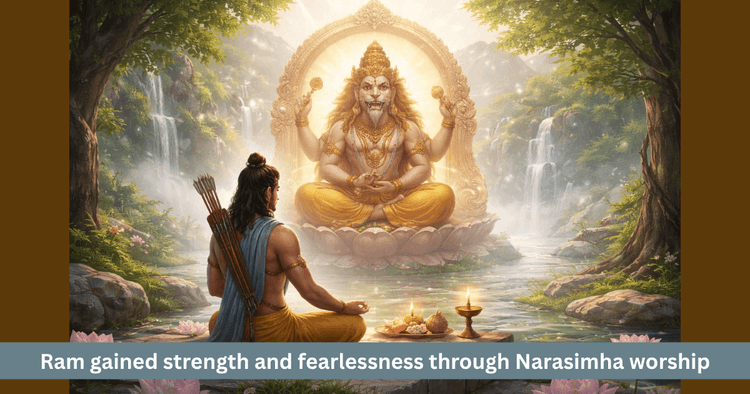
Table of Contents
The connection between Lord Rama and Lord Narasimha is not usually presented in a direct way in common devotional understanding. Rama is generally seen as the embodiment of maryada, righteous restraint, dharmic conduct and noble order, while Narasimha is remembered as the fierce divine protector who intervenes immediately when adharma becomes unbearable. Yet in certain regional traditions, local Ramayana memories and sacred folk narratives, there appears a deeply meaningful episode that brings these two forms into a profound spiritual relationship.
According to this tradition, during the period of exile, when Rama was passing through some of the most difficult trials of his life and the great war against Ravana was drawing near, He is said to have worshipped Lord Narasimha at the famous sacred site of Ahobilam in Andhra Pradesh. This is not merely the story of one form of the Divine worshipping another. Its deeper meaning is that before a decisive victory, even an avatara turns toward spiritual discipline in order to awaken the exact inner force required for the coming struggle.
Why is this episode considered so important
This narrative is not only about pilgrimage or devotional reverence. It teaches that even the highest dharmic warrior does not rely solely on outer preparation. Before confronting a great battle, one must also gather inner strength, steady the mind and align the heart with divine purpose. This is what makes the episode so profound.
Rama turning toward Narasimha worship suggests that dharma yuddha, righteous conflict, is never only an external contest. It also demands inner steadiness, spiritual courage, clear direction and divine support. For this reason, the story becomes much more than a local tradition. It becomes a teaching on how victory is prepared inwardly before it is expressed outwardly.
A few important points help explain its significance:
- The episode shows that inner practice is essential for the establishment of dharma
- Victory is not gained only through outer strength but also through inner balance
- Rama’s worship teaches that even the greatest beings seek divine force in decisive moments
- The worship of Narasimha here becomes the awakening of protective force, fearlessness and dharmic strength
What does the choice of Ahobilam itself signify
Ahobilam is regarded as the sacred place where Lord Narasimha destroyed Hiranyakashipu. In the devotional traditions of South India, this site is not seen as a mere temple location. It is understood as a region still charged with Narasimha’s divine presence. Many forms of the Lord are worshipped there, known collectively as the Nava Narasimha, the nine forms of Narasimha. Because of this, Ahobilam is seen not only as a place of darshana, sacred vision but also as a field of protection, intensity and divine energy.
If Rama is said to have come there before the battle with Ravana, then the meaning becomes highly symbolic. He chose a sacred place associated with decisive triumph of dharma, destruction of evil and divine protection. This suggests that before the coming war, Rama invoked that exact form of force which does not hesitate before injustice.
The importance of Ahobilam may be understood in the following way:
| Aspect | Outer meaning | Deeper indication |
|---|---|---|
| Ahobilam | Sacred Narasimha site | Land of dharmic victory |
| Nava Narasimha | Many worshipped forms | Multiple dimensions of divine force |
| Rama’s arrival | Pilgrimage | Inner preparation before war |
| Worship of Narasimha | Devotion | Awakening of protective spiritual force |
Why is it said that Rama chose the worship of Narasimha
This is a very important question. Rama Himself is understood as an avatara of Vishnu, so if He turns toward Narasimha, the story becomes even deeper. One spiritual meaning is that different forms of the same Divine represent different modes of sacred force. Rama embodies maryada, patience, nobility and ideal kingship. Narasimha embodies immediate protection, fierce destruction of injustice and fearless dharmic intervention.
The battle with Ravana was not merely a conflict with one king. It was a decisive confrontation with arrogance, injustice, misuse of power and insult to dharma. In such a situation, the worship of Narasimha can be understood as the awakening of that divine energy within which stands without hesitation against deeply established evil.
This choice suggests the following:
- Rama prepared Himself inwardly for the coming war through protective force
- Narasimha worship becomes remembrance of immediate and unwavering dharmic power
- It shows that maryada and shakti, divine force, are not opposites but complements
- Before victory, mind, will and spiritual force must become one
How do regional Ramayana traditions keep this episode alive
This episode does not appear in exactly the same way in every mainstream retelling of the Ramayana. Yet it survives in regional Ramayana traditions, local devotional narratives and sacred folk memory in South India. This itself is significant. Folk tradition often preserves emotional and symbolic dimensions that formal texts may mention only briefly or not at all. There, the story is not merely written. It is lived, remembered and linked with sacred geography.
This means the episode is not merely literary. It survives as a form of living sacred memory. Such folk preservation also teaches that religious truth is not confined to scriptural text alone. It also survives in landscape, temple tradition, local devotion and collective remembrance.
What does the idea of spiritual preparation before victory teach us
This is one of the greatest teachings of the narrative. Whenever a person stands before a major challenge, responsibility, struggle or turning point, the first instinct is usually to prepare outwardly. One gathers resources, makes plans, seeks support and studies the situation. All of this is necessary but not complete. If there is fear, confusion or fragmentation within, then even the best external preparation may fail at the decisive moment.
The episode of Rama’s worship of Narasimha teaches that inner discipline is equally necessary. Before battle one must awaken the force within, steady the consciousness and purify the intention. Only then does outer victory become meaningful and sustainable.
This may be understood as the following life teaching:
- Before a great challenge, one must gather inner strength
- External preparation remains incomplete without inner firmness
- Spiritual discipline keeps a person steady in decisive moments
- Divine refuge deepens self confidence
How can the relation between Narasimha worship and inner power be understood
The form of Narasimha is not limited only to the destruction of outer enemies. He is also understood as the divine force that cuts through fear, confusion, hesitation and hidden weakness within. therefore if Rama worshipped Narasimha, it may also be understood as the awakening of that inner power which leaves no place for doubt or collapse when dharma must be defended.
Inner strength does not mean mere enthusiasm. It includes:
- Patience before danger
- Clarity amidst adversity
- Decision making amidst fear
- Firmness in justice
- Proper use of energy in the right direction
For this reason, Narasimha worship may be seen not only as devotion but also as a discipline that strengthens consciousness.
Why is success never gained by external means alone
This narrative makes it clear that success is never only the product of outward means. If that were so, wars would be decided only by skill and strategy. But spiritual tradition and lived history both show that in decisive moments the mind, resolve, faith and moral foundation of a person matter just as much.
The life of Rama is itself proof of this. He was not merely a warrior with a bow. He was the representative of dharmic consciousness. Therefore the basis of His victory was not only martial excellence but also inner purity, maryada and divine surrender. The worship of Narasimha brings this inner dimension into even sharper focus.
How does this story remain relevant in life today
Today most people are not facing a war like Ravana’s battlefield, yet they face many kinds of struggle. Some face relational conflict, some face pressure in work, some face mental unrest, some struggle with lack of confidence, some with fear of decision. In such a time, this story becomes deeply relevant.
It teaches that when a major challenge appears, planning alone is not enough. One must recognize and awaken inner strength. One must understand that victory does not begin outside. It begins within. When the mind is steady, the resolve is clear and the energy is directed correctly, one can face difficulty in a far more integrated way.
For present life, the story gives the following teachings:
- Prepare yourself inwardly before facing major difficulty
- Do not depend only on outer resources
- Treat mental steadiness and self confidence as forms of sadhana
- Awakening the right force is the foundation of right victory
When maryada and shakti come together
The most beautiful dimension of the relationship between Rama and Narasimha is that it brings maryada and shakti together. Rama teaches dharma, restraint, balance and ideal conduct. Narasimha teaches fearlessness, protection, swift justice and the force to stand against overwhelming evil. When these two principles unite, victory becomes not only possible but meaningful.
This is the deepest life teaching of the episode. Power without maryada can become destructive. Maryada without decisive force can become helpless. But when shakti and maryada unite, the victory of dharma becomes certain.
FAQs
Did Lord Rama really worship Narasimha at Ahobilam
This episode is found in regional traditions, local sacred memory and certain devotional retellings where it is remembered with deep reverence.
Why is Ahobilam considered important in this story
Ahobilam is regarded as the sacred field of Narasimha’s divine act and as a site of the Nava Narasimha forms, making it a place of protective spiritual force.
Why is Rama said to have worshipped Narasimha
It is understood that before the battle with Ravana, He invoked protective force, fearlessness and inner dharmic strength through Narasimha worship.
What is the greatest teaching of this story
It teaches that before any great struggle, inner spiritual preparation is as necessary as outer preparation.
What does the relationship between Rama and Narasimha symbolize
It symbolizes that when maryada and divine force come together, victory becomes not only certain but righteous and meaningful.
Get your accurate Kundali
Generate KundaliDid you like it?
Author

Pt. Suvrat Sharma (63)
Experience: 20
Consults About: Family Planning, Career
Clients In: Punjab, Haryana, Delhi
Share this article with friends and family
About ZODIAQ
ZODIAQ is an online Vedic Astrology platform. It connects clients seeking astrological advice to experienced astrologers with deep knowledge. Our users also generate kundali and perform kundali milan for free. ZODIAQ also offers services to the Astrologers. Astrologers utilize various offerings by ZODIAQ to serve their clients effectively.
If you are a User
Consult with experienced astrologers and seek their guidance. You can also order handwritten Janm Patrika report with life prediction prepared by experienced astrologers. Generate accurate Kundali, perform Kundali Matching and check horoscope and muhurat. Utilize our online library for all the necessary astrological and spiritual information.
If you are an Astrologer
Create accurate kundali for your clients and perform Kundali Matching for up to 5 people at a time. Write comprehensive Janm Patrika report for your clients with ZODIAQ. Check client details anytime by saving it in client directory. Become more productive by tracking how many clients you guide every day.
WELCOME TO
ZODIAQ
Right Decisions at the right time with ZODIAQ
