Yoga Narasimha: From Fierceness to Peace
By Pt. Amitabh Sharma
The Meditative Form of Divine Balance
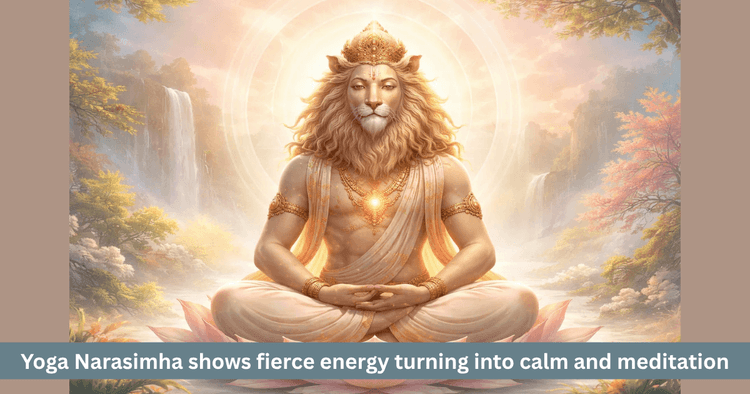
Table of Contents
Lord Narasimha is generally known in devotional tradition as a fierce and protective form of the Divine. Yet there is also a deeply peaceful, balanced and contemplative form of Narasimha known as Yoga Narasimha. In this form, He is not engaged in battle or in wrath. He is seated in deep meditative stillness. This image reveals that the same power that can destroy adharma can also remain fully restrained, inwardly absorbed and perfectly balanced.
The form of Yoga Narasimha is especially important because it does not allow the meaning of Narasimha to remain limited to ferocity alone. Here, the blazing force has become inwardly settled. The same energy that once moved outward in protection of dharma has now turned within and become centered in meditation. That is why Yoga Narasimha is not only an object of worship. It is also a profound life teaching that the highest destiny of power is peace.
Why is the form of Yoga Narasimha considered so special
The form of Yoga Narasimha shows that divine energy is complete not only in action but also in restraint. If power can only move outward and cannot become inwardly steady, it is not yet complete. Yoga Narasimha symbolizes that completeness. Here Narasimha is not in combat but in meditation. He is not in rage but in balance. He is not facing an outer enemy but established in inner stillness.
For this reason, this form is considered deeply inspiring for seekers. It teaches that the spiritual path is not complete merely by removing negativity. One must also calm the mind, regulate the breath, gather scattered energy and center consciousness within.
This uniqueness may be understood through the following points:
- It represents inner stillness after intensity
- It reveals the union of power and meditation
- It emphasizes inner victory more than outer victory
- It teaches self mastery to the practitioner
What does the posture of Yoga Narasimha reveal
The seated meditative posture of Yoga Narasimha speaks in a very subtle way. The body is still, the gaze is controlled, the energy is turned inward and the entire posture reflects a silence that is not dull but awake. This form teaches that meditation is not merely sitting still. It is the drawing inward of one’s scattered force.
When such stillness appears in the form of the deity, it shows the seeker that meditation is not weakness but one of the highest forms of strength. Many people recognize strength only in movement. Yoga Narasimha teaches that stillness too is a great form of power.
The posture of Yoga Narasimha offers the following indications:
| Aspect | Outer appearance | Deeper indication |
|---|---|---|
| Stable seat | Seated posture | End of inner scattering |
| Restrained gaze | Outward calmness | Complete inward awareness |
| Balanced energy | Withdrawal from action | Control of force |
| Meditative state | Silence | Centering of consciousness |
What importance is given to this form in Narasimha Purana
In the Narasimha Purana, Lord Narasimha is not limited only to the image of a fierce avatara. One also finds the possibility of understanding His wider dimensions. In that broader view, Yoga Narasimha becomes especially meaningful. It shows that divine force is not meant only for outer action. It also has an inward dimension where the same force transforms into practice, balance and higher awareness.
This perspective is profound because it teaches the devotee not to understand divine forms only at the level of story. Every form contains a contemplative indication. Yoga Narasimha is the name of that indication where the protecting force of the Divine comes to rest in the center of meditation.
Is Yoga Narasimha only a religious form
This is a very important question. If Yoga Narasimha is seen only as a special temple image or a ritual form of worship, then only half its meaning becomes visible. In reality, this form also points toward a way of living. It teaches that inward steadiness is essential if one wants to handle outer complexity properly.
Human life too often becomes like the fierce form of Narasimha. Circumstances create pressure, the mind becomes disturbed, anger rises, anxiety increases and inner peace begins to fade. At such times, the form of Yoga Narasimha teaches that the solution is not only in reaction. The solution also lies in returning to the inner center where the mind can regain balance.
When viewed in the context of life, this form gives the following teaching:
- Every intensity must eventually end in peace
- It is not enough only to struggle. One must also learn to become still
- Meditation gathers back scattered energy
- Inner steadiness gives rise to outer clarity
Why is this form important for anger, stress and mental restlessness
The form of Yoga Narasimha is especially meaningful for those who are passing through anger, stress, restlessness, mental pressure or inner agitation. This is because the form does not speak only at a theological level. It also carries a deep psychological teaching. It shows that the energy which now feels explosive can, if rightly directed, become a source of strength, patience and clarity.
Anger is itself a form of energy. Stress is also a disturbed form of energy. Mental restlessness is an expression of scattered consciousness. Yoga Narasimha does not teach suppression of these conditions. He teaches their transformation. That is the depth of this form. There is no weakness here, yet there is no violence either. There is silence but not passivity.
Can contemplation of Yoga Narasimha really calm the mind
Traditions hold that meditation on Yoga Narasimha can help calm the mind gradually. The deeper reason is that the mind slowly begins to absorb the qualities of the form upon which it meditates. If the object of contemplation is fear, the mind grows more disturbed. If it is anger, the mind may become more agitated. But if it is peaceful power, the mind slowly begins to move in that direction.
Yoga Narasimha is exactly such a form of peaceful power. Through contemplation of Him, the practitioner may begin to absorb the feeling that strength and peace are not opposites. The mind may gradually learn that it is possible to pause before reacting, to balance the breath and to return inward.
This meditative effect may be understood through the following indications:
- The movement of the mind may gradually slow down
- Reactive tendencies may begin to lessen
- Greater clarity may arise in thought
- A feeling of inner balance and safety may grow
How can the relation with physical effects such as high blood pressure be understood
Traditions also hold that contemplation of Yoga Narasimha may be beneficial in conditions such as high blood pressure. This should not be understood as a replacement for medical care but as a supportive spiritual discipline. When a person enters a meditative state, the breath often becomes more balanced, the intensity of mental turbulence may reduce and the internal movement of the body can begin to calm. For this reason, contemplative practices have often been associated with bodily balance as well.
The form of Yoga Narasimha becomes especially meaningful here because He embodies both strength and peace. When the practitioner meditates upon such a form, there may arise not only relaxation but also a kind of alert stillness. This state can be supportive for both mind and body.
Does every fierceness hold within it the possibility of peace
The form of Yoga Narasimha reveals this truth very clearly. Yes, within every fierceness there may exist the possibility of peace. Narasimha Himself is the divine example of this. The same force that destroyed adharma can also become established in meditation. This teaches that fierceness is not the final truth. If it is given right direction, it may become a path of spiritual practice.
The same applies to the human being. At times, intensity, agitation, anger or inner unrest may later become the basis of deep spiritual growth, if one learns how to understand them. The fire within does not always need to be crushed. Sometimes it needs to be transformed.
Why is Yoga Narasimha especially relevant today
Modern life has become intensely fast, busy and pressure filled. Human beings live under constant stress. The mind does not remain steady, attention is scattered, anger comes quickly, sleep is disturbed and a hidden exhaustion often remains within. In such a time, the message of Yoga Narasimha becomes deeply relevant.
This form teaches that no matter how intense outer conditions become, it is still possible to steady the mind. Strength does not mean merely enduring struggle. It also means returning inward and balancing oneself. This teaching is especially useful today because people now need inner stability even more than outer tools.
In the present context, Yoga Narasimha teaches us the following:
- Meditation is possible even amidst stress
- Awareness is possible even amidst anger
- Inner silence is possible even amidst speed
- The highest form of strength is self mastery
Where fierceness becomes radiant peace
The final message of Yoga Narasimha is that the fullness of power lies in peace. As long as power only moves outward, it may remain impressive. But when that same power turns inward and becomes balanced, it becomes divine. Yoga Narasimha is the form of that divinity. He teaches that outer victory is not the only greatness. Mastery over one’s own reactions, impulses and emotions is even greater.
That is why Yoga Narasimha is not merely a religious image. He points toward a way of life. He teaches that true strength is that which remains inwardly peaceful, mentally balanced and consciously steady. When such a condition arises, a person does not break under the complexity of life but moves forward with greater clarity and center.
Frequently Asked Questions
What does the form of Yoga Narasimha represent
It represents the transformation of fierce power into meditation and balance, where strength and peace appear together.
Is Yoga Narasimha mentioned in Narasimha Purana
Yes, in traditional understanding the broader contemplative and peaceful dimensions of Narasimha are associated with the Narasimha Purana.
Is this form considered helpful for mental stress
Yes, traditions hold that meditation on Yoga Narasimha may help calm the mind, bring clarity and support inner balance.
Is it also associated with physical well being
Because of meditation and balanced breathing, traditions sometimes associate this practice with support in conditions such as high blood pressure, though its primary purpose is spiritual balance.
What is the greatest teaching of Yoga Narasimha
The greatest teaching is that true strength is the power to remain inwardly balanced and to transform fierceness into peace.
Get your accurate Kundali
Generate KundaliDid you like it?
Author
Pt. Amitabh Sharma (56 Years)
Experience: 20
Consults About: Family Planning, Career
Clients In: Punjab, Haryana, Delhi
Share this article with friends and family
About ZODIAQ
ZODIAQ is an online Vedic Astrology platform. It connects clients seeking astrological advice to experienced astrologers with deep knowledge. Our users also generate kundali and perform kundali milan for free. ZODIAQ also offers services to the Astrologers. Astrologers utilize various offerings by ZODIAQ to serve their clients effectively.
If you are a User
Consult with experienced astrologers and seek their guidance. You can also order handwritten Janm Patrika report with life prediction prepared by experienced astrologers. Generate accurate Kundali, perform Kundali Matching and check horoscope and muhurat. Utilize our online library for all the necessary astrological and spiritual information.
If you are an Astrologer
Create accurate kundali for your clients and perform Kundali Matching for up to 5 people at a time. Write comprehensive Janm Patrika report for your clients with ZODIAQ. Check client details anytime by saving it in client directory. Become more productive by tracking how many clients you guide every day.
WELCOME TO
ZODIAQ
Right Decisions at the right time with ZODIAQ
