The Meeting of Ashwatthama and Parashurama: The Chiranjivi Tradition and a Timeless Dialogue
By Pt. Abhishek Sharma
The meeting of Ashwatthama and Parashurama reflects deep truths of dharma, karma, and time beyond mortality
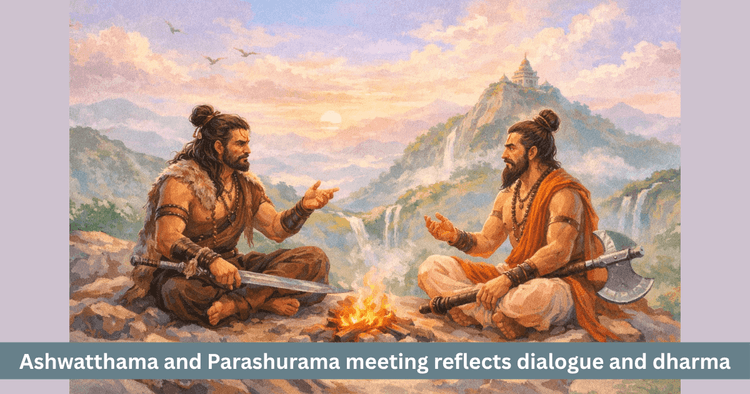
Table of Contents
In the sacred traditions of India, some figures are not seen merely as part of history. They are understood as living presences beyond ordinary time. Ashwatthama and Bhagavan Parashurama are two such extraordinary beings, both regarded in tradition as Chiranjivi, those who continue beyond the usual limits of age and decay. On this basis there exists a deeply meaningful belief that the two still meet from time to time upon Mahendragiri Mountain, where they reflect upon dharma, karma, history and the future movement of the world.
This story is not merely about the meeting of two immortal beings. It is the meeting of two very different life paths. On one side stands Ashwatthama, whose life is marked by war, rage, destruction and the long burden of sorrow and consequence. On the other stands Parashurama, whose life represents tapas, discipline, the protection of dharma and the controlled use of immense power. When tradition imagines these two seated together in dialogue, it is not creating wonder for its own sake. It is expressing a profound truth of life. When experience and wisdom, power and restraint, pain and inner correction meet in dialogue, then a deeper understanding of dharma begins to arise.
Why does the Chiranjivi tradition mean more than mere immortality
When a figure is called Chiranjivi, the ordinary mind first understands this in terms of bodily immortality. Yet in Indian thought, the meaning is much deeper. Some beings are considered beyond time in body, some in consciousness and some through the continuation of unfinished karma or enduring responsibility. Ashwatthama and Parashurama both belong to this tradition, though not in exactly the same way.
Parashurama’s Chiranjivi nature is connected with tapas, dharmic responsibility and his role as a bridge between ages. He is remembered as one whose task is not exhausted within a single era. Ashwatthama’s continued existence, however is more painful. For him, continuity is not celebration but a long unfolding of karma and suffering. This is what makes the imagined meeting of these two so rich in meaning. One is timeless through austerity and dharmic purpose. The other is timeless through the burden of his deeds. This difference raises the story beyond folklore and turns it into a meditation on life itself.
Why is Ashwatthama’s character considered so complex
In the Mahabharata, Ashwatthama is not a figure who can be understood in one color alone. He is not merely the son of Dronacharya. He is also a warrior in whom talent, anger, insecurity, filial loyalty, warrior identity and destructive reaction all exist together. He is not only a villain and he is not merely a victim. His life shows how power without restraint and a wounded mind can combine to push a person into actions whose consequences follow him for ages.
He received a form of immortality but not one of peace. It became a kind of living punishment. His character thus reveals that war does not end only on the battlefield. Its weight remains upon memory, mind and inner being. Ashwatthama becomes the representative of that burden. This is why his meeting with Parashurama in traditional imagination becomes so meaningful. For Parashurama is not merely a warrior. He is a master of disciplined power. In this sense, the meeting becomes not simply an outer encounter but also an opportunity for inner reflection.
What does Parashurama’s Chiranjivi nature symbolize
Bhagavan Parashurama is not remembered only through stories of anger or the destruction of tyrannical rulers. He is a being in whom Brahmin radiance and Kshatriya force exist together. He is both ascetic and warrior. He is both disciplinarian and teacher. He possesses not merely power but a moral basis for the use of power. That is why he is also remembered as the teacher of many great heroes and as a continuing symbol of vigilance in the defense of dharma.
Parashurama’s timelessness symbolizes the fact that the principle of protecting dharma does not come to an end. Ages change. Wars change. Rulers change. Moral crises take on new forms. Yet the questions of balance and justice remain. Parashurama represents that continuity. He embodies the awareness that repeatedly asks who holds power, how it is being used and whether the world remains in balance. therefore when tradition imagines him in conversation with Ashwatthama, it is envisioning a meeting between experience and discipline.
Why is Mahendragiri Mountain chosen as the place of this meeting
In traditional belief, this meeting is said to occur on Mahendragiri Mountain. This is not only a geographical choice but a symbolic one. Mountains in Indian thought are always associated with height, stability, tapas, detachment and a wide vision. From the mountain, the noise of the lower world becomes distant and meaning becomes clearer. Mahendragiri thus becomes more than a place. It becomes a sign of an inner state.
If the dialogue of Ashwatthama and Parashurama is imagined upon a high mountain, then the meaning is that this is no ordinary conversation. It is a reflection taking place at a raised level of consciousness. There is no battlefield smoke there, only the stillness of tapas. There is no immediate reaction there but far seeing thought. There is not merely discussion of the past but a drawing of lessons for what lies ahead. In this way Mahendragiri becomes the silent third participant in the story.
How is this meeting really a union of two experiences rather than two persons
The beauty of this episode lies in the fact that it places not only two famous names together but two entire modes of experience. It may be understood this way
• Ashwatthama represents pain, restlessness, karma and the burden of long consequence
• Parashurama represents tapas, discipline, vision of dharma and controlled power
• Ashwatthama’s life asks what happens when power is misused
• Parashurama’s life answers how power can protect the world when governed by dharma
This is why the meeting becomes a great philosophical dialogue within the imagination of tradition. One side comes carrying the fire of consequence. The other comes tempered by the fire of tapas. One side is broken by memory. The other is refined by discipline. Whatever dialogue is imagined between them is, in truth, a reflection on the most difficult questions of human life.
What does this meeting mean for Ashwatthama
The greatest tragedy of Ashwatthama’s life is not only that he committed terrible acts but that he had to continue living with their consequences. It should not be forgotten that punishment is not always death. Sometimes punishment is prolonged life, especially when that life is joined with memory, remorse and incompletion. Ashwatthama stands as the symbol of exactly such living suffering.
For such a being, meeting Parashurama does not mean merely receiving instruction. It also means seeing his life through a wider lens. Parashurama is a guru who has known anger, battle, punishment and also the restraint born of tapas. therefore for Ashwatthama he becomes not merely another Chiranjivi but a witness who understands both faces of power. One face rises for dharma. The other falls into destruction through impatience. In this sense, the presence of Parashurama appears almost like a form of inner healing for Ashwatthama.
What significance might Ashwatthama hold for Parashurama
If we look from the other side, Ashwatthama is not merely a suffering warrior for Parashurama. He is also a living example of what happens when martial power and divine weapons are severed from restraint and dharmic vision. For Parashurama, Ashwatthama can serve as a mirror revealing that the teaching of power cannot end with technique alone. It must be joined with moral discipline and inner maturity.
In this way, Parashurama appears in this story not only as a guide but also as a reflective presence. The beauty of traditional imagination lies in the fact that it does not keep characters static. It continues to understand them more deeply over time. Here Parashurama is not merely a punisher. He is a master shaped by long experience in dharma.
Does this story explain the relationship between karma and dharma
Yes and in a profound way. Ashwatthama’s life shows that karma does not vanish. It continues to accompany a being. Parashurama’s life shows that dharma is not passive stillness but alert, disciplined and responsible action. When these two perspectives meet, a deeper understanding emerges. A human being is not only the sufferer of his deeds. He can also become one who learns from them, if the right dialogue and right insight enter his life.
This may be understood through the following structure:
| Side | Indication |
|---|---|
| Ashwatthama | Karma, pain, memory and remorse |
| Parashurama | Discipline, dharma, balance and direction |
| Mahendragiri | Height, tapas and silent reflection |
| Meeting | The union of experience and wisdom |
This is the philosophical heart of the traditional story.
Why does this episode make dharma appear timeless
Many people understand dharma only as a set of scriptural rules. But in Indian thought, dharma is also a living understanding. It deepens with time, learns through circumstance and draws meaning from the lives of great beings. The timeless dialogue of Ashwatthama and Parashurama affirms exactly this. Dharma is not determined only on the battlefield. It also takes shape in the aftermath of war, in remorse, in austerity, in memory and in reflection.
Therefore the story suggests that Chiranjivi beings are not important merely because they continue to exist. They matter because they represent ongoing learning. They witness ages, watch changes unfold and remind humanity that dharma is not exhausted by one event but is understood through long experience.
What message does this story hold for present life
This story remains deeply relevant even now. Human beings still desire power, achievement and victory, yet often fail to take equal responsibility for the moral consequences that accompany them. Ashwatthama teaches that the misuse of power can wound a person inwardly for a very long time. Parashurama teaches that power can be used rightly only when joined with discipline, restraint and dharmic awareness.
Several enduring lessons come from this episode
- Every power carries consequence
- Karma does not disappear merely because time has passed
- Even pain can be transformed into wisdom under proper guidance
- Height of vision comes not only from experience but from reflection
- Dharma means not only right action but right understanding
Where two Chiranjivis become a timeless teaching
Ultimately it may be said that the meeting of Ashwatthama and Parashurama is not merely a piece of folklore. It is a beautiful philosophical structure within Indian thought. It contains pain, tapas, memory, direction and above all dialogue. It teaches that human growth does not come only through victory. It also comes through wounds, mistakes, reflection and the right company. The timeless meeting of Ashwatthama and Parashurama stands as the symbol of this deep truth.
This is the enduring message of the episode. When experience meets wisdom and pain becomes joined with vision of dharma, learning can continue even beyond ordinary time. That is the true meaning of the Chiranjivi tradition. Some dialogues never end. They continue maturing the human being across ages.
FAQs
Why are Ashwatthama and Parashurama regarded as Chiranjivi
Both are understood in Indian tradition as beings who continue beyond ordinary time and remain connected with the reflection upon dharma.
What is the importance of Mahendragiri Mountain in this story
It symbolizes tapas, stability, elevated vision and deep reflection, making it a meaningful place for such a meeting.
What does the meeting of Ashwatthama and Parashurama signify
It signifies a dialogue between pain and wisdom, karma and discipline, experience and the vision of dharma.
Is this story mainly a traditional belief
Yes. It lives mainly in sacred and folk traditions, yet its philosophical meaning is very deep.
What is the main teaching of this story
It teaches that experience, power and suffering require the guidance of wisdom and dharmic understanding in order to be transformed.
Get your accurate Kundali
Generate KundaliDid you like it?
Author

Pt. Abhishek Sharma (63)
Experience: 20
Consults About: Family Planning, Career
Clients In: Punjab, Haryana, Delhi
Share this article with friends and family
About ZODIAQ
ZODIAQ is an online Vedic Astrology platform. It connects clients seeking astrological advice to experienced astrologers with deep knowledge. Our users also generate kundali and perform kundali milan for free. ZODIAQ also offers services to the Astrologers. Astrologers utilize various offerings by ZODIAQ to serve their clients effectively.
If you are a User
Consult with experienced astrologers and seek their guidance. You can also order handwritten Janm Patrika report with life prediction prepared by experienced astrologers. Generate accurate Kundali, perform Kundali Matching and check horoscope and muhurat. Utilize our online library for all the necessary astrological and spiritual information.
If you are an Astrologer
Create accurate kundali for your clients and perform Kundali Matching for up to 5 people at a time. Write comprehensive Janm Patrika report for your clients with ZODIAQ. Check client details anytime by saving it in client directory. Become more productive by tracking how many clients you guide every day.
WELCOME TO
ZODIAQ
Right Decisions at the right time with ZODIAQ
