Parashurama as Originator of Kalaripayattu: Martial Art and Spiritual Discipline
By Pt. Nilesh Sharma
The divine origin of an ancient tradition balancing body mind and energy
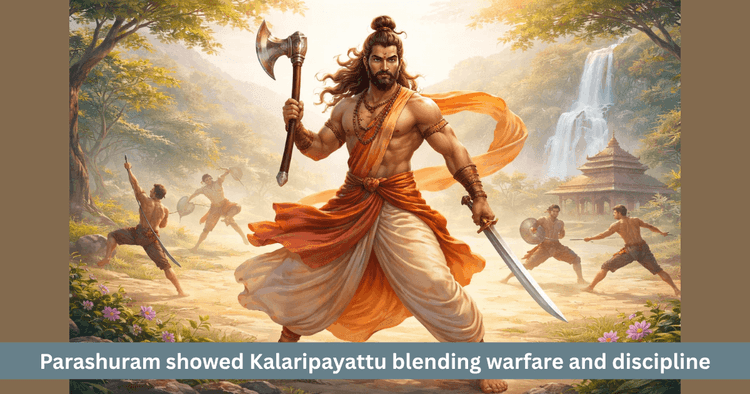
Table of Contents
In the sacred traditions of India, Bhagavan Parashurama is not remembered only as a warrior or a protector of dharma. He is also seen as a guardian of knowledge, discipline and living tradition. Among the many beliefs associated with his life, one especially significant tradition holds that the ancient South Indian martial discipline known as Kalaripayattu was established by him. This belief is deeply rooted in the cultural memory and sacred narratives of Kerala.
Kalaripayattu cannot be understood merely as a martial art. To describe it only in that way would reduce its depth. It is a complete path of body, mind, breath, balance, awareness and inner discipline. It includes not only methods of combat but also forms of meditation, flexibility training, inner energy awakening and disciplined movement. That is why it is regarded as one of the oldest and most integrated martial traditions of India. When this tradition is linked with Parashurama, the connection becomes meaningful not merely at the level of valor but also at the level of a philosophy in which power is governed by restraint, balance and dharma.
How is Parashurama connected with the tradition of Kerala
In regional sacred memory and South Indian lore, it is widely believed that Parashurama reclaimed land from the sea and established Kerala. Whatever outer form one gives to this story, its cultural meaning is profound. It suggests that Parashurama is remembered as one of the foundational sacred figures associated with the shaping of that land. When a land is established not only geographically but also culturally, it becomes linked with ways of living, protection, education and ethical order. It is within this larger context that the origin of Kalaripayattu is connected to Parashurama.
This belief says that Parashurama did not merely establish land. He also laid the foundations of traditions that would make life on that land secure, disciplined and dharmic. Among those was a system of martial training that was not based only on physical strength but also on the inner preparation of the practitioner. That system is believed to have developed into what is now known as Kalaripayattu.
Why can Kalaripayattu not be called merely a martial technique
The true nature of Kalaripayattu is much broader. It gives deep attention to flexibility, reaction speed, balance, bodily awareness, combat posture, control of breath and mental alertness. This is not the result of casual training. It demands patience, regular discipline and devotion to the teacher. For this reason, it may be understood not merely as a martial method but as a complete discipline of cultivation.
In this tradition, the body is not trained only as an instrument of force. It is refined into a conscious medium. The goal is not simply to defeat an opponent but also to gain mastery over one’s speed, fear, imbalance and inward restlessness. When viewed in this light, the connection between Kalaripayattu and Parashurama appears deeply natural, because Parashurama himself represents not only outer battle but also self mastery and dharmic strength.
How do battle and sadhana come together in the personality of Parashurama
The life of Bhagavan Parashurama is one of the clearest examples of how strength and sadhana are not opposites. He was born in a Brahmin lineage, yet within him blazed extraordinary Kshatriya radiance. He took up arms against injustice but he also upheld austerity, sacred discipline, guru devotion and inner restraint. This unusual fullness is what makes him so distinctive.
If a martial tradition is linked to Parashurama, it does not mean that the tradition is one of destruction alone. It means the opposite. It means that the martial path is associated with one who knew when power must be used, how much must be used and for what purpose it must be used. This may also be seen as the inner philosophy of Kalaripayattu. It contains skill but skill joined with restraint. It contains force but force guided by wisdom.
What does the inner structure of Kalaripayattu reveal
In Kalaripayattu, the practitioner is trained in a gradual and disciplined way. Movement, balance, breath, bodily control, weapon practice and knowledge of vital points are all developed step by step. Such training is not an achievement of a single day. It demands endurance, regularity and commitment. These are the very qualities that also appear clearly in the life and tapasya of Parashurama.
Some of the principal dimensions of this tradition may be understood as follows:
- Physical flexibility is cultivated not merely for combat but for making the body fully responsive
- Mental concentration is trained so that action arises from awareness rather than impulse
- Guru disciple discipline keeps power within the bounds of dignity and restraint
- Energy regulation helps the practitioner remain inwardly balanced
- Dharmic protection ensures that the art serves defense rather than oppression
These points show clearly that at the heart of Kalaripayattu lies not mere aggression but a complete philosophy of life.
Why is the guru disciple tradition so important here
In Kalaripayattu, the place of the guru is considered extremely high. The guru does not merely transmit technique. He trains the disciple’s body but even more importantly, he disciplines the mind and character. He teaches when martial force is justified, when it is not, when restraint is necessary and when one must rise to protect. This is not simply technical teaching. It is the formation of character.
This again strongly echoes the life of Parashurama. In many traditions he appears as a guru figure. He does not merely create warriors. He shapes disciples who understand dharma, restraint, duty and honor. Seen from this perspective, the guru centered nature of Kalaripayattu stands in deep harmony with the teaching tradition associated with Parashurama.
Does this tradition also include spiritual discipline
Yes, and this is one of its deepest features. As the practitioner trains the body, he gradually comes to understand that body and mind are not separate. If the mind is disturbed, movement loses balance. If breath breaks, both defense and attack suffer. If fear remains within, outward skill weakens. For that reason, the art also teaches inward steadiness.
To connect this spiritual dimension of martial discipline with Parashurama is profoundly meaningful. His life too teaches that outer force is incomplete unless it is joined with inner peace and awareness. That is why Kalaripayattu may be seen not only as a tradition of weapons but also as a tradition of living discipline.
What is the deeper meaning of calling Parashurama its originator
To call Parashurama the originator of Kalaripayattu does not merely mean that he created a certain method of combat. Its deeper meaning is that the soul of this martial path is believed to arise from a philosophy in which strength and restraint, valor and humility, skill and dharma, body and inner realization move together. This tradition does not teach that one should become powerful in order to dominate others. It teaches that one should become powerful in order to gain mastery over oneself and to protect what is right when needed.
This perspective is crucial because it separates martial discipline from violence. Violence is born from impulse, while the highest form of martial discipline arises from controlled strength. The name of Parashurama symbolizes that controlled force. Thus the belief is important not only historically but also philosophically.
Why does this belief remain alive even today
In Kerala and in related South Indian cultural traditions, the belief that Kalaripayattu is rooted in Parashurama remains alive even now. Behind it lies not only devotion but also cultural continuity. When a tradition survives through the guru disciple lineage across generations, it does not endure by technique alone. It endures because it contains a deeper living spirit. The spirit of Kalaripayattu is still seen in discipline, reverence, training and inward balance.
Even in the present age, those who study this art do not gain only bodily capability. They also cultivate a certain self trust, inner steadiness and self discipline. The tradition still teaches that it is not enough to make the body strong. It must also be made aware, controlled and dharmically aligned.
Where martial discipline becomes a philosophy of life
Ultimately it may be said that if Kalaripayattu is linked with Bhagavan Parashurama, it should not be seen merely as an ancient claim. It is a profound cultural and spiritual indication. It suggests that India’s ancient martial traditions were not only systems of attack. They were also philosophies of life based upon self restraint, guru lineage, body discipline, protection of dharma and inner balance.
This is the enduring message of the episode. A true warrior is not merely one who knows how to defeat others. A true warrior is one who has learned how to master fear, impulse and imbalance within. If Kalaripayattu is believed to be rooted in Parashurama, then it affirms precisely that ideal, where strength, discipline and self awareness are joined within a single path of practice.
FAQs
Is Kalaripayattu connected with Parashurama
Yes. In the sacred and cultural traditions of Kerala, Kalaripayattu is widely believed to have been established by Bhagavan Parashurama.
Why is Kalaripayattu not seen merely as a martial art
Because it includes not only bodily training but also discipline of mind, breath, balance, meditation and the guru disciple tradition.
How is Parashurama understood in relation to this tradition
He is remembered as the foundational inspirer of a martial system in which strength is joined with dharma and restraint.
Does Kalaripayattu contain a spiritual dimension
Yes. It gives importance to inner energy, concentration, discipline and self mastery along with martial skill.
What is the main message of this tradition
It teaches that true strength is meaningful only when joined with discipline, balance and self realization.
Get your accurate Kundali
Generate KundaliDid you like it?
Author
Pt. Nilesh Sharma (63)
Experience: 20
Consults About: Family Planning, Career
Clients In: Punjab, Haryana, Delhi
Share this article with friends and family
About ZODIAQ
ZODIAQ is an online Vedic Astrology platform. It connects clients seeking astrological advice to experienced astrologers with deep knowledge. Our users also generate kundali and perform kundali milan for free. ZODIAQ also offers services to the Astrologers. Astrologers utilize various offerings by ZODIAQ to serve their clients effectively.
If you are a User
Consult with experienced astrologers and seek their guidance. You can also order handwritten Janm Patrika report with life prediction prepared by experienced astrologers. Generate accurate Kundali, perform Kundali Matching and check horoscope and muhurat. Utilize our online library for all the necessary astrological and spiritual information.
If you are an Astrologer
Create accurate kundali for your clients and perform Kundali Matching for up to 5 people at a time. Write comprehensive Janm Patrika report for your clients with ZODIAQ. Check client details anytime by saving it in client directory. Become more productive by tracking how many clients you guide every day.
WELCOME TO
ZODIAQ
Right Decisions at the right time with ZODIAQ
