The Curse of Parashurama on Karna: Truth, Concealment, and Fate in Mahabharata
By Pt. Sanjeev Sharma
How Karna’s hidden identity led to Parashurama’s curse and changed the course of his destiny forever
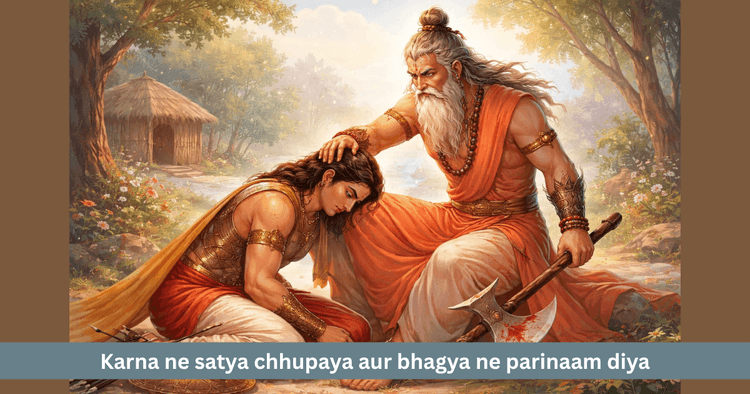
Table of Contents
Among the characters of the Mahabharata, Karna stands as one of the most deeply moving, complex and tragic figures. He was born with greatness, endowed with extraordinary ability and driven by an intense desire to prove his worth. Yet his life moved through such painful contradictions that almost every achievement carried suffering within it. One of the most decisive episodes in his life is the curse he received from Bhagavan Parashurama, a curse that altered not only his present but the direction of his destiny itself. This is not merely a story of a curse. It is a story about truth, trust, concealment, talent and fate, all intertwined in a single turning point.
Karna’s deepest longing was not simply to become a warrior. He wanted to become such a master of archery that his greatness could never be denied and that his worth would be recognized not by birth or social identity but by effort and ability. Yet in that age, access to certain forms of divine knowledge was restricted. A teacher like Parashurama imparted celestial weapon knowledge only to Brahmins. Karna was born a Kshatriya, though he had been raised as a charioteer’s son and this contradiction became one of the greatest sorrows of his life. Therefore he concealed his true identity, presented himself as a Brahmin and approached Parashurama for discipleship. At this very point, the rise of his brilliance and the tragedy of his destiny begin together.
Why did Karna hide his identity
Without understanding Karna’s decision, the deeper meaning of the curse cannot be understood. He did not hide his identity because he wished to harm anyone, nor because he found joy in deceit. He chose this path because the doors of knowledge were closed to him. He believed that if he spoke the truth, his inner warrior would be denied before he could even begin to grow. This was not merely an issue of ambition. It also reflected a social condition in which talent was measured through birth and status.
This is where Karna becomes deeply tragic. He possessed an honest hunger to learn. He wanted to make his place in the world through merit. He did not want the fire within him to remain buried. Yet the path he chose moved away from truth. That is the deepest sorrow of the story. His goal was noble but his method was flawed. The Mahabharata repeatedly teaches that a pure goal alone is not enough. The path must also be pure. Karna becomes one of the most painful examples of this principle.
The root of this episode may be understood briefly like this:
- Karna possessed extraordinary martial talent
- He longed to learn divine weapons from Parashurama
- He believed he would be rejected if he spoke the truth
- Therefore he assumed the identity of a Brahmin
- That very decision later became the decisive flaw of his life
How did trust grow between guru and disciple
When Karna came to Parashurama, he did not gain entry through falsehood alone. He also won his guru’s trust through service, discipline and exceptional effort. Parashurama was not a teacher who would be satisfied by words alone. He looked into the worthiness of the student. Through relentless dedication, humility and the power of his learning capacity, Karna quickly proved that he was no ordinary disciple.
Parashurama recognized his brilliance. He taught him many divine weapons and subtle forms of martial knowledge. Karna did not receive this learning merely by listening. He absorbed it through deep effort and inner discipline. Over time, a profound bond of trust formed between guru and disciple. This is why what happens later becomes so intense. Had the relationship remained merely formal, the anger would have been limited to the breaking of a rule. But here, trust was broken. And the breaking of trust cuts much deeper.
The moment when pain revealed the hidden truth
One day Parashurama lay down to rest with his head in Karna’s lap. That image itself shows the depth of the guru’s trust in his disciple. But at that very peaceful moment fate brought its turning point. A poisonous insect burrowed into Karna’s thigh and began to bite with terrible force. The pain was so intense that any ordinary person would have moved at once, cried out or at least reacted. But Karna remained still. Blood began to flow, yet he would not disturb the sleep of his guru.
Here Karna’s nature appears in one of its most radiant forms. His endurance, guru devotion and self control are astonishing. He did not merely bear the pain. He held it within himself. The moment is deeply inspiring, yet profoundly ironic, because the very endurance that reveals his greatness also reveals the hidden truth. When Parashurama awoke and saw the blood flowing from Karna’s thigh, he was startled. He immediately understood that such unimaginable endurance could not belong to an ordinary Brahmin. It was the mark of a Kshatriya.
Why did Parashurama become angry
It is important to understand that Parashurama’s anger did not arise merely because Karna was a Kshatriya. His anger arose because he realized that the disciple had hidden the truth, broken his trust and gained access to sacred knowledge through deception. In the guru disciple relationship, the foundation is not only teaching. The foundation is trust. If a guru discovers that the disciple entered through untruth, then the wound is deeper than a breach of rule. It is a breach of relationship.
From Parashurama’s point of view, this was not merely a lie spoken by a student. It was a violation of the discipline and order he upheld. Therefore his anger was sharp. It must also be remembered that Parashurama himself was a being of fierce discipline and truth centered austerity. In his life there was little place for deception. Karna’s intention may have been to gain knowledge but his means were rooted in concealment. That is why the curse came forth.
What was the curse and what did it mean
Parashurama cursed Karna that the divine knowledge he had gained through concealment would fail him at the most crucial moment. This was not merely a spoken sentence. It cast a shadow across the whole arc of Karna’s warrior life. For Karna, divine weapon knowledge was not merely skill. It was his identity, his pride and his inner assurance. If that very knowledge were to abandon him at the decisive moment, then it meant not merely losing a battle but seeing the fruit of a lifetime of striving collapse when it was needed most.
The deeper structure of the curse may be understood through the following:
| Element | Meaning |
|---|---|
| Knowledge gained through concealment | An incomplete moral foundation |
| Broken trust of the guru | Inner rupture in the relationship |
| Forgetfulness at the decisive moment | The severest test of fate |
| Curse | Not only punishment but a moral consequence |
This is what raises the episode beyond a mere mythic event and turns it into a principle of life.
Was Karna only guilty
One must be careful here. It is very easy to simply call Karna guilty but that would be incomplete. Karna possessed talent, discipline, devotion and service. He worked hard to transform the fire within him into mastery. He served his guru with sincerity. Even in the moment of insect pain, he endured agony for the sake of his guru’s rest. All this reveals his noble character.
Yet this is precisely where the Mahabharata becomes so moving. A great person may still make one decisive choice that follows him throughout life. Karna is guilty but he is also deeply tragic. He deceives, yet his deception is not born of low selfishness but of the desperation to gain the opportunity he believed would otherwise never be given to him. That is why this episode demands not only moral judgment but also compassion.
How did the curse become real in Kurukshetra
This episode does not remain in the past. Its consequence appears in the war of Kurukshetra. When Karna stands before Arjuna in the most crucial battle of his life, the full remembrance of his celestial weapon knowledge becomes essential. Yet at that decisive moment, fate turns against him. The curse of Parashurama comes alive there. He cannot summon the knowledge with the perfection he requires.
Here the story gains yet another dimension. Decisions do not remain confined to the moment in which they are made. They move silently through time and return at points where a person least wants to confront them. Karna’s one decision becomes his greatest weakness in the final battle of his life. This is the tragedy of the story and this is also its moral force.
What is the deepest message of this episode
The story of Karna and Parashurama compels thought at many levels. It does not merely say that lying is wrong. It says something more subtle. It teaches that even a small compromise with truth can become unbearably heavy at the most important moment of life. It also teaches that talent alone is not enough. The right path matters equally. And at the same time, it asks us to understand a person not only by his fault but also by his suffering, his social limitations and the pain of his circumstances.
Several deep lessons emerge from this episode:
- Talent may be extraordinary but falsehood cannot become its true foundation
- The center of the guru disciple bond is trust more than knowledge
- Even a noble intention can be damaged by a flawed path
- Life decisions return in unexpected ways in the future
- Karna can be understood only through both compassion and moral seriousness
Where hidden truth became the decisive turn of fate
Ultimately it may be said that the curse given by Parashurama to Karna was not merely a punishment. It was the result of a deep irony in Karna’s life, where a man of extraordinary brilliance had to take shelter in concealment to open the path to his own greatness and that very concealment later became the heaviest point in his destiny. In this one story there is the anger of the guru, the brilliance of the disciple, the price of concealment and the mercilessness of fate. But there is also a deep current of compassion, because Karna’s flaw does not make him small. It makes him even more human.
This is the enduring message of the episode. Truth is not merely a moral ornament. It is also the inner strength that remains with a person in the hardest hour. Once that truth is fractured, the result may come late but it does come. Karna’s story continues to live as a memory of this profound and painful truth.
FAQs
What did Karna do to receive education from Parashurama
He hid his real identity and presented himself as a Brahmin in order to become Parashurama’s disciple.
How did Parashurama discover Karna’s true identity
When an insect bit deeply into Karna’s thigh and he endured the pain without moving, Parashurama realized that such endurance belonged to a Kshatriya.
What curse did Parashurama give Karna
He cursed him that at the most decisive moment, he would fail to remember and use the divine knowledge he had gained.
Was Karna’s intention evil
His intention was to become a great archer but he compromised with truth to do so and that became his tragedy.
What is the main teaching of this story
That truth and trust are the real foundations of all great achievement and compromise with them can become devastating at the crucial hour.
Get your accurate Kundali
Generate KundaliDid you like it?
Author

Pt. Sanjeev Sharma (63)
Experience: 20
Consults About: Family Planning, Career
Clients In: Punjab, Haryana, Delhi
Share this article with friends and family
About ZODIAQ
ZODIAQ is an online Vedic Astrology platform. It connects clients seeking astrological advice to experienced astrologers with deep knowledge. Our users also generate kundali and perform kundali milan for free. ZODIAQ also offers services to the Astrologers. Astrologers utilize various offerings by ZODIAQ to serve their clients effectively.
If you are a User
Consult with experienced astrologers and seek their guidance. You can also order handwritten Janm Patrika report with life prediction prepared by experienced astrologers. Generate accurate Kundali, perform Kundali Matching and check horoscope and muhurat. Utilize our online library for all the necessary astrological and spiritual information.
If you are an Astrologer
Create accurate kundali for your clients and perform Kundali Matching for up to 5 people at a time. Write comprehensive Janm Patrika report for your clients with ZODIAQ. Check client details anytime by saving it in client directory. Become more productive by tracking how many clients you guide every day.
WELCOME TO
ZODIAQ
Right Decisions at the right time with ZODIAQ
