Mystery of Mahendragiri Mountain: Where Parashurama’s Tapasya Is Still Believed to Live
By Aparna Patni
A sacred site reflecting austerity detachment and the living Chiranjivi tradition
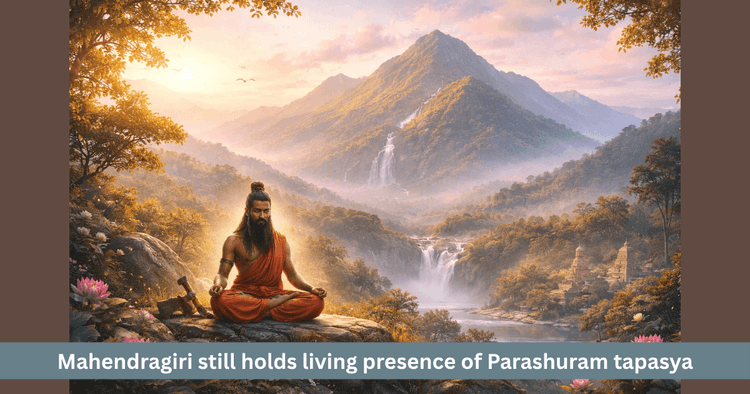
Table of Contents
In the sacred traditions of India, some places are not understood merely as geographical locations. They are regarded as living centers of spiritual memory, subtle presence and continuing sacred power. Mahendragiri Mountain in Odisha is one such mysterious and revered place. It is known as a site of Parashurama’s tapasya, and for that reason its importance is not limited to pilgrimage alone. It is seen as a symbol of austerity, detachment, the refinement of strength and the continuing current of the Chiranjivi tradition.
When the name of Mahendragiri is heard, the mind does not form only the image of a mountain. It evokes the feeling of a sacred field of discipline where outer stillness and inwardly awakened force are experienced together. In living tradition there is a deep belief that Bhagavan Parashurama remains present there even now in a subtle form. This belief is not merely about wonder or the search for marvels. Its deeper meaning is that the consciousness of certain great ascetics becomes so deeply connected with a place that the place itself begins to carry their tapas. The association of Mahendragiri with Parashurama expresses this enduring spiritual presence.
Why is the name of Mahendragiri considered so special
Mahendragiri is remembered in ancient Indian texts, epic traditions and regional devotional memory. For that reason its significance does not rest only on religious emotion. It also becomes part of the larger civilizational memory of India. The mountain is situated amidst the beauty of nature, yet its real importance is not merely scenic. Its true significance lies in the spiritual force believed to be connected with the tapasya of Parashurama.
Many seekers and devotees who visit this region describe the atmosphere as different from ordinary mountain spaces. There is not only natural beauty but also a sense of deep quiet, gravity and inner stillness. Such experiences are not always easy to express through outward language. That is why Mahendragiri is not regarded merely as a place to see. It is understood as a field to be inwardly experienced.
Is Parashurama truly believed to be doing tapas there even now
According to traditional belief, Bhagavan Parashurama remains present on Mahendragiri in a subtle form. This is best understood spiritually rather than literally. A subtle form does not mean that he is ordinarily visible in physical appearance. It means that his tapasya, his sacred force and his spiritual influence are believed to remain present there even today.
In Indian tradition, the idea of Chiranjivi beings is closely connected with this kind of understanding. Such great beings are not considered limited to one historical age. They remain, in some sense, continuing carriers of dharmic consciousness across time. The name of Parashurama is counted among such rare beings. therefore the belief that he continues his tapasya at Mahendragiri suggests that his existence belongs not only to the past but is also spiritually active in the present.
Why does tapasya hold such an important place in the life of Parashurama
Many people remember Parashurama only in connection with battle, the axe and the punishment of adharma. Yet his life is equally a story of discipline, austerity and inner mastery. He was not only the destroyer of unrighteousness. He was also a great ascetic who eventually turned his immense energy toward self contemplation and detachment.
Several episodes in his life suggest that he did not merely fight outer battles. He also undertook the work of refining his own inner force. That is why it is deeply meaningful that Mahendragiri is regarded as his tapasya sthala. A being who wielded tremendous force, gave punishment and defended dharma also had to bring that same energy into peace. Mahendragiri thus becomes a symbol of this inward transformation.
Is the final destination of strength peace
This is perhaps the most beautiful and profound message of the entire story. Every form of true strength must ultimately return to peace. The life of Parashurama expresses this principle powerfully. He possessed great force, martial mastery and fierce dedication to dharma but the deepest fulfillment of his life does not lie only in outward victory. It appears most clearly when that same intensity is transformed into tapas, detachment and silent inward absorption.
That is why the mystery of Mahendragiri is not merely that Parashurama is remembered there. Its deeper meaning is that strength raised for dharma must eventually become self purification and inner balance. If force remains only outwardly active and never returns inward, it never becomes complete. The tapasya of Parashurama teaches precisely this, that after outer action there still remains a profound inner journey.
How should Mahendragiri be understood as a field of sadhana
Mahendragiri should not be understood merely as a pilgrimage point. It is better understood as a sacred field of sadhana. Such a place is not simply where ascetics once sat in penance. It is a place where the mind naturally slows, where inwardness begins to awaken and where the noise of outer life seems to recede before a subtler silence.
The traditions associated with this mountain suggest that certain places gather a form of energetic memory within themselves. They continue to hold the tapasya of those who once performed profound spiritual discipline there. Mahendragiri is regarded in this way. A person who comes there does not merely remember Parashurama. He also tries to feel that dimension of Parashurama in which immense force transforms itself into restraint and stillness.
What spiritual teaching emerges from this episode
This story offers guidance at many levels. Its direct lesson is that the power, influence, success or knowledge gained in life should not remain limited to outward accomplishment alone. If a person spends all energy in the outer world and never returns inward to see himself, then his development remains incomplete. The association of Parashurama with Mahendragiri teaches that after external action, self reflection is essential.
Some deeper teachings from this episode may be understood in this way:
• Tapasya is not merely hardship. It is the process of bringing inner energies into balance
• Detachment does not mean running away from life but gaining the ability to see beyond it
• Strength becomes complete only when it learns to rest in peace
• The Chiranjivi tradition reminds us that great beings continue to inspire across ages
• Sacred places are not only physical spaces but also centers of consciousness
Is the mystery of Mahendragiri only a folk belief
Even if one chooses to see this episode as a traditional sacred belief, its spiritual value does not diminish. Indian tradition contains many such narratives that are not based only on outer historical proof but also on experience, devotion, sadhana and the felt consciousness of place. The mystery of Mahendragiri belongs to this category. Not everyone may receive it in the same way, yet it is important to understand that such narratives express the spiritual sensitivity of a civilization.
In the case of Mahendragiri, local memory, sacred tradition and seeker experience appear woven together. This is why the mountain becomes more than a subject of history or geography. It becomes a living spiritual symbol. The belief in Parashurama’s tapasya gives the place its deeper meaning.
What does the subtle presence of Parashurama actually mean
A subtle presence means that a great being continues to live beyond bodily form through a place, a lineage or an ongoing spiritual current. The tradition of regarding Parashurama as Chiranjivi gives further strength to this understanding. His name is not confined to battles of the past. He is also a symbol of the memory of dharma, the discipline of power and the continuity of tapas.
The belief in his subtle presence on Mahendragiri suggests that certain spiritual presences never disappear. They continue to guide, inspire and remind human beings that the final purpose of strength is not ego but inner refinement.
Where a mountain becomes more than a mountain
Ultimately it may be said that the mystery of Mahendragiri is not merely a local legend but a profound spiritual indication. It reveals that within the sacred geography of India there are places where memory, austerity, power and silence meet. Mahendragiri is one such place. There, the story of Parashurama is not merely narrated. It becomes an inward experience.
This is the lasting message of the episode. The final form of true strength is tapasya, and the final fruit of true valor is peace. Mahendragiri stands as a beautiful symbol of this transformation, where the tapasya of Parashurama is still believed to live in the form of devotion, silence and subtle spiritual presence.
FAQs
Where is Mahendragiri Mountain located
Mahendragiri is regarded as a sacred and ancient mountain region located in Odisha.
Why is it called the tapasya site of Parashurama
According to sacred traditions and local belief, Bhagavan Parashurama performed tapasya there and his subtle presence is still associated with the place.
What does tapasya in subtle form mean
It means that the consciousness, tapas force and spiritual influence of Parashurama are believed to remain present there even if he is not physically visible.
What is the spiritual message of Mahendragiri
It teaches that the final purpose of strength is fulfillment through peace, self reflection and inner balance.
Is this story still relevant today
Yes. It reminds us that even after outward success and power, a person must eventually return inward and refine himself.
Get your accurate Kundali
Generate KundaliDid you like it?
Author

Aparna Patni (63)
Experience: 20
Consults About: Family Planning, Career
Clients In: Punjab, Haryana, Delhi
Share this article with friends and family
About ZODIAQ
ZODIAQ is an online Vedic Astrology platform. It connects clients seeking astrological advice to experienced astrologers with deep knowledge. Our users also generate kundali and perform kundali milan for free. ZODIAQ also offers services to the Astrologers. Astrologers utilize various offerings by ZODIAQ to serve their clients effectively.
If you are a User
Consult with experienced astrologers and seek their guidance. You can also order handwritten Janm Patrika report with life prediction prepared by experienced astrologers. Generate accurate Kundali, perform Kundali Matching and check horoscope and muhurat. Utilize our online library for all the necessary astrological and spiritual information.
If you are an Astrologer
Create accurate kundali for your clients and perform Kundali Matching for up to 5 people at a time. Write comprehensive Janm Patrika report for your clients with ZODIAQ. Check client details anytime by saving it in client directory. Become more productive by tracking how many clients you guide every day.
WELCOME TO
ZODIAQ
Right Decisions at the right time with ZODIAQ
