The Terrible Battle Between Parashurama and Bhishma
By Pt. Narendra Sharma
A clash of dharma, vows, and justice between guru and disciple
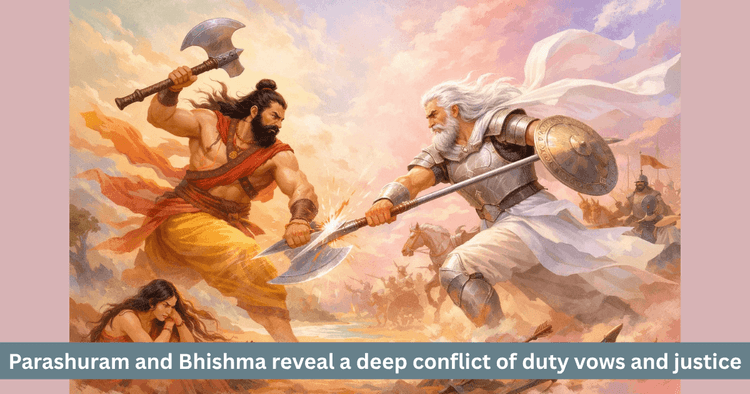
Table of Contents
Within the vast narrative of the Mahabharata, there are episodes that do not merely describe war but reveal the deep tension that arises between justice, vows, duty and dharma. The battle between Bhagavan Parashurama and his disciple Bhishma Pitamaha is one such extraordinary episode. At first glance, it appears to be a fierce duel between guru and disciple. But when seen more deeply, it becomes clear that it was not only a clash of weapons. It was a conflict between two forms of dharma, between the burden of vow, the call of justice and the dignity of duty.
At the root of this episode stands the pain of Amba. It was her anguish that gave birth to a chain of events in which Parashurama stood as the defender of justice, while Bhishma remained immovable in his vow. Neither side stood on the ground of simple falsehood. Each stood upon a principle. That is why this story forces us to think deeply. What should a person choose when two righteous commitments stand against each other. This is what makes the episode unique, moving and deeply philosophical.
How did Amba’s pain become the fire that led to war
This story begins with Amba, the princess of Kashi. At her svayamvara, Bhishma carried away the three princesses for his brother Vichitravirya. From the standpoint of royal custom, this may not have appeared unusual in that age, yet for Amba’s life it became the turning point from which everything changed. Amba openly declared that her heart was already devoted elsewhere. Bhishma then allowed her to go. Up to this point, the matter may still have found some resolution. But circumstances became so harsh that Amba found no place anywhere.
The one she loved did not accept her. Bhishma himself could not marry because of his vow of lifelong celibacy. Between royal custom, social perception and personal honor, Amba was trapped in a situation where her very existence was pushed into crisis. This was no longer merely a question of marriage. It had become a question of a woman’s dignity, honor and right to live with meaning. The Mahabharata here reminds us that a decision which may appear acceptable from the standpoint of power or custom can still destroy the life of an individual from within.
Without understanding Amba’s suffering, the true cause of this battle cannot be understood. Her humiliation was not merely social. It was existential. She could not return to the past, nor move forward into the future. Justice ceased to be an idea for her. It became the only meaningful purpose left in life.
When Amba came to Parashurama in search of justice
When every worldly door seemed to close, Amba came to Bhagavan Parashurama. Parashurama was not only a great warrior. He was also remembered as a protector of dharma, a punisher of injustice and one who could not tolerate moral wrong. When Amba placed her suffering before him, it was not merely a cry of sorrow. It was a demand for justice before dharma itself. Parashurama did not dismiss her pain as misfortune. He recognized it as wrong that required redress.
This is an important aspect of Parashurama’s nature. He was intense, even fiery but he was not a being of anger alone. There was within him a fierce commitment to justice. When he understood that Amba had suffered a grave wrong, he took it upon himself to pursue a remedy. That is why he stood before Bhishma not only as guru but as one who had taken the side of justice itself.
From Parashurama’s perspective, the resolution was clear. Bhishma should marry Amba and thereby restore her honor. For him this was not merely a social arrangement. It was a means of restoring dignity to one whose life had been broken.
Why did Bhishma refuse Parashurama’s command
This question lies at the center of the story. If Parashurama was the guru, if he stood for justice, why did Bhishma refuse his command. The answer lies in the defining vow of Bhishma’s life. For the happiness of his father Shantanu, the stability of Hastinapura and the continuation of the royal line, Bhishma had taken the vow of lifelong celibacy. This vow is what made him Bhishma. It was not simply a promise. It had become the axis of his being.
For Bhishma, to break that vow was not merely to alter one decision. It was to destroy the very foundation of his life dharma. therefore when Parashurama ordered him to marry Amba, Bhishma did not reject the command with arrogance. He refused it respectfully, yet with absolute firmness. This is where the story becomes most complex. On one side stands the guru’s command and the demand for justice. On the other side stands the disciple’s vow and self dharma.
Bhishma’s position may be understood briefly like this:
• He had taken the vow of celibacy not for himself alone
• That vow had become the axis of his entire life
• To break it would have meant violating his own deepest dharma
• He could understand Amba’s pain but could not resolve it by abandoning his vow
This makes it clear that the story is not a simple case of one being right and the other being wrong.
Why was this conflict between guru and disciple so profound
Parashurama and Bhishma are both extraordinary beings. Both are warriors. Both stand upon the ground of discipline, tapas and dharma. Both are linked to sacred martial order and spiritual training. That is why when conflict arises between them, it cannot remain ordinary. If one side had clearly stood in adharma, the story would not carry such complexity. But here both stand within their own understanding of dharma.
Parashurama stands for justice and the honor of a wronged woman. Bhishma stands for vow, self dharma and fidelity to his word. On one side is the protection of Amba’s dignity. On the other is the preservation of Bhishma’s life vow. Neither side could simply yield. That is what turns the episode into one of the deepest moral crises in the Mahabharata.
This tension may be understood through the following summary:
| Side | Form of dharma |
|---|---|
| Parashurama | Protection of Amba’s honor and justice |
| Bhishma | Vow, self dharma and fidelity to promise |
| Amba | The cry for existence, dignity and justice |
| Result | War between two colliding truths of dharma |
This is the soul of the entire episode.
When dialogue failed and war became unavoidable
When the command of the guru and the vow of the disciple could not be reconciled, the situation turned into war. This war was not merely born of anger. It emerged at the point where neither side could withdraw from what each regarded as sacred duty. Parashurama challenged Bhishma. Bhishma raised weapons before his own guru. This creates yet another layer of complexity. How can a disciple wage war against his guru. The Mahabharata answers by showing that life sometimes creates obligations so severe that even the highest relationships are drawn into conflict.
Both Parashurama and Bhishma were masters of celestial weapons. Both possessed immense power. Both had discipline, tapas and unmatched martial knowledge. When such beings stood against each other, the war did not remain a simple exchange of strikes. It rose into an extraordinary and terrifying contest of force, divine weapons and immovable resolve.
What did the many days of battle symbolize
The tradition says that the battle continued for many days. This is not merely a statement about duration. It also indicates that the conflict was not simple enough for one side to fall quickly. If Parashurama possessed boundless power, Bhishma’s resolve was equally immovable. If Parashurama had the advantage of age and experience, Bhishma had the strength of vow and unmatched discipline. That is why the war could not easily reach a conclusion.
The prolonged nature of the battle also carries symbolic meaning. Some questions in life do not yield immediate answers. Powerful principles may continue to strike against one another for a long time. Justice and vow, compassion and promise, the word of the guru and the law of one’s own being do not always reconcile quickly. The battle of Parashurama and Bhishma becomes the symbol of precisely such long moral tension.
Several features define this battle:
- Both warriors fought at the height of their power
- Each knew the strength and dignity of the other
- The conflict arose not from personal hatred but from colliding principles
- The very absence of a decisive result deepens the significance of the episode
Why was there no clear victor in this war
This episode is especially important because no simple victor emerges from it. Parashurama does not easily defeat Bhishma. Bhishma does not decisively conquer his guru. This makes it clear that the battle was never only a test of power. It represented a situation where both stood within a valid moral framework. When two forms of truth stand face to face, outer victory becomes secondary.
Had Bhishma yielded, his vow would have broken. Had Amba received no justice, her dignity would remain wounded. Had Parashurama withdrawn, he would have abandoned the cause of justice he had taken up. That is why the battle’s lack of conclusion becomes itself a teaching.
Why did the gods have to intervene
When the war stretched on and it became clear that no simple conclusion was possible, the gods were compelled to intervene. This intervention was not only to stop physical destruction. It was also an acknowledgment that some conflicts cannot be resolved on the level of force alone, because both sides are upheld by profound principles.
The gods explained that the battle would continue endlessly. Both warriors represented distinct dimensions of dharma. No final answer could come merely through weapons. Here the story rises from the level of war into the level of philosophical insight. The solution does not emerge from force but from understanding, recognizing limits and accepting the complexity of dharma.
Why does Amba remain the moral center of the entire episode
Although the visible center of the story is the battle between Parashurama and Bhishma, its moral center remains Amba. Without her pain, this battle would never have occurred. That is why the story must not be read merely as a tale of martial brilliance. Beneath it beats the suffering, humiliation and demand for justice of a woman whose life was altered irreversibly.
Amba’s story also teaches that a decision that appears ordinary from the standpoint of power or tradition can utterly destroy a person’s life. Therefore dharma cannot remain only in vow keeping or martial excellence. It also lies in sensitive decision making. In this way Amba becomes one of the deepest moral voices in the Mahabharata.
What does this story teach us about dharma
The greatest philosophical message of this episode is that dharma is not always simple. It is not merely a list of rules. It is the difficult art of balancing circumstance, relationship, outcome and inner fidelity. Parashurama and Bhishma both stand on the ground of dharma, yet they wage war. This means dharma is not a straight line. At times it becomes the field where different truths collide.
This story teaches:
• Not every vow remains righteous if it destroys another life
• Not every demand for justice is simple if it shatters another sacred duty
• Guru and disciple may stand within different valid interpretations of dharma
• The final solution often lies not in battle but in deeper understanding
That is why this episode stands so close to the heart of the Mahabharata.
Where war taught that the answer does not always lie in weapons
Ultimately it may be said that the battle between Parashurama and Bhishma is not merely an account of heroic warfare. It is the story of a conflict between guru and disciple, justice and vow, the honor of a woman and the burden of a promise, command and self dharma. Since no side here stands wholly in falsehood, the resolution too cannot come through the easy language of victory and defeat.
The deepest and most difficult message of the story is this. When two forms of dharma stand facing one another, war ceases to be merely an outer event. It becomes a test of human understanding. Then the way forward is found not through weapons but through balance, sensitivity and deeper vision. That is the enduring greatness of this episode and that is why the battle of Parashurama and Bhishma continues to invite reflection even today.
FAQs
What was the root cause of the battle between Parashurama and Bhishma
The root cause was the question of Amba’s dignity and justice, for which Parashurama demanded a resolution from Bhishma.
Why did Bhishma refuse Parashurama’s command
Because he had taken a vow of lifelong celibacy and to break it would have meant betraying his own deepest dharma.
Was either Parashurama or Bhishma entirely wrong
No. Both stood for different dimensions of dharma, which is why the episode becomes deeply complex.
Why did this war produce no clear victor
Because both were great warriors and both were supported by profound principles, so the conflict could not end in a simple decisive outcome.
What is the greatest lesson of this story
That when two forms of dharma stand against one another, the answer is found not only in struggle but in understanding, sensitivity and balance.
Get your accurate Kundali
Generate KundaliDid you like it?
Author

Pt. Narendra Sharma (63)
Experience: 20
Consults About: Family Planning, Career
Clients In: Punjab, Haryana, Delhi
Share this article with friends and family
About ZODIAQ
ZODIAQ is an online Vedic Astrology platform. It connects clients seeking astrological advice to experienced astrologers with deep knowledge. Our users also generate kundali and perform kundali milan for free. ZODIAQ also offers services to the Astrologers. Astrologers utilize various offerings by ZODIAQ to serve their clients effectively.
If you are a User
Consult with experienced astrologers and seek their guidance. You can also order handwritten Janm Patrika report with life prediction prepared by experienced astrologers. Generate accurate Kundali, perform Kundali Matching and check horoscope and muhurat. Utilize our online library for all the necessary astrological and spiritual information.
If you are an Astrologer
Create accurate kundali for your clients and perform Kundali Matching for up to 5 people at a time. Write comprehensive Janm Patrika report for your clients with ZODIAQ. Check client details anytime by saving it in client directory. Become more productive by tracking how many clients you guide every day.
WELCOME TO
ZODIAQ
Right Decisions at the right time with ZODIAQ
