Putrakameshti Yajna and the Birth of Parashurama: Union of Brahmin and Kshatriya Qualities
By Pt. Suvrat Sharma
The birth story that reflects the powerful balance of wisdom and warrior strength
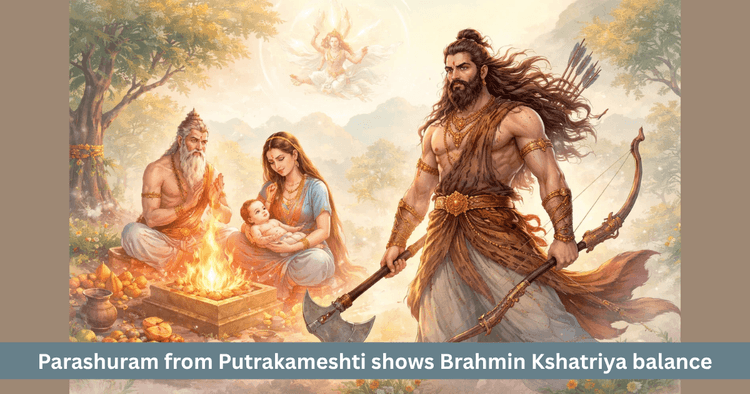
Table of Contents
In the sacred traditions of India, the personality of Bhagavan Parashurama has always stood as something unique. He was born in a Brahmin lineage, yet within him there appeared the courage, martial intensity, righteous anger and warrior discipline usually associated with a Kshatriya. At first glance this may seem like a contradiction. How can one person be so deeply rooted in austerity, wisdom and sacred knowledge, while also carrying such force, decisiveness and battle power. The answer lies in a profound and symbolic birth narrative connected with the Putrakameshti Yajna.
This episode is not merely a divine birth story. It brings forth the subtle truth that a human being is not shaped by birth alone. One’s nature may also be influenced by samskara, divine design, sacrificial force, life purpose and the need of the age. The birth of Parashurama appears to belong to such a deeper plan. The world of that time required a figure who would not only know the scriptures but would also raise weapons when dharma was threatened. It required one who would not remain confined to contemplation but who could stand decisively against injustice when necessary. That is why Parashurama occupies such a singular place in Indian memory.
What is Putrakameshti Yajna and why is it regarded as so important
In the Vedic tradition, Putrakameshti Yajna is regarded as a highly significant sacrificial rite. Its purpose is not merely the birth of a child but the prayer for a child who is worthy, radiant, dharmic and endowed with special qualities. Such a yajna is performed with the feeling that the child should not be merely the continuation of a family line but also a vehicle of higher responsibility, lineage honor and the protection of dharma.
For this reason, whenever Putrakameshti is mentioned, the child born through it is not seen as a simple biological result but as part of a divine responsibility. According to the story, Maharishi Jamadagni and Mata Renuka performed this sacred rite in the hope of receiving such a child. At the completion of the yajna, a divine charu, often described as sacred prepared offering or kheer, was received. This charu was regarded not as ordinary food but as something carrying the subtle force awakened through sacrifice. Because of that, it was believed to influence the nature, qualities and destiny of the child born through it.
Where does the turning point come that changes everything
The most intriguing and philosophical aspect of the story emerges at the point where a special exchange or variation is said to have taken place in the receiving of the charu. In some traditional tellings, Mata Renuka and her maternal relative, who is associated with the mother of Maharishi Vishvamitra, were both to partake of the sacred preparation. Yet through a certain shift in distribution or consumption, the expected order of qualities was altered or blended in a remarkable way.
This is where the story becomes profoundly subtle. It does not mean that nature became confused. Rather, it suggests that divine intention arranged a new balance of qualities for a deeper purpose. As a result, Parashurama, though born in a Brahmin lineage, manifested a powerful Kshatriya force, while Vishvamitra, though born in a Kshatriya line, moved ultimately toward Brahmarishihood. Thus the story becomes not only a birth legend of two great beings but also a profound reflection on the relationship between birth and qualities in Indian thought.
How do both Brahmin and Kshatriya qualities appear in Parashurama
If one observes the life of Parashurama carefully, this story does not seem merely symbolic. It becomes visible in his conduct. On one side he is a knower of the Vedas, an ascetic, the son of a sage and a guardian of Brahmin discipline. He understands austerity, sacred learning, vows, ritual and spiritual order. On the other side he is also a warrior who lifts the Parashu, enters battle, punishes the unrighteous and sees force as a valid instrument of dharma when rightly used.
These two dimensions do not divide him inwardly. They do not create conflict within his being. Rather, they appear as a profound balance of scripture and weapon, wisdom and action, austerity and justice. That is why Parashurama is not remembered merely as an angry divine figure, nor only as an ascetic sage. He represents that rare state in which sacred knowledge and righteous force stand together in harmony.
Does this story only describe an unusual birth or something more
If this episode is treated only as an extraordinary birth story, then its deepest meaning is lost. At its heart, this narrative establishes that a person’s true nature cannot be reduced to lineage alone. Birth gives a foundation but the qualities that emerge within a being may also be shaped by divine intent, samskara, sacrificial force and the role required by time itself. Parashurama stands as one of the strongest examples of this truth.
The episode also suggests that in certain ages, nature gives rise to extraordinary personalities who cannot be contained within ordinary categories. At that time, mere Brahmin learning was not enough and mere Kshatriya force was not enough either. What was needed was a being who could give direction to power through wisdom and protect wisdom through power. Parashurama was the answer to that need.
Why does the comparison with Vishvamitra deepen the meaning of this story
One of the most beautiful elements in this narrative is that its meaning does not remain confined to Parashurama. The life of Vishvamitra also becomes part of its philosophical depth. He was born a Kshatriya, yet through tapas, struggle and aspiration he rose toward the state of a Brahmarishi. Parashurama, by contrast, was born a Brahmin, yet manifested powerful Kshatriya force.
This comparison reveals a profound principle in Indian thought. Human life begins from birth but it does not end there. The deeper possibilities within a person can take him far beyond the social identity of origin. For this reason, the story is not only about the greatness of Parashurama. It is also about the truth that qualities, tapas, discipline and action determine the real height of a human being.
What is the philosophical meaning of this story
The deepest philosophical meaning of this episode is that no single quality is sufficient in itself. If there is knowledge without courage, dharma may not be protected. If there is strength without wisdom, that same strength may become destructive. The birth of Parashurama stands as a living image of this principle. He shows that when knowledge and valor, austerity and force, peace and fierceness are held in right balance, then the fullest expression of dharma emerges.
This meaning may be understood in the following way:
| Dimension | Expression in Parashurama |
|---|---|
| Brahmin nature | Vedic knowledge, tapas, lineage of sages, sacrificial consciousness |
| Kshatriya force | Martial skill, courage, decisive action against adharma |
| Balance | Power used under the guidance of dharma |
| Divine purpose | Restoration of balance in a disturbed world |
This is also the enduring teaching of the story. Neither thought alone nor force alone can establish dharma. It is their rightful union that creates completeness.
Is the life of Parashurama still relevant today
Yes and in a deeply meaningful way. Even today, society often reveals two kinds of deficiency. In some places there is knowledge without courage. In other places there is power without moral direction. Some speak of righteousness, yet do not stand against injustice. Others display force, yet lack restraint and ethical clarity. The life of Parashurama reminds us that true leadership requires both wise strength and courageous understanding.
This story also teaches the individual not to limit himself to birth identity or outer classification. What qualities may awaken within a person depends greatly on discipline, character and purpose. In that sense, Parashurama is not only a puranic figure but also a profound model of inner development.
Where a sacrificial offering becomes the birth of a new balance
Ultimately it may be said that the story of Putrakameshti Yajna and the birth of Parashurama is not merely a wondrous event. It expresses the vast truth that when creation brings forth a great being for a special purpose, it also places within that being the necessary balance of qualities. Parashurama symbolizes exactly such a divine balance. He is neither merely Brahmin nor merely Kshatriya. He stands for a higher condition in which knowledge of dharma and the protection of dharma unite.
This is the lasting message of the story. True completeness does not lie at one extreme. It lies in balance. When wisdom and strength, tapas and radiance, compassion and discipline are held together in one consciousness, a personality is born who continues to inspire across ages. The birth of Parashurama is a divine example of that extraordinary harmony.
FAQs
What is Putrakameshti Yajna
Putrakameshti Yajna is a special Vedic rite performed for the birth of a child and for receiving a worthy and blessed offspring.
How is it connected with the birth of Parashurama
According to tradition, Maharishi Jamadagni and Mata Renuka performed this yajna and Parashurama was born through the divine charu received from it.
Why did Kshatriya qualities appear in Parashurama
Traditional narratives say that because of a special exchange in the receiving of the sacred charu, he manifested powerful Kshatriya qualities despite being born in a Brahmin lineage.
Why is Vishvamitra mentioned in this story
Because the story explains the deep relationship between birth and qualities. Vishvamitra was born a Kshatriya yet became a Brahmarishi, while Parashurama was born a Brahmin yet carried Kshatriya force.
What is the main message of this episode
It teaches that the balance of wisdom and power is essential for the true establishment of dharma and that identity is shaped not only by birth but by qualities and action.
Get your accurate Kundali
Generate KundaliDid you like it?
Author
Pt. Suvrat Sharma (63)
Experience: 20
Consults About: Family Planning, Career
Clients In: Punjab, Haryana, Delhi
Share this article with friends and family
About ZODIAQ
ZODIAQ is an online Vedic Astrology platform. It connects clients seeking astrological advice to experienced astrologers with deep knowledge. Our users also generate kundali and perform kundali milan for free. ZODIAQ also offers services to the Astrologers. Astrologers utilize various offerings by ZODIAQ to serve their clients effectively.
If you are a User
Consult with experienced astrologers and seek their guidance. You can also order handwritten Janm Patrika report with life prediction prepared by experienced astrologers. Generate accurate Kundali, perform Kundali Matching and check horoscope and muhurat. Utilize our online library for all the necessary astrological and spiritual information.
If you are an Astrologer
Create accurate kundali for your clients and perform Kundali Matching for up to 5 people at a time. Write comprehensive Janm Patrika report for your clients with ZODIAQ. Check client details anytime by saving it in client directory. Become more productive by tracking how many clients you guide every day.
WELCOME TO
ZODIAQ
Right Decisions at the right time with ZODIAQ
