Parashurama and the Final Limit of Weapons: Complete Knowledge of Divine Powers
By Pt. Suvrat Sharma
A deep exploration of divine weapons, their control, restraint, and the spiritual discipline behind them
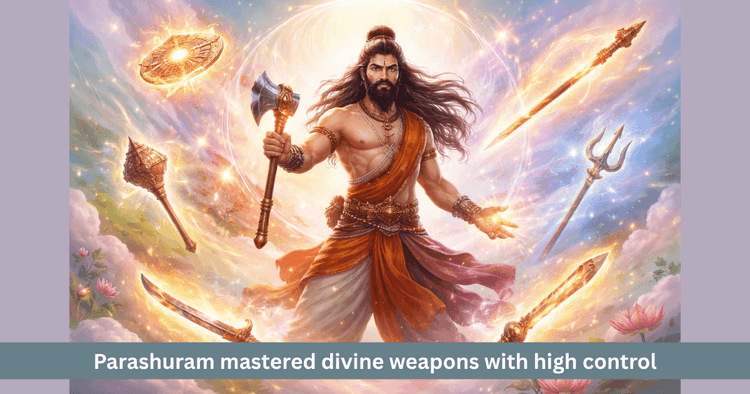
Table of Contents
Bhagavan Parashurama is remembered not only as a great warrior but also as one of the highest masters of divine weapons in the Indian sacred tradition. Many heroes and great fighters are praised in ancient literature, yet Parashurama is seen as a unique being who not only received various celestial weapons but also knew their complete use, control and rightful restraint. This makes his personality much deeper than that of a battlefield hero alone.
In ancient texts, the divine weapons that are mentioned were not ordinary instruments of war. They were powers invoked through mantra, tapasya, purified consciousness and inner discipline. They could not be safely used by one who lacked control over his own mind. Only one who had attained a high state of self mastery, austerity and sacred responsibility could become their true bearer. In this context, Parashurama occupies an extraordinary place. He is counted among those rare beings who did not merely possess such weapons but also understood their invocation, containment, direction and withdrawal.
The knowledge of divine weapons was more than martial skill
In the ancient Indian view, the knowledge of weapons was never only about victory in battle. It was also a form of sacred responsibility. To hold a divine weapon meant to understand the force, mantra and cosmic order behind it. That is why great teachers did not merely instruct disciples in how to release a weapon. They also taught them when not to use it. This discipline was even greater than combat itself.
This becomes especially important in the case of Parashurama. His life certainly contains fierceness but it is not blind violence. His decisions are sharp, yet not directionless. Even his anger is bound to dharma. Because of that, he is remembered not merely as a possessor of power but as a guardian of power. That is his real greatness.
Which divine weapons are associated with him
Tradition speaks of many sacred weapons, yet a few are regarded as especially exalted and difficult to command. Among them, Brahmastra, Narayanastra and Pashupatastra are often remembered as the highest. The very idea that one being could possess the knowledge of all three is itself extraordinary, and this is what makes Parashurama’s association with them so significant.
A brief table helps clarify the symbolic character of these weapons:
| Weapon | Divine association | Main significance |
|---|---|---|
| Brahmastra | The vast energy of Brahman | A force of creation level magnitude |
| Narayanastra | The power of Bhagavan Vishnu | A divine force acting on behalf of dharma |
| Pashupatastra | The supreme power of Bhagavan Shiva | The most intense and most difficult to control |
This table is not only about names. It also shows that the knowledge associated with Parashurama was not simply technical warfare. It was linked with powers connected to the highest divine streams.
What is the deeper meaning of Brahmastra
To call Brahmastra merely destructive would reduce its meaning. It is regarded as a symbol of immense concentrated cosmic force. Its use was extremely rare and demanded the highest caution, because its effect could extend far beyond an ordinary battlefield. That is why the bearer of Brahmastra had to be someone who possessed complete mastery over his own mind.
The connection of Parashurama with this weapon suggests that he knew not merely external warcraft but also power at the level of principle. Such understanding does not arise through martial practice alone. It requires prolonged tapas, initiation, mantra siddhi and profound self control. For that reason, the name of Parashurama linked with Brahmastra also reveals his spiritual stature.
Why is Narayanastra important as a force of dharma
Narayanastra is associated with the divine power of Bhagavan Vishnu. It is not merely a weapon of force but a symbol of dharmic protection. Its deeper meaning is that divine strength does not act only to destroy. It also acts to preserve righteousness. Here the bond between power and moral order becomes clear.
Parashurama is himself regarded as an avatar of Vishnu, so his association with Narayanastra appears natural. Yet the deeper point is that the force within him was not merely the power of reaction or attack. It was the force of a consciousness that sought to restore balance when order had broken down. That remained a central aspect of his life.
Why is Pashupatastra regarded as the most difficult
Pashupatastra is associated with the supreme power of Bhagavan Shiva. It is considered one of the most powerful and at the same time one of the most difficult weapons to control. This means that the one who bears it must possess not only courage but also deep yogic attainment, unparalleled restraint and great inner stillness. Such a weapon is safe only in the hands of one whose consciousness is undivided, whose resolve is pure and whose mind is not disturbed by impulse.
Parashurama is remembered as a supreme devotee of Shiva and also as one blessed by him. therefore the knowledge of Pashupatastra adds another profound dimension to his character. It shows that he was not merely a wielder of weapons. He was also one entrusted with divine discipline. One who has touched the power of Shiva must understand both destruction and restraint together.
Was Parashurama only a master of war
This is an important question. If Parashurama is seen only as a martial hero, then only half of his greatness is understood. His true form is much broader. He is the son of a sage, an ascetic, a holder of sacred discipline and a protector of dharma. That is why one sees in him a rare balance between severity and compassion.
His strength did not lie only in striking. It also lay in knowing which force was appropriate at what time and when restraint itself was the greater power. This is the point where his knowledge of weapons rises above mere combat skill. He knew not only how to release power but how to restrain it, withdraw it, govern it and hold it within dharma.
What does the final limit of weapons really mean
When it is said that Parashurama reached the final limit of weapons, it does not simply mean that he knew many kinds of celestial powers. The deeper meaning is that he understood the inner boundary of power, not just its outer reach. He understood that the highest meaning of strength is not destruction but disciplined and dharmic use. The final limit of power is reached when a person is fully capable of using it, yet chooses not to use it without rightful cause.
This truth may be understood through a few key insights:
- Power without wisdom can become dangerous
- Knowledge without discipline can lose direction
- A weapon without discernment can turn against dharma
- Even the greatest force becomes destructive without self control
- Divine power becomes complete only when joined with moral awareness
Parashurama represents all five of these dimensions together. Therefore his mastery of weapons becomes a symbol not only of war but of ripened consciousness.
What does this story teach in the modern age
When this episode is brought into the present, its meaning becomes highly practical. Human beings today possess more information, technology, influence and tools than ever before. Yet without discernment, restraint and ethical direction, that very power can become destructive. This is the deeper lesson that the story of Parashurama teaches.
In modern terms, the mastery of weapons in his life may be understood as a reminder that before mastering outer powers, one must master one’s inner tendencies. A person who cannot govern anger, greed, pride and impulse is not truly safe in the presence of great power. Parashurama stands as a symbol of the truth that only one who has command over himself is fit to hold command over force.
Where power finds restraint within wisdom
Ultimately it may be said that the complete authority of Bhagavan Parashurama over divine weapons is not merely a glorious mythic account. It is a profound ideal. It teaches that human greatness does not lie simply in how much power one possesses. Real greatness lies in the spirit, discipline and moral clarity with which that power is used.
The form of Parashurama makes this truth living and visible. He shows that Brahmastra, Narayanastra and Pashupatastra are not merely spectacular celestial weapons. They are symbols of those heights where power, wisdom and self restraint begin to flow together as one. That is where true completeness begins.
FAQs
Why is Parashurama regarded as the highest knower of divine weapons
Because tradition presents him as one who possessed the knowledge of many celestial weapons and also knew their proper use and control.
What is the significance of Brahmastra, Narayanastra and Pashupatastra
These are regarded as among the highest divine weapons and are associated respectively with Brahman, Vishnu and Shiva.
Could any warrior hold such weapons
No. Only one who had attained high levels of tapas, mantra, self control and purified awareness was considered fit to bear them.
What is the main lesson of Parashurama’s mastery of weapons
It teaches that real power lies not only in possessing force but in using it at the right time, for the right purpose and within rightful limits.
What does this story teach us today
It teaches that knowledge and power become safe and meaningful only when joined with discipline, discernment and self mastery.
Get your accurate Kundali
Generate KundaliDid you like it?
Author
Pt. Suvrat Sharma (63)
Experience: 20
Consults About: Family Planning, Career
Clients In: Punjab, Haryana, Delhi
Share this article with friends and family
About ZODIAQ
ZODIAQ is an online Vedic Astrology platform. It connects clients seeking astrological advice to experienced astrologers with deep knowledge. Our users also generate kundali and perform kundali milan for free. ZODIAQ also offers services to the Astrologers. Astrologers utilize various offerings by ZODIAQ to serve their clients effectively.
If you are a User
Consult with experienced astrologers and seek their guidance. You can also order handwritten Janm Patrika report with life prediction prepared by experienced astrologers. Generate accurate Kundali, perform Kundali Matching and check horoscope and muhurat. Utilize our online library for all the necessary astrological and spiritual information.
If you are an Astrologer
Create accurate kundali for your clients and perform Kundali Matching for up to 5 people at a time. Write comprehensive Janm Patrika report for your clients with ZODIAQ. Check client details anytime by saving it in client directory. Become more productive by tracking how many clients you guide every day.
WELCOME TO
ZODIAQ
Right Decisions at the right time with ZODIAQ
