Parashurama’s Gift of the Entire Earth and Ideal of Renunciation
By Pt. Amitabh Sharma
The profound story of dharma established through renunciation and the right use of power
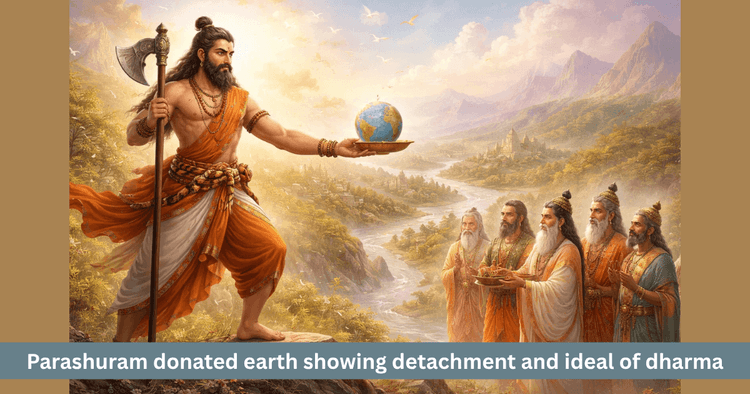
Table of Contents
If the life of Bhagavan Parashurama is viewed only through the lens of war, anger and punishment, then only half of his personality is seen. The deeper side of his being reveals a great ascetic, a master of self control and a figure who knew not only how to wield power but also how to release it. The episode in which he conquers the earth and then gives the whole of it away is one of the clearest expressions of this inner greatness. It is not merely a tale of victory. It is a tale of renunciation, detachment and the right use of power. In this story, triumph does not lead to possession. It leads to freedom from possession.
This episode is especially significant because it reveals the final purpose of strength. Often human beings struggle in order to acquire, preserve and control. Parashurama’s life moves in the opposite direction. He confronted unrighteous powers, restored balance upon the earth and, once that work was complete, refused to convert victory into personal ownership. This is the point at which he rises above the image of a conqueror and appears instead as a true guardian of dharma.
Why does the donation of the earth become so important after the destruction of unrighteous rulers
According to the narrative, Parashurama destroyed unrighteous Kshatriyas 21 times and restored dharma upon the earth. The spirit of this tradition is that when ruling power abandons justice and turns into arrogance, oppression and abuse, balance must be restored. That is what Parashurama did. Yet the next step in the story is what gives the entire episode its highest meaning. If he had wanted, he could have established his own rule over all the earth after such victory. He could have stood as the unquestioned sovereign.
But he did not do so. This reveals that for him, battle was never a means of personal empire. It was a means of removing adharma. The moment that purpose was fulfilled, his claim over victory ended as well. This is the spiritual beauty of the story.
What is the meaning of giving the earth to Maharishi Kashyapa
Parashurama gave the entire earth to Maharishi Kashyapa. This was not an ordinary charitable act. It was the expression of a higher renunciation in which a person lets go even of his greatest achievement. The earth here must not be understood only as land. It also symbolizes victory, authority, influence, power and success. Parashurama gave all of this away.
The choice of Kashyapa is also deeply meaningful. Kashyapa is associated with cosmic order, preservation and balanced continuity. Thus, handing over the earth to him suggests that power must finally rest with those who represent stability, protection and a balanced order. In this way, Parashurama not only performed an act of giving but also restored the moral basis of rulership.
This may be understood through the following structure:
| Element | Deeper meaning |
|---|---|
| Victory over the earth | The triumph of dharma over imbalance |
| Donation of the earth | Freedom from attachment to achievement |
| Maharishi Kashyapa | Stability, preservation and balanced order |
| Parashurama’s renunciation | Mastery over power itself |
Who is the true conqueror
This story asks a profound question. Who is the true conqueror. One who acquires everything or one who can acquire everything and yet remain free from it. Parashurama gives a clear answer. The true conqueror is the one who can hold authority and yet relinquish it when the time demands. One who cannot let go remains inwardly bound. One who can let go is truly free.
Parashurama showed that the highest form of power is not separate from renunciation. When power only accumulates, it turns into ego. When power restores dharma and then withdraws from possession, it becomes tapas filled strength. That is why Parashurama appears not merely as a forceful warrior but as a deeply balanced being.
What remained with him after the donation
At this point the story becomes even more meaningful. Once Parashurama had donated the entire earth, nothing remained for his own residence. This shows that his renunciation was not symbolic. It was real. He kept nothing secured for himself. This is the point at which the story moves beyond moral teaching into the highest form of inner nonattachment.
It is said that after this, he sought land from the ocean. This moment is very beautiful, because here a mighty conqueror does not claim space for himself through force but asks for it with humility. This shows that in Parashurama, power and humility were not opposites. They completed one another.
What is the symbolic meaning of the land received from the ocean
Traditional belief holds that the land granted to him by the ocean later became associated with certain regions of South India. Whether understood regionally or symbolically, the deeper meaning remains powerful. When a person truly lets go, nature itself opens new paths before him. When one gives up possessiveness, one still receives what is necessary for life and sadhana.
A profound principle of life is hidden here. The one who clings to everything for himself becomes inwardly narrow. The one who releases more than he needs finds that life creates new space for him. The story of obtaining land from the sea expresses exactly this. Parashurama did not keep an empire for himself, yet he received what was required for his disciplined life. That is the balance of dharma.
What is the right use of power
The greatest message of this story is that power must not be limited to acquisition. The right use of power can be understood in three stages:
• Power first stops adharma
• Power then restores dharma
• Power finally places limits upon itself
Parashurama’s life demonstrates all three stages. He restrained injustice. He restored balance. Then he refused to convert achievement into private possession. That is why his life becomes not merely a tale of strength but a teaching about the pure use of power.
Even today this question remains relevant. Knowledge, wealth, position, influence, administration, leadership, popularity and political authority are all forms of power. The real question is not whether one possesses power. The real question is whether that power is being used for self interest or with responsibility. Parashurama gives a clear answer. The purpose of power is not possession but balance.
Does detachment mean abandoning the world
This episode also makes it clear that detachment does not mean running away from life. Detachment means acting fully in the world while not being inwardly bound to what is achieved. Parashurama fought, punished, restored dharma, conquered the earth and then gave it away. If he had been an ascetic escaping the world, this story would not exist. If he had been merely a ruler hungry for power, the donation of the earth would never have taken place. He stands in the rare middle path.
Detachment here is not passivity. It is inner freedom born in the midst of intense action. Parashurama acted, yet did not become bound by the fruit of action. In that sense, the story also carries a deep resonance with the philosophy of sacred action.
What does this story teach life today
This episode remains a living guide. It is not merely a puranic ideal but also a practical wisdom for human life. One may rightly take pride in achievement but if one clings to it, achievement itself becomes bondage. The life of Parashurama teaches that even the greatest success is not the final truth. The deeper truth is why that success was gained and what was done with it afterward.
Several enduring teachings emerge from this story:
- The purpose of power should be dharma and balance
- Renunciation after victory reveals the true height of a person
- Achievement becomes bondage when turned into attachment
- Detachment does not mean escape but inward freedom
- After true renunciation, life opens new paths
Where the donation of the earth becomes a symbol of self conquest
Ultimately it may be said that Parashurama’s donation of the entire earth is not merely a mythic event. It is the story of a higher self conquest in which a person, after overcoming outer disorder, also overcomes inner attachment. Many win battles. Many acquire status. Many gain authority. But very few can relinquish all of it. It is here that Parashurama’s greatness shines most clearly.
This is the eternal message of the story. True power is that which is worthy of renunciation. True detachment is that which arises in the midst of action. And the true victor is the one who, after conquering the world, also conquers himself. Parashurama’s gift of the earth remains a luminous example of that completeness.
FAQs
To whom did Parashurama donate the entire earth
Parashurama donated the entire earth to Maharishi Kashyapa so that righteous balance could be restored.
Why did he give away the earth
Because for him, victory was not meant to establish personal rule but to remove adharma and restore dharma.
What remained for him after the donation
After donating the earth, no land remained for himself, so he sought land from the ocean for his life of tapas.
What does detachment mean in this story
Here detachment means not escaping the world but remaining inwardly free from achievement and authority.
What is the main message of this episode
It teaches that the highest form of power is revealed through renunciation, balance and its use for dharma.
Get your accurate Kundali
Generate KundaliDid you like it?
Author
Pt. Amitabh Sharma (56 Years)
Experience: 20
Consults About: Family Planning, Career
Clients In: Punjab, Haryana, Delhi
Share this article with friends and family
About ZODIAQ
ZODIAQ is an online Vedic Astrology platform. It connects clients seeking astrological advice to experienced astrologers with deep knowledge. Our users also generate kundali and perform kundali milan for free. ZODIAQ also offers services to the Astrologers. Astrologers utilize various offerings by ZODIAQ to serve their clients effectively.
If you are a User
Consult with experienced astrologers and seek their guidance. You can also order handwritten Janm Patrika report with life prediction prepared by experienced astrologers. Generate accurate Kundali, perform Kundali Matching and check horoscope and muhurat. Utilize our online library for all the necessary astrological and spiritual information.
If you are an Astrologer
Create accurate kundali for your clients and perform Kundali Matching for up to 5 people at a time. Write comprehensive Janm Patrika report for your clients with ZODIAQ. Check client details anytime by saving it in client directory. Become more productive by tracking how many clients you guide every day.
WELCOME TO
ZODIAQ
Right Decisions at the right time with ZODIAQ
