The Battle of Parashurama and Ganesha: Story of Ekadanta
By Pt. Abhishek Sharma
A profound lesson in duty, humility, and sacrifice
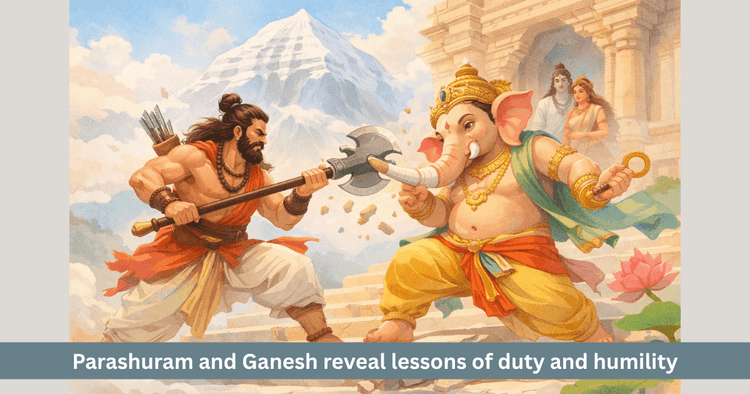
Table of Contents
Stories connected with Lord Ganesha are never merely religious incidents. They often present the deepest principles of life in simple and memorable form. The episode of Parashurama and Ganesha is one such profound example. At first glance it appears to be a conflict, yet when seen more deeply it becomes a story about duty, humility, sacrifice, respect and sacred restraint. This is why the form of Ganesha as Ekadanta is not only a physical identity but also an eternal teaching.
The beauty of this episode lies in the fact that no character appears to stand completely on the side of falsehood. On one side is Bhagavan Parashurama, who arrives at Kailasha with intense devotion and a powerful longing to meet Lord Shiva. On the other side is Ganesha, who has been entrusted by Mother Parvati with the responsibility of guarding the entrance. Both are devoted. Both are sincere. Both are unwilling to step back from what they believe is right. That is what gives this story its unusual depth.
How did a simple question at the gate of Kailasha turn into a profound conflict
According to the tradition, once Bhagavan Parashurama, who is regarded as an incarnation of Lord Vishnu and who was also a great warrior and an ardent devotee of Lord Shiva, came to Mount Kailasha for the darshana of his beloved Lord. His devotion was intense and naturally he did not wish to be delayed. But at that time, Lord Shiva was resting and Mother Parvati had given Ganesha the responsibility of guarding the entrance. This duty was not merely physical watchfulness. It was a matter of obedience, discipline and trust.
When Parashurama arrived, Ganesha stopped him with complete politeness. He did not insult him, did not use harsh language and did not display arrogance. He simply said that this was not the proper time to enter. This is the first radiant aspect of Ganesha in the story. He stands at the gate not with insecurity but with perfect commitment to duty. Even while knowing who stood before him, he did not think of abandoning the task entrusted to him. This reveals his discipline and sense of responsibility.
Parashurama may first have seen this only as an obstacle. But when Ganesha remained firm, the situation deepened. For a great warrior, an incarnation of Vishnu and a passionate devotee of Shiva, this refusal became not only delay but something that touched his intense self regard. This is where the temperature of the conversation rises and a seemingly ordinary moment transforms into a deeper confrontation.
Was this battle only the result of anger
If the story is read only at the outer level, it may seem that the conflict emerged simply from anger. But within it, two major principles are standing face to face. On one side is Parashurama’s self respect and his determination to meet the Lord he adores. On the other side is Ganesha’s duty and unwavering obedience to Mother Parvati’s command. When two devoted beings remain firm in what each sees as right, the conflict appears outwardly sharp, yet inwardly it becomes much more meaningful.
For Ganesha, the question was whether he should abandon his duty merely because a great warrior stood before him. If he had done so, his character would have become incomplete. For Parashurama, the question was whether he should allow himself to be restrained in the intensity of his devotional longing and heroic self regard. This tension is what makes the episode living and profound. It is not only power that clashes here. It is also inner principle.
The core tension of the episode may be understood like this:
• Parashurama came with intense longing for the darshana of Lord Shiva
• Ganesha stood in complete fidelity to Mother Parvati’s command
• Both believed their own position to be righteous
• The conflict deepened because neither was careless toward dharma
This is why the story reminds us of those situations in life where both sides may be right in their own place, yet conflict still arises.
Why does the moment of the axe become so decisive
When conversation did not resolve the matter, the fierceness and force within Parashurama arose. He used his divine weapon, the parashu, the axe that had been given to him by Lord Shiva himself. This was no ordinary weapon. It was a symbol of Shiva’s grace and power. The moment it was released, the story moved into a far deeper space.
Now before Ganesha there was not merely an attack but a decision. He had the strength to resist. He was not powerless. He possessed force, wisdom and divine might. If he had wished, he could have stopped the blow. But it is here that his greatness shines most brightly. He recognized the weapon. He understood that it had come from his father, Lord Shiva. The matter was no longer about simple self defense. It had also become a question of honoring the father and preserving the dignity of the weapon.
At this decisive moment, Ganesha chose the path that makes him incomparable. He did not choose display of power. He did not choose retaliation. He did not choose to protect himself at the cost of reverence. Instead, he accepted the blow and sacrificed one of his tusks. Outwardly this may seem like injury but inwardly this is his highest victory.
Why did Ganesha not strike back
This question lies at the heart of the entire story. If Ganesha had the power to stop the blow, why did he not do so. The answer lies in the depth of his nature. Ganesha is not only the remover of obstacles and the lord of wisdom. He is also a guardian of sacred restraint. He understood that the weapon before him had been granted by his father. Had he dishonored it, he may have protected himself but he would have violated a higher principle.
Here Ganesha teaches that victory in every conflict does not always mean resistance. Sometimes the greatest decision is the one in which a being has the power to respond, yet gives greater importance to respect, humility and restraint. He showed that the highest form of strength is not always in proving power but also in withholding it at the right time.
That is why the breaking of his tusk does not remain a small event. It becomes a symbol of sacrifice made in order to preserve a higher truth.
What is the real meaning of the Ekadanta form
The form of Ganesha as Ekadanta is not merely a physical feature. It is a sign of his entire life vision. The broken tusk does not tell us merely that he was struck. It tells us that he accepted personal loss in order to protect a higher value. This is why the Ekadanta form reflects humility, sacrifice, duty and sacred dignity all at once.
This form may be understood at several levels:
| Symbol | Deeper meaning |
|---|---|
| Broken tusk | Acceptance of personal loss for a higher principle |
| Refusal to block the weapon | Reverence for the father and sacred dignity |
| Standing firm at the gate | Unwavering commitment to duty |
| Grace even after conflict | The greatness of restraint over brute force |
For this reason, Ganesha as Ekadanta continues to be remembered as one of the highest expressions of wisdom, endurance and inner balance.
Why is this episode also important for Parashurama
It is not enough to view this episode only from the side of Ganesha. It is also deeply meaningful for Parashurama. When he realized what had happened, he understood the greatness of Ganesha’s sacrifice and restraint. Here the second great teaching of the story emerges. Greatness lies not only in prowess and force but also in recognizing one’s mistake and accepting it.
Parashurama is a devotee of Shiva, a being of tapas and a guardian of dharma. therefore when truth became clear before him, he did not turn away from it. This too makes him great within the story. Thus the conflict does not end only in injury. It ends in understanding and humility. This teaches that clashes born of ego can be resolved only when truth is recognized.
What does this story teach life today
This episode remains just as relevant today as it was in ancient times. Many situations in life arise where two sides may be right in their own way, yet conversation turns into conflict. In such moments, this story asks us to pause and reflect. Must all strength be answered with strength. Must every disagreement reach the stage of battle. Must every hurt be repaid. Ganesha’s answer is clear. Not always.
This story teaches:
- Duty must not be abandoned under pressure
- Humility does not diminish strength, it elevates it
- Respect may sometimes be a greater value than self protection
- Sacrifice may appear like outward loss, yet become inward victory
- Accepting one’s mistake is also a sign of greatness
That is why this is not merely a mythological incident. It is a mirror for human life.
Where a broken tusk became a divine teaching
Ultimately, it may be said that the episode of Parashurama and Ganesha is not the story of an ordinary battle. It is the story of a moment where duty, honor, power, restraint and sacrifice all stand together. Ganesha showed that true strength lies not only in stopping the blow but also in accepting it for the right reason. Parashurama showed that true radiance lies not only in wielding power but also in becoming humble before truth.
This is the deepest message of the episode. The Ekadanta form of Ganesha reminds us that greatness is not measured merely by visible victory but by the purity of one’s decision. When a being gives place within to sacred restraint, respect and humility, then power itself becomes divine.
FAQs
What was the main reason for the conflict between Parashurama and Ganesha
The main reason was Parashurama’s intense desire to see Lord Shiva and Ganesha’s unwavering duty to guard the entrance according to Mother Parvati’s command.
Why did Ganesha not resist the parashu
Because he recognized it as a weapon given by Lord Shiva and chose reverence over display of power.
How did Ganesha become Ekadanta
By accepting the blow of Parashurama’s axe, one of his tusks was sacrificed and he became known as Ekadanta.
What is the deepest teaching of this story
That true strength lies not only in force but also in humility, sacred restraint, sacrifice and respect.
What does Parashurama’s role teach us
It teaches that greatness also lies in recognizing one’s mistake and becoming humble before truth.
Get your accurate Kundali
Generate KundaliDid you like it?
Author

Pt. Abhishek Sharma (63)
Experience: 20
Consults About: Family Planning, Career
Clients In: Punjab, Haryana, Delhi
Share this article with friends and family
About ZODIAQ
ZODIAQ is an online Vedic Astrology platform. It connects clients seeking astrological advice to experienced astrologers with deep knowledge. Our users also generate kundali and perform kundali milan for free. ZODIAQ also offers services to the Astrologers. Astrologers utilize various offerings by ZODIAQ to serve their clients effectively.
If you are a User
Consult with experienced astrologers and seek their guidance. You can also order handwritten Janm Patrika report with life prediction prepared by experienced astrologers. Generate accurate Kundali, perform Kundali Matching and check horoscope and muhurat. Utilize our online library for all the necessary astrological and spiritual information.
If you are an Astrologer
Create accurate kundali for your clients and perform Kundali Matching for up to 5 people at a time. Write comprehensive Janm Patrika report for your clients with ZODIAQ. Check client details anytime by saving it in client directory. Become more productive by tracking how many clients you guide every day.
WELCOME TO
ZODIAQ
Right Decisions at the right time with ZODIAQ
