Parashurama and Kalki Avatara: The Guru Secret Connecting the Ages
By Pt. Narendra Sharma
The hidden story of guru-disciple tradition and the cyclical nature of time in Sanatan tradition
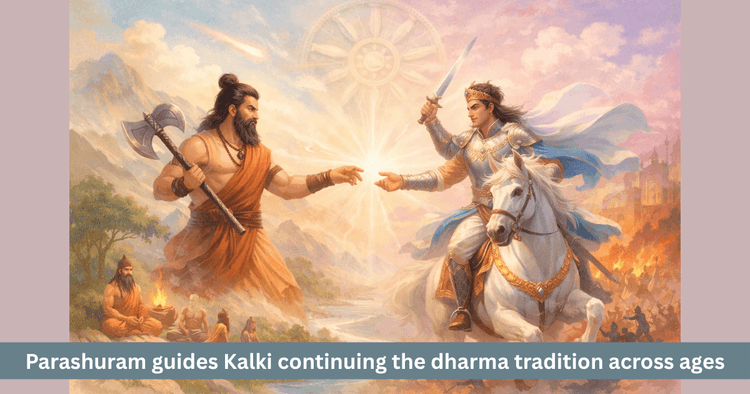
Table of Contents
In Indian sacred thought, time is not seen merely as a straight line but as a living cycle in which every age carries its own dharma, its own crisis and its own responsibility. When an age moves too far away from balance, when adharma, arrogance, injustice and confusion begin to dominate the structure of society, divine power manifests in some form to restore order. Within this vast understanding, the place of the Kalki Avatara is considered extremely important. A profound traditional belief connected with this future avatara is that when he appears at the end of Kali Yuga, his guru will be Bhagavan Parashurama. This idea is not merely an interesting mythic detail. It expresses the eternal continuity of knowledge, the right use of power and the timeless guru disciple tradition.
The most striking beauty of this episode is that it links two streams of avatara consciousness. On one side stands Parashurama, regarded as the sixth avatara of Vishnu, whose life is a powerful union of tapas, warrior discipline, the defense of dharma and inner control. On the other side stands Kalki, the future avatara who will appear when the light of dharma has become deeply weakened. The belief that Parashurama will become Kalki’s guru suggests that divine action never appears in isolation. Every age leaves something for the next and every avatara carries significance not only for his own time but also for what is yet to come.
The cycle of time and the necessity of the Kalki Avatara
In Indian scriptural thought, Satya Yuga, Treta Yuga, Dvapara Yuga and Kali Yuga are not merely historical periods. They are also symbolic states of collective consciousness, moral strength and social balance. The final stage of Kali Yuga is described as a time when the foundation of dharma becomes extremely weak, truth becomes rare and power begins to serve oppression rather than protection. In such a time, the manifestation of the Kalki Avatara is understood not merely as destruction but as restoration.
A very subtle point must be understood here. The restoration of dharma is not achieved by force alone. The destruction of adharma may be necessary, yet equally necessary are right direction, right understanding and right training. If power exists without clarity of purpose, that same power can create further imbalance. If purpose exists without skill, the protection of dharma remains incomplete. This is why the presence of a guru within the story of Kalki becomes so meaningful. Even the future avatara is linked with instruction and guidance. This reveals the profound humility of Indian spiritual thought.
Why is Parashurama regarded as the guru of Kalki
Bhagavan Parashurama is one of the rare beings regarded as Chiranjivi, one who continues across ages. The meaning is not merely that he lives long. The deeper meaning is that he serves as a bridge between ages. He is not only a warrior of his own era but a continuing representative of the consciousness of dharma. This is precisely why his role as guru to Kalki appears deeply appropriate.
Kalki’s task will not be merely to win a battle. He will have to descend into a time where truth itself must be re established. For that, mere outer strength will not be enough. There must also be martial mastery, vision of justice, disciplined force and clarity about dharma. The life of Parashurama stands as a living embodiment of all these elements. He is therefore uniquely suited to prepare the one who must act at the very end of the cycle.
The reasons Parashurama is seen as most fitting may be understood in this way:
- He is an ascetic, so he understands how power must remain under self control
- He is a warrior, so he understands the practical use of weapons
- He is an avatara of Vishnu, so he remains linked with the wider flow of dharma
- He is a guru, so he knows how power must be entrusted to the worthy
Here the guru tradition means more than instruction. It means succession
The relationship between Parashurama and Kalki is not simply that one will teach and the other will learn. It is something much deeper. It is a form of divine succession. The wisdom, tapas and dharmic experience of one age remain preserved for the next. Parashurama becomes the carrier of that preserved current. Through him, the story reveals that divine work is sustained through an unbroken stream of learning.
If looked at carefully, the guru tradition in this episode works on three levels:
| Dimension | Meaning |
|---|---|
| Training in weapons | Outer skill and martial preparedness |
| Training in dharma | When, why and to what extent force should be used |
| Training in succession | The experience of one age being carried into the next |
That is why this episode is not merely about a future event. It is also about the deeper truth that the work of dharma does not belong to one age alone. It is a continuous current.
Will Kalki receive only martial training
Traditional interpretations say that Parashurama will teach Kalki the science of weapons and warfare. Yet if this is understood only as battlefield skill, the meaning becomes very limited. In Indian thought, the right use of weapons has always been linked with conduct, discernment and awareness of dharma. It is therefore more meaningful to understand this future education as multi layered.
Some dimensions of that training may be understood in the following manner:
1. Discipline of power
It is not enough to know how to strike. One must also know when not to strike.
2. Balance between justice and punishment
Not every opponent is an enemy and not every problem is solved through force. This distinction is central to dharma.
3. Purification of anger
Anger directed against adharma, if not refined through tapas, can become personal vengeance.
4. Purpose behind battle
The goal of dharmic action is not victory for its own sake but the restoration of balance.
therefore Parashurama will not merely teach Kalki how to fight. He will also teach him when force is dharmic and when it is not.
What does this age linking tradition reveal
This episode brings forward one of the most beautiful qualities of Indian spiritual thought. Time here does not break. It connects. The past does not vanish. It transforms into the future. Parashurama stands linked with the memory of earlier ages, while Kalki is linked with the final restoration of the future. Their relationship tells us that knowledge, tapas, experience and moral force are never destroyed. They continue through changing forms across ages.
It is also important to note that Indian tradition does not imagine any true new beginning as arising from complete emptiness. Every new beginning is supported by earlier austerity, earlier consciousness and earlier wisdom. The guru role of Parashurama in the story of Kalki symbolizes exactly this principle. It means that even the final great restoration of dharma will remain linked to the greatest tapas of the past.
Why is a guru necessary to give direction to power
One of the timeless messages of this story is that power by itself is never sufficient. Without direction, power can become distorted. Both history and sacred memory show that unbalanced power eventually becomes destructive. This is why, whenever a great mission is imagined, the presence of a guru becomes essential.
The guru form of Parashurama confirms that:
• Without knowledge, power remains incomplete
• Without discipline, weapons become dangerous
• Without vision of dharma, even victory can turn destructive
• Without guidance, even avatara force does not reveal its full purpose clearly
This makes the story not only about Parashurama and Kalki but also about every life in which great capacity needs right direction.
Why is Parashurama especially suited for this role
If one asks why Parashurama in particular is appropriate as the guru of the final avatara, the answer lies in his life itself. He has seen the extreme of power, the fire of wrath, the consequences of injustice and the refinement of the self through tapas. He is not merely a figure of battle. He is a figure of power ripened by experience. This ripeness is what makes him unique.
His qualities may be understood like this:
| Quality of Parashurama | Its significance for Kalki |
|---|---|
| Tapas | The ability to keep power under restraint |
| Martial mastery | Decisive strength against adharma |
| Chiranjivi nature | A bridge of experience across ages |
| Dharmic vision | Guidance for final restoration |
This is why his role becomes not merely that of a teacher but that of a guardian of transition between ages.
What is the philosophical meaning of this story
This episode may be read at many levels but its deepest meaning is that divinity itself is not separate from discipline. It is profoundly beautiful that even the future avatara is imagined as advancing toward fullness through the guru tradition. This teaches that no great action, however divine, shines in its complete form without wisdom, lineage, guidance and humility.
The story also tells us that the protection of dharma requires not only freshness but also memory. Parashurama is memory. Kalki is new beginning. When memory and new beginning come together, restoration becomes complete.
What does this story teach present life
Though mythic in form, this story is deeply relevant today. Human beings still seek knowledge, power, influence and transformation. Yet without a true guide, right direction and disciplined restraint, that very power can turn into confusion. The relationship between Parashurama and Kalki reminds us that it is essential to join ability with tradition, power with restraint and purpose with wisdom.
Five enduring lessons arise from this episode:
- No great power is complete without the guru tradition
- Dharma is protected not only by force but by discernment
- The experience of the past is necessary for preparing the future
- The right use of power is possible only through discipline
- Ages change but true values remain
Where the future avatara is linked with the tapas of the past
Ultimately it may be said that the relationship between Parashurama and the Kalki Avatara is not merely an extension of sacred imagination. It is one of the most beautiful expressions of Indian spiritual vision, where time, tradition, guru, power and dharma come together at one center. Parashurama symbolizes the truth that wisdom gained through tapas is never wasted. Kalki symbolizes the truth that when time calls, that same wisdom becomes the direction of the future.
This is the enduring message of the episode. The flame of dharma never moves alone. It passes from one hand to another, from one age to another and from one great discipline to the next great responsibility. The relationship between Parashurama and Kalki is a profound and inspiring form of that unbroken flame.
FAQs
Is Parashurama truly regarded as the guru of the Kalki Avatara
Yes. In puranic belief, it is said that at the end of Kali Yuga, Kalki will receive the knowledge of weapons and dharma from Parashurama.
Why is Parashurama considered suited for this role
Because he is regarded as Chiranjivi, an ascetic, a great warrior and a continuing representative of dharmic consciousness.
Why would Kalki need a guru
Because the restoration of dharma cannot happen through force alone. It also requires discernment, discipline and right guidance.
What does guru tradition mean in this story
It means that the accumulated wisdom and experience of one age are carried forward into the next, so that the current of dharma remains unbroken.
What is the central message of this episode
It teaches that the true tradition of knowledge and power never ends. It continues across ages through the right bearers.
Get your accurate Kundali
Generate KundaliDid you like it?
Author

Pt. Narendra Sharma (63)
Experience: 20
Consults About: Family Planning, Career
Clients In: Punjab, Haryana, Delhi
Share this article with friends and family
About ZODIAQ
ZODIAQ is an online Vedic Astrology platform. It connects clients seeking astrological advice to experienced astrologers with deep knowledge. Our users also generate kundali and perform kundali milan for free. ZODIAQ also offers services to the Astrologers. Astrologers utilize various offerings by ZODIAQ to serve their clients effectively.
If you are a User
Consult with experienced astrologers and seek their guidance. You can also order handwritten Janm Patrika report with life prediction prepared by experienced astrologers. Generate accurate Kundali, perform Kundali Matching and check horoscope and muhurat. Utilize our online library for all the necessary astrological and spiritual information.
If you are an Astrologer
Create accurate kundali for your clients and perform Kundali Matching for up to 5 people at a time. Write comprehensive Janm Patrika report for your clients with ZODIAQ. Check client details anytime by saving it in client directory. Become more productive by tracking how many clients you guide every day.
WELCOME TO
ZODIAQ
Right Decisions at the right time with ZODIAQ
