Parashurama and the 21 Destructions of Kshatriyas: Restoration of Dharma, Not Revenge
By Pt. Nilesh Sharma
Understanding the deeper meaning behind Parashurama’s actions as divine correction of adharma and imbalance of power
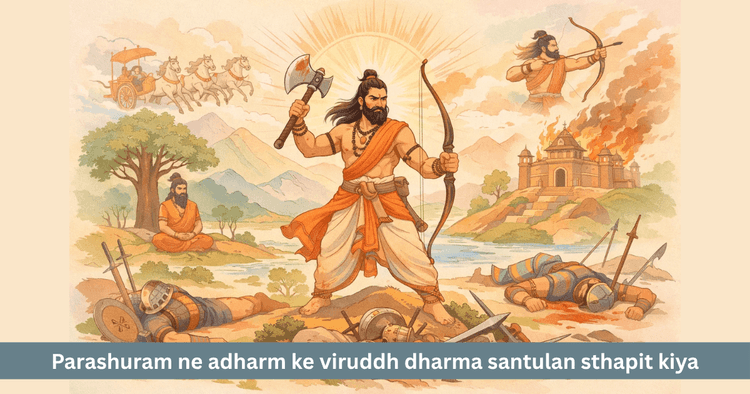
Table of Contents
The life of Bhagavan Parashurama contains many episodes of profound intensity and among them one of the most discussed is the account that he made the earth free of Kshatriyas not once but 21 times. At first glance this may appear to be only a story of wrath and revenge. Yet when understood more deeply, it becomes clear that the episode is not merely about anger. It is about the protection of dharma and the restoration of balance when power had turned into oppression.
This episode should not be reduced to bloodshed alone. Parashurama was not an ordinary warrior. He was born in a Brahmin lineage, yet carried weapons. He was an ascetic, yet never passive before injustice. He was devoted to Shiva, yet his life did not remain only inward or meditative. When power crushed dignity and violated sacred order, he rose as divine punishment. That is why the destruction of Kshatriyas 21 times cannot be understood merely as personal rage. It was a response to a point at which power had ceased to protect and had begun to oppress.
Why is the root of this story hidden in the arrogance of Sahasrarjuna
Behind every great conflict stands some moment when power loses its restraint. In Parashurama’s life that moment appears through King Sahasrarjuna, also known as Kartavirya Arjuna. He was a ruler of immense strength and extraordinary might. As long as strength remains joined with dharma, it serves the welfare of society. But when strength becomes intoxicated with itself, it turns destructive. That is what happened in Sahasrarjuna’s life.
His power slowly transformed into arrogance. This arrogance was not merely a flaw in personality. It began to affect the very character of rule. When rulers begin to imagine that no sage, no ashrama, no sacred order and no moral limit stands above their authority, then a grave imbalance is born within society. Sahasrarjuna becomes the symbol of exactly that imbalance. Through him, the story teaches that adharma does not always arrive as chaos alone. Sometimes it comes in the form of power seated upon the throne.
How does the ashrama of Maharishi Jamadagni become the moral center of the story
One day Sahasrarjuna came to the ashrama of Maharishi Jamadagni. The ashrama was not merely a dwelling. It was a center of tapas, simplicity, sacred learning and spiritual force. There was no royal splendor there, yet there was the radiance of dharma. It was there that the king beheld the extraordinary power of Kamadhenu, the divine cow capable of manifesting abundance and resources according to need. Kamadhenu was not merely a miraculous possession. She represented the sacred wealth that arises through tapas and righteous life.
When Sahasrarjuna saw this wonder, reverence did not arise in him. Instead, greed arose. That is the decisive turning point in the story. Had he remained aligned with dharma, he would have honored this power as the fruit of tapas. Instead, he regarded it as something to be seized by force. Maharishi Jamadagni opposed this, because the matter was not only about a cow. It concerned the dignity of the ashrama, the rights of a sage and the sanctity of tapas.
This moment may be understood clearly through the following:
| Element | Deeper meaning |
|---|---|
| Kamadhenu | Divine abundance born of tapas and dharma |
| Ashrama | A place of simplicity, restraint and sacred power |
| Sahasrarjuna’s greed | The deviation of kingship from dharma |
| Forced seizure | An insult to dignity and rightful order |
This was the moment when power ceased to protect and turned into violation.
Why did Parashurama kill Sahasrarjuna
When Parashurama came to know that Sahasrarjuna had forcefully taken Kamadhenu and violated the sanctity of the ashrama, he killed him and brought Kamadhenu back. This act was not the first explosion of private anger. It was the first punishment in defense of dharma. Through this, Parashurama made it clear that if political power trampled sacred order, it would meet resistance.
Parashurama’s nature must be understood carefully here. He was not someone who simply lifted weapons out of impulse. He lifted them when the limits of dharma were broken. The slaying of Sahasrarjuna was therefore not merely the killing of a king. It was a declaration that tapas, truth and the culture of sages are as sacred as royal authority. If a ruler violated that balance, his arrogance would be punished.
Why does the story not end here
If the story had ended with the death of Sahasrarjuna, it might have been understood as a direct retaliation. But epic and puranic narratives often become deeper precisely where a simpler tale might end. The sons of Sahasrarjuna, burning with vengeance, killed Maharishi Jamadagni. This transformed the story entirely. It was no longer only about royal arrogance. It had become a wound touching sonhood, sagehood and social order all at once.
The killing of Jamadagni was not only the murder of a father. It was an assault upon the lineage of sages. It showed that political force had become so corrupted that it could strike even a tapasvin in revenge. This event shook Parashurama at the deepest level. The fire within him did not now arise only from the pain of a son. It arose from the realization that if such power were not checked, the place of dharma itself in society would collapse.
Why was the vow to destroy the Kshatriyas 21 times not mere revenge
At this point Parashurama made his terrible vow to make the earth free of Kshatriyas 21 times. When read superficially this appears extreme but the inner meaning is broader. His aim was not to annihilate the entire Kshatriya principle. His aim was to punish those arrogant, oppressive and unrighteous rulers who had strayed from their true dharma.
What is the dharma of a Kshatriya. To protect the people, establish justice, defend the weak, uphold dharma and use power with discipline. When that very class of protectors becomes an oppressive force, punishment becomes necessary. Parashurama’s vow symbolizes precisely this punishment. That is why it cannot be understood merely as revenge. Revenge belongs to private injury. Parashurama’s campaign belonged to the restoration of moral and social balance.
This may be understood through these points:
• The death of his father gave him personal pain
• The slaying of a sage wounded the moral order of society
• The rise of oppressive rulers revealed deep imbalance
• Therefore the wars became not private revenge but disciplinary action in defense of dharma
What is the symbolic meaning of the number 21
The mention of 21 times is itself very significant. It is not merely a number of battles. It also carries symbolic meaning. It suggests that adharma does not disappear in one stroke. It rises again and again. It changes forms, returns through power and must be confronted repeatedly. Therefore the defense of dharma also requires continued vigilance.
Some traditions also interpret the number symbolically, as referring to the many layers of ego, violence and corruption that take root in individual and collective life. Whether read historically, puranically or symbolically, the number clearly indicates repeated effort toward the restoration of order.
Was Parashurama’s target the entire Kshatriya society
A necessary clarification must be made here. Parashurama’s target was not the complete destruction of the Kshatriya principle, because the structure of society itself recognizes the need for a protecting class. A society cannot remain balanced without those who defend order. But when the protectors become devourers, punishment becomes unavoidable. In that sense, Parashurama was not the enemy of Kshatriya dharma. He was the destroyer of the unrighteous distortion of Kshatriya power.
This is why the episode should not be read as class conflict. It should be read as the protection of dharma. Parashurama shows that Brahminhood is not only instruction and prayer. When required, it can also become active resistance against adharma. This is part of what makes him unique.
This distinction may be seen clearly below:
| What was destroyed | What was preserved |
|---|---|
| Arrogant ruling tendency | Righteous royal duty |
| Misuse of power | The duty to protect the people |
| Insult to sages | The dignity of tapas and wisdom |
| Unrighteous authority | Social balance |
Is righteous anger possible
This episode raises another important question. Is anger always a fault. Is every fierce response adharma. The life of Parashurama offers a subtle answer. Anger arising from ego is destructive. But anger aligned with dharma, when directed toward a just purpose, can become corrective. Parashurama’s anger is understood in this way. It was not a momentary flame of personal insult. It was a fierce form of punishment arising on behalf of dharma.
Even here caution is necessary. Not every person can declare his anger righteous. Parashurama is unique because his life is bound by tapas, discipline, guru tradition and control over force. His wrath is not impulsive lawlessness. It remains within a moral frame. That is what separates it from mere violence.
How does this story reveal the relationship between power and responsibility
This is not only a story about punishment. It is also a story about the responsibility that must accompany power. Sahasrarjuna’s error lay in treating his strength as entitlement. His attack upon Jamadagni and Kamadhenu shows that when power loses restraint, it begins to seize the dignity of others. Parashurama’s resistance is therefore not directed against power as such. It is directed against unrestrained power.
From this emerges a crucial social teaching. In any society, if political authority, military strength or institutional force drift away from their moral purpose, the entire social body suffers. Therefore the possession of power is never the final issue. The true issue is whether power is used with responsibility. Parashurama becomes the symbol of restoring that responsibility.
What meaning does this story carry for life today
Today no one should read this story as a literal endorsement of violence, nor would that be appropriate. Yet its symbolism remains deeply relevant. Even now societies face situations where position, authority, institutional power and political force are misused. In such moments, the restoration of dharma becomes necessary. Today that restoration may not come through weapons but through moral courage, just systems, truthful speech and responsible leadership.
This episode offers several lessons for the present:
- When power loses moral restraint, it must be resisted
- Dharma is not only worship but also the courage to stand against injustice
- No group or authority should be judged only by role but by conduct
- When balance collapses, restoration may demand difficult measures
- Personal pain can become a wider call for justice when joined to dharma
Where destruction carried the purpose of restoration
Ultimately it may be said that Parashurama’s destruction of the Kshatriyas 21 times is not merely an episode of war, anger or revenge. It is the story of dharmic punishment directed against corrupted kingship. It contains the grief of a son, the defense of the lineage of sages, the punishment of the misuse of power and the attempt to restore balance in society. For this reason the episode should be read not with fear or excitement alone but with deep moral reflection.
This is its greatest message. When power becomes separated from dharma, punishment becomes inevitable. And when a warrior ascetic takes up that punishment, the ultimate purpose is not destruction alone but the restoration of dharma. That is the image of Parashurama that makes him truly unique.
FAQs
Why did Parashurama destroy the Kshatriyas 21 times
Because arrogant and unrighteous rulers had begun to misuse power and he sought to restore the balance of dharma.
Was this only revenge for his father’s death
No. His father’s death caused deep personal pain but the larger purpose was to punish corrupted royal power.
What was the greatest mistake of Sahasrarjuna
His greatest mistake was arrogance, greed and the forcible seizure of Kamadhenu in violation of the dignity of a sage and an ashrama.
What is the significance of the number 21
It symbolizes repeated effort, the repeated rise of adharma and the sustained need to restore dharma.
What is the central message of this story
When power turns from protection into oppression, a firm restoration of dharma becomes necessary.
Get your accurate Kundali
Generate KundaliDid you like it?
Author

Pt. Nilesh Sharma (63)
Experience: 20
Consults About: Family Planning, Career
Clients In: Punjab, Haryana, Delhi
Share this article with friends and family
About ZODIAQ
ZODIAQ is an online Vedic Astrology platform. It connects clients seeking astrological advice to experienced astrologers with deep knowledge. Our users also generate kundali and perform kundali milan for free. ZODIAQ also offers services to the Astrologers. Astrologers utilize various offerings by ZODIAQ to serve their clients effectively.
If you are a User
Consult with experienced astrologers and seek their guidance. You can also order handwritten Janm Patrika report with life prediction prepared by experienced astrologers. Generate accurate Kundali, perform Kundali Matching and check horoscope and muhurat. Utilize our online library for all the necessary astrological and spiritual information.
If you are an Astrologer
Create accurate kundali for your clients and perform Kundali Matching for up to 5 people at a time. Write comprehensive Janm Patrika report for your clients with ZODIAQ. Check client details anytime by saving it in client directory. Become more productive by tracking how many clients you guide every day.
WELCOME TO
ZODIAQ
Right Decisions at the right time with ZODIAQ
