Parashurama’s Slaying and Restoration of His Mother
By Pt. Amitabh Sharma
A profound balance between obedience, dharma, and compassion
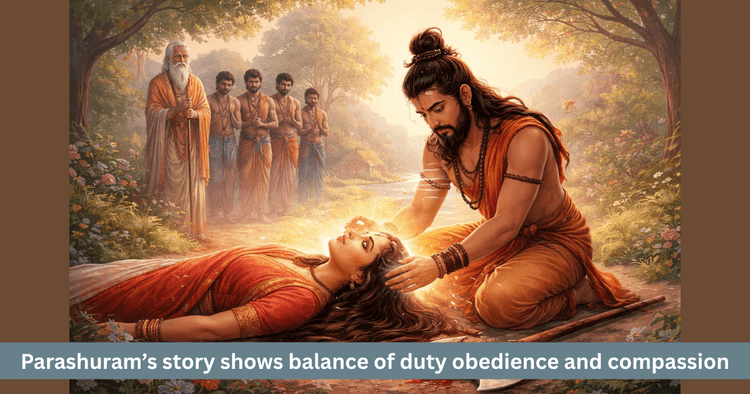
Table of Contents
Among the stories connected with Bhagavan Parashurama, this episode is one of those that appears severe at first glance, yet contains deep spiritual and philosophical meanings within it. It does not merely describe an extraordinary act. It opens the difficult terrain where duty, obedience, austerity, emotional sacrifice and compassion meet in painful tension. That is why this story is not only shocking. It is also deeply reflective.
Parashurama is often remembered as the embodiment of force, discipline and divine wrath. Yet this episode shows that within his seemingly hard exterior there also lived sensitivity, restraint and compassion. The story includes the tapas of Mother Renuka, the stern command of Maharishi Jamadagni, the hesitation of the elder sons, Parashurama’s difficult obedience and finally his desire not for personal gain but for his mother’s restoration to life. For this reason, the episode becomes not merely a tale of harsh obedience but a teaching on the balance between duty and compassion.
The purity of Mother Renuka and the sacred discipline of the ashrama
To understand the depth of this story, one must first understand the stature of Mother Renuka. She was not merely the wife of Maharishi Jamadagni. She was remembered as pure, disciplined and deeply established in tapas. It is said that through the strength of her inner purity and yogic concentration, she would daily bring water from the river in a way made possible by the subtle power of her chastity and mental steadiness. This means that her outer action was directly connected to the state of her inner consciousness.
In the ashrama life of that age, tapas was not limited to fasting or physical discipline. It was also tied to purity of thought, emotional steadiness and inward restraint. That is why Renuka’s life represented not only household virtue but also a form of sacred feminine austerity in which service, discipline and spiritual concentration lived together. This background makes the later event even more serious, because the moment of deviation did not occur in the life of an ordinary person but in the life of one whose austerity had become the basis of her power.
The brief inner disturbance that changed everything
According to the story, one day Mother Renuka went to the river to bring water. There she saw celestial beings engaged in water sport and for a brief moment her mind became inwardly disturbed. The meaning of this moment is not that of some long fall from virtue but of a subtle mental shift that in the path of severe tapas was considered significant. The story does not present this as prolonged wrongdoing. It was a momentary wave in the mind but in the atmosphere of intense austerity even a moment could become decisive.
When she returned to the ashrama, Maharishi Jamadagni perceived through his spiritual insight that this brief disturbance had arisen within her. From a modern perspective the response may seem excessive and it is natural that it would. Yet to understand the story, one must also consider the spiritual intensity and uncompromising ideal of that era. The point is not to imitate the event but to understand the kind of inner discipline through which the story was framed.
Maharishi Jamadagni’s command and the difficult question of dharma
At this point the story takes its hardest turn. Maharishi Jamadagni ordered his sons to slay their mother. This is the moment that shakes the mind. It forces the listener to ask whether this could ever be justified, whether this was dharma and whether spiritual discipline could become this severe. It is precisely because of these questions that the story must be read not only with reverence but also with great seriousness of thought.
The elder sons refused the command. Their refusal is important. It shows their emotional inability to move beyond the natural bond with their mother. They stood between filial love and obedience to their father and could not perform the act. Their refusal reveals human tenderness. It also confirms that the command itself was not ordinary and that it placed them in an impossible inner conflict.
Here the deeper questions of dharma begin to emerge:
• Is the command of father and guru to be treated as supreme
• Can emotional relationship stand above that command
• Does severe tapas operate by a different moral intensity than ordinary life
• Can obedience and compassion remain in the same heart at once
These questions are what make the story philosophically alive even today.
Why did Parashurama obey
When the elder brothers refused, Parashurama obeyed without open resistance. This is the most difficult point of the entire narrative. If seen only outwardly, he may appear harsh. But if seen inwardly, he appears as one who did not kill his emotional self but restrained it before what he believed to be a higher command. Before him stood his mother. Yet on the other side stood the word of father and guru. He chose duty over personal feeling.
This reveals Parashurama not only as a warrior but also as one formed by rigorous ascetic discipline. He did not perform the act for personal satisfaction, anger or cruelty. He performed it in obedience. This becomes evident from what follows later. His action was severe but it was not born of hatred.
The story therefore must not be read as a celebration of violence. It is a portrayal of a painful moral world in which a person may be made to choose between two unbearable truths.
Was this only blind obedience
This is the central question of the episode. Was Parashurama merely blindly obedient. The answer is not simple. If it had been only blind obedience, then when offered a boon he would not have asked for his mother’s restoration to life. That first wish reveals that love and compassion were still alive within him. For this reason, his action cannot be reduced to mere cruelty or mechanical submission. It was a severe decision made within a world where the command of father and guru was treated as supremely binding.
At the same time, the story makes one thing very clear. Dharma is not always emotionally comforting. It can place a person in situations where no decision feels pure at the human level. That is one of the deepest strengths of the story.
This episode may be understood through three levels:
| Level | Meaning |
|---|---|
| Command | The supreme authority of father and guru |
| Duty | A decision placed above personal emotion |
| Compassion | Love revealed later in the request for restoration |
This shows that Parashurama’s character is not one dimensional. Severity and compassion coexist within him.
The boon of restoration and the revelation of Parashurama’s heart
When Maharishi Jamadagni saw Parashurama’s obedience, he became pleased and offered him a boon. This is the moment where Parashurama’s deeper heart is revealed. He did not ask for more power, greater weapons, wealth or victory. He asked that his mother be restored to life.
This is the softest and deepest turning point of the story. The same son who had obeyed the terrible command now used the first opportunity given to him not for himself but for his mother. This proves that his maternal love had not died. It had been restrained, not destroyed. That is why the episode does not remain merely a tale of harsh discipline. It becomes the story of a heart that fulfilled duty, yet did not extinguish compassion.
Maharishi Jamadagni granted the boon and Mother Renuka was restored. Thus the story does not end in destruction. It moves toward restoration, forgiveness and the return of life. That is the inner balance that makes it spiritually meaningful.
How does this story make dharma appear complex
People often want to reduce dharma to simple rules. Do this, avoid that, this is right, that is wrong. But this episode shows that dharma often walks upon difficult ground. Here no single rule resolves the whole matter. There is the father’s command, the mother’s place, the severity of tapas and the eventual necessity of compassion. This is why the story presents dharma not as rigid simplicity but as something requiring deep discernment.
Several points emerge from this:
• Dharma can outwardly appear severe
• Emotion and duty do not always move in the same direction
• Compassion must ultimately be given a place
• Power and discipline are incomplete without restoration
That is why this episode becomes not only about punishment but about a dharma that finally returns life.
What does this story teach for present life
No one today is meant to live this story literally, nor would that be appropriate. But its symbolism remains powerful. In life many situations arise where emotion and responsibility stand against one another. At times family and principle collide. At times love and discipline appear opposed. At times justice and compassion demand balance. In such moments this story teaches that no decision should be understood from only one side.
For modern life, this episode offers several deep lessons:
- Duty is important but incomplete without compassion
- Discipline matters, yet restoration may matter even more
- One may make a hard decision without making the heart permanently hard
- The true goal of dharma is not punishment alone but balance and renewal
- The highest use of power is that which restores life rather than only ending it
Where obedience and compassion meet in a single story
Ultimately it may be said that the story of Parashurama slaying and restoring his mother is not merely a startling mythic event. It opens the difficult moral terrain of human dharma. Within it are the father’s command, the son’s restraint, the mother’s austerity, the brothers’ emotional inability and finally the same son asking that his mother be brought back to life. For this reason, the story teaches that true dharma is revealed not in obedience alone but in the balance of command, discernment and compassion.
This is the deepest message of the episode. If there is only severity, dharma dries out. If there is only emotion, discipline may collapse. But when both are held in balance, life can move forward in a deeper way. The story of Parashurama brings forth exactly this difficult, serious and deeply human truth.
FAQs
What was the name of Parashurama’s mother
His mother was known as Mother Renuka, who was regarded as deeply pure and austere.
Why did Maharishi Jamadagni give such a severe command
According to the story, a brief mental disturbance arose in Renuka and in the severe discipline of tapas this was treated as a serious deviation.
Why did Parashurama obey the command
He regarded the command of father and guru as supreme and placed duty above personal emotion.
Was Parashurama only severe in nature
No. His request for his mother’s restoration reveals that compassion and love remained alive within him.
What is the main teaching of this story
It teaches that the balance of duty, discipline and compassion is what makes dharma complete.
Get your accurate Kundali
Generate KundaliDid you like it?
Author

Pt. Amitabh Sharma (56 Years)
Experience: 20
Consults About: Family Planning, Career
Clients In: Punjab, Haryana, Delhi
Share this article with friends and family
About ZODIAQ
ZODIAQ is an online Vedic Astrology platform. It connects clients seeking astrological advice to experienced astrologers with deep knowledge. Our users also generate kundali and perform kundali milan for free. ZODIAQ also offers services to the Astrologers. Astrologers utilize various offerings by ZODIAQ to serve their clients effectively.
If you are a User
Consult with experienced astrologers and seek their guidance. You can also order handwritten Janm Patrika report with life prediction prepared by experienced astrologers. Generate accurate Kundali, perform Kundali Matching and check horoscope and muhurat. Utilize our online library for all the necessary astrological and spiritual information.
If you are an Astrologer
Create accurate kundali for your clients and perform Kundali Matching for up to 5 people at a time. Write comprehensive Janm Patrika report for your clients with ZODIAQ. Check client details anytime by saving it in client directory. Become more productive by tracking how many clients you guide every day.
WELCOME TO
ZODIAQ
Right Decisions at the right time with ZODIAQ
