Parashurama’s Divine Vehicle Pavan: Symbol of Speed and Sacred Resolve
By Pt. Sanjeev Sharma
Understanding the mythic vehicle that represents mind-speed travel and spiritual power in ancient tradition
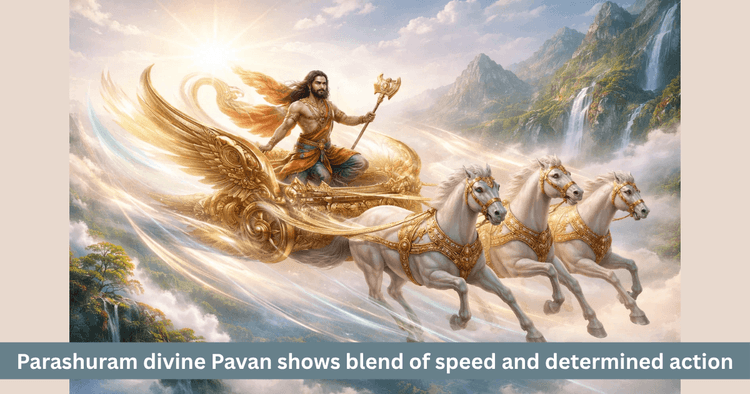
Table of Contents
Many stories associated with Bhagavan Parashurama reveal his extraordinary valor, tapasya and dharmic force, yet there are also rare references that point toward his divine means and subtle powers. Among these is the fascinating belief that he possessed a divine chariot or aerial vehicle known as Pavan. This was not seen as an ordinary vehicle. It was described as a sacred means of movement capable of traveling with the speed of the mind.
This reference is mainly associated with traditions such as Ananda Ramayana, where gods, sages and great beings are described as possessing special weapons, vehicles and sacred instruments suited to their nature. The vehicle of Parashurama belongs to that same larger stream of sacred symbolism. If he is said to have had a vehicle that moved at the speed of thought, then it reflects not only external power but also the intensity of his resolve, the clarity of his purpose and the force of his consciousness.
To view this story merely as a miraculous incident would not be enough. Indian sacred literature often expresses inward truths through outer symbols. For that reason, understanding the divine vehicle Pavan does not mean only learning that Parashurama had a wondrous means of travel. It also means understanding how that vehicle becomes a symbol of his life vision, strength of resolve, mental swiftness and divine effectiveness. When a great being is described as having a vehicle that moves with the mind, it also suggests that there is no distance left between intention and action. What he thinks becomes movement. What he resolves becomes direction.
The tradition of divine vehicles in Ananda Ramayana
The mention of this divine vehicle is generally linked with traditions such as Ananda Ramayana. In Indian sacred literature, there are many descriptions of divine beings, sages and heroic figures possessing celestial weapons, chariots, aerial vehicles and subtle instruments. These are not mere decorations of narrative. They often suggest that great beings do not act only through physical strength. There is also a subtle divine order working with them, and in that order even the vehicle reflects the nature of the one who uses it.
The vehicle Pavan associated with Parashurama may be understood within this broader stream. If it could move not in an ordinary way but with the speed of the mind, then it also reveals the sharpness of his purpose and the intensity of his action. For a great yogic and ascetic being such as Parashurama, hesitation or inward slowness would not be natural. His life was marked by clarity in decision, intensity in action and firmness in purpose. therefore the form of his vehicle is described in a corresponding way.
What does the name Pavan symbolize
The name Pavan itself carries deep symbolic meaning. Pavan means wind or air, and in Indian thought air is not merely physical movement in the atmosphere. It symbolizes motion, prana, freedom, ungraspable power, swift transmission and subtle influence. Air cannot be bound, yet its effect is felt everywhere. It does not remain still, yet it is not chaotic by nature. It goes where it is needed without delay.
If Parashurama’s vehicle is called Pavan, then the meaning is not only that it was fast. It may also suggest unobstructed movement, instant presence, goal centered travel and resolve driven force. These same qualities are visible in the personality of Parashurama. He arrives without delay when dharma requires intervention. He does not hesitate before action. He does not remain confused about his aim. In that sense, the vehicle Pavan appears almost like an outer extension of his own inner consciousness.
What does movement with the speed of the mind really mean
The most striking part of this tradition is the statement that the vehicle could move with the speed of the mind. This phrase holds profound spiritual and philosophical meaning. In ordinary human life, thought, intention and action often move separately. A person thinks one thing, desires another and acts in a different direction altogether. This separation gives rise to delay, confusion and fragmentation.
But when a seeker’s mind becomes concentrated, purified and purposeful, then the distance between thought and action diminishes. A vehicle moving with the speed of the mind may be seen as the symbol of such a state. It indicates that in Parashurama, resolve and action were not divided. What arose within as thought could immediately become movement in the outer world. This is not only a matter of divine technology. It is also a sign of spiritual efficiency and inward mastery.
How does this connect with the life of Parashurama
The life of Bhagavan Parashurama is itself a life of intensity. Whenever he took a decision after due discernment, there was no wavering in it. He remained clear in questions of dharma, swift in his response to injustice and steady in his austerity. Within him were joined the wisdom of a Brahmin, the fire of a Kshatriya and the discipline of an ascetic. For such a being, a vehicle like Pavan becomes a deeply fitting symbol.
If one observes his life, some qualities appear again and again:
- Clarity of resolve
- Swiftness of action
- Firm discipline
- Life connected with divine purpose
- Harmony of inner and outer power
These are the very qualities reflected in the symbolism of Pavan. Thus the vehicle does not remain merely external. It becomes the moving form of Parashurama’s own consciousness.
Is this only a mythical imagination
This is a natural question. From a modern standpoint, a vehicle moving with the speed of the mind may immediately seem like pure imagination. Yet the language of Indian sacred literature can be both symbolic and experiential. This does not mean every statement must be judged only by the standards of physical mechanics. At times a story may express inner capacity, yogic attainment, divine transmission or spiritual realization through outer forms.
For this reason, Pavan may be understood on three levels:
| Level | Meaning |
|---|---|
| Mythic | Parashurama possessed a divine vehicle |
| Symbolic | It is an image of the unity of resolve and movement |
| Spiritual | It represents the state where thought and action are instantly aligned in purified consciousness |
When these three levels are held together, the story becomes much richer. It is then no longer only an amazing memory of the past. It begins to question the reader of the present. How much distance remains between one’s thought and one’s action. How clear is one’s intention. How purified is one’s movement through life.
The relationship between science and spirituality in ancient Indian thought
This episode also points toward another important insight. In Indian tradition, science and spirituality were not always understood as separate or opposed. Descriptions of celestial weapons, subtle vehicles, swift travel, distant communication and extraordinary energies appear in many sacred narratives. Whether one sees these through a technological lens or a symbolic one, one thing is clear. The ancient Indian imagination was not restricted only to the material level of existence. It accepted that on higher levels of consciousness and power, possibilities might exist that ordinary perception cannot easily explain.
Parashurama’s vehicle Pavan should be viewed in this broader context. It reminds us that in Indian thought, movement did not mean only physical speed. Prana, thought, resolve, tapas and divine purpose could also direct movement. This perspective remains relevant even now, because outer speed has greatly increased in modern life but inner clarity has not always grown along with it. The story of Pavan reminds us of that difference.
What does this story teach for life today
If this narrative is interpreted in a contemporary way, its message becomes deeply practical. Human beings today possess many external tools, yet if the mind remains scattered, even the best tools do not bring one to the right destination. On the other hand, if the mind is centered, clear, steady and ripened by discipline, then even limited means can produce extraordinary results. The story of Pavan teaches that the real power does not lie in the instrument first. It lies in the consciousness of the one who uses it.
This story offers several deep indications for life today:
- A clear mind is the greatest vehicle
- Strong resolve multiplies the speed of progress
- Without discipline, power loses direction
- Spiritual centeredness can make action extraordinarily effective
- Inner awareness is what makes outer tools meaningful
Thus the story of Pavan is not merely a memory of the distant past. It urges the modern reader to ask whether thought and action in one’s own life truly flow in the same direction.
Where resolve, movement and sadhana become one
Ultimately it may be said that Bhagavan Parashurama’s divine vehicle Pavan is not merely an interesting mythical reference. It is a symbol of that state in which mind, resolve, movement and action flow in one rhythm. The life of Parashurama itself embodies such unity. What he thinks, he moves toward. What he recognizes as right, he stands for. What he accepts as his purpose, he serves with total commitment.
This is the deepest message of the episode. True divine technology does not begin outside. It is born within first. When consciousness becomes clear, resolve becomes stable and action aligns with both, life itself begins to move like Pavan, swift, goal directed and deeply effective.
FAQs
Where is the reference to Parashurama’s vehicle Pavan found
It is mainly associated with traditions such as Ananda Ramayana, where divine means and sacred instruments of great beings are described.
What is the symbolic meaning of the name Pavan
Pavan symbolizes movement, prana, freedom, intensity of resolve and unobstructed flow toward a goal.
What does a vehicle moving with the speed of the mind signify
It suggests a state where thought, resolve and action are no longer separated from one another.
Should this story be seen only as a miracle
No. It may be understood at mythic, symbolic and spiritual levels together.
What is the main teaching of this episode
It teaches that when the mind is clear, resolve is firm and consciousness is centered, life gains extraordinary speed and effectiveness.
Get your accurate Kundali
Generate KundaliDid you like it?
Author

Pt. Sanjeev Sharma (63)
Experience: 20
Consults About: Family Planning, Career
Clients In: Punjab, Haryana, Delhi
Share this article with friends and family
About ZODIAQ
ZODIAQ is an online Vedic Astrology platform. It connects clients seeking astrological advice to experienced astrologers with deep knowledge. Our users also generate kundali and perform kundali milan for free. ZODIAQ also offers services to the Astrologers. Astrologers utilize various offerings by ZODIAQ to serve their clients effectively.
If you are a User
Consult with experienced astrologers and seek their guidance. You can also order handwritten Janm Patrika report with life prediction prepared by experienced astrologers. Generate accurate Kundali, perform Kundali Matching and check horoscope and muhurat. Utilize our online library for all the necessary astrological and spiritual information.
If you are an Astrologer
Create accurate kundali for your clients and perform Kundali Matching for up to 5 people at a time. Write comprehensive Janm Patrika report for your clients with ZODIAQ. Check client details anytime by saving it in client directory. Become more productive by tracking how many clients you guide every day.
WELCOME TO
ZODIAQ
Right Decisions at the right time with ZODIAQ
