The Rare Meeting of Parashurama and Ravana: When Pride Faces Tapas
By Aparna Patni
A symbolic encounter revealing how inner discipline outweighs power and knowledge when pride begins to dominate.
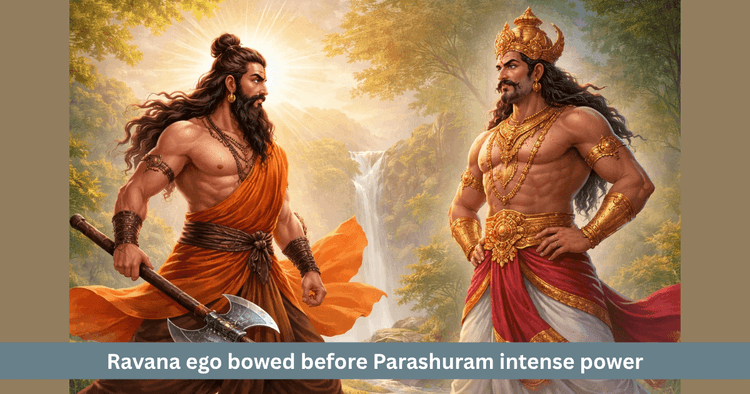
Table of Contents
In the sacred traditions of India, some episodes are far more than meetings between two powerful beings. They become deep revelations about the true nature of strength itself. The rare meeting between Bhagavan Parashurama and Ravana is one such episode. On one side stands a being who represents tapas, self restraint and dharma, while on the other stands Ravana, a figure of immense learning, power and brilliance, yet one who moves steadily toward downfall because of growing pride. In some regional Ramayana traditions and sacred folk narratives, there is mention of a striking encounter between these two extraordinary personalities, and in that encounter the most important force is not battle but the silent power that arises from inner realization.
At first glance this may seem like a short episode, yet its layers are profound. There is no battlefield prepared here. No clash of weapons takes place. No dramatic slaughter unfolds. Yet the scene conveys the weight of a confrontation in which pride and inner force stand face to face. That is why the value of this episode lies not only in its narrative curiosity but in its spiritual and moral depth.
Ravana approaches Mahendragiri in pride
According to the traditional telling, Ravana had begun moving through the worlds with growing confidence in his strength, victories and apparent invincibility. He did not challenge only kings. He also challenged great sages, ascetics and mighty beings. The thought had become firm within him that there was no one in existence who could truly resist him. It is this inner condition that brings him one day to Mahendragiri Mountain, where Bhagavan Parashurama is said to be absorbed in deep tapasya.
Mahendragiri is not remembered merely as a mountain. It is regarded as a place of austerity, silence and accumulated spiritual force. Ravana’s arrival there is therefore symbolic. He comes as the representative of outer victories, while before him sits one whose power has been born not from conquest but from long self mastery. Ravana’s nature does not allow him to remain quiet. He wishes to challenge Parashurama as well, because for him every great presence is an object of conquest, and every challenge is an opportunity for self assertion.
What happened when Ravana challenged Parashurama
The traditional account says that Ravana, true to his temperament, challenged Parashurama to combat. He carried within him the conviction that he had shaken even the gods, and therefore no ascetic could stand before him. Yet the moment he tried to advance toward Parashurama, an unseen obstruction arose. This was not a wall of stone, nor a weapon lifted in defense. It was the radiance of tapas that surrounded Parashurama, and Ravana could not bear it.
Here the most astonishing part of the episode appears. Parashurama needed to do nothing outwardly. He did not lift a weapon. He did not declare his strength. He did not respond in anger. He remained established in tapas, and that very tapas formed around him a field of power before which Ravana’s outer might became ineffective. The one who had triumphed over many beings, who had shaken worlds with his force, was halted here without any battle at all. This stopping was no ordinary thing. It was the experience of a truth in which one realizes that not every power can be faced through aggression.
What is the deepest significance of this episode
The central teaching of this narrative is that outer strength has its own limit, while inner strength belongs to an entirely different order. Outer strength reveals itself through armies, victories, weapons and domination. Inner strength is born through tapas, restraint, silence, discernment and purified consciousness. Ravana represents the first. Parashurama represents the second. Both are powerful, yet the level and nature of their power are not the same.
Ravana’s pride compels him to believe that whatever can be seen is the whole of strength. The presence of Parashurama proves that the greatest force may also be the one that appears outwardly still. That is why Ravana is defeated here even though no battle occurs. His defeat is not physical. It is the defeat of assumption. For the first time he confronts the reality that the radiance born of tapas stands at a level where external aggression cannot function in the same way.
The power of Parashurama was not limited to weapons
Bhagavan Parashurama is often remembered as the warrior who carries the parashu, yet that image reveals only one part of his being. The other and deeper part is his tapasya. He represents a tradition in which the right to wield weapons becomes meaningful only when the wielder also has mastery over himself. This is why in him martial force and spiritual discipline appear in an extraordinary balance.
Ravana may have assumed that he was confronting merely another warrior. In truth, he stood before a being whose essential force arose not from battle but from self conquest. One who has conquered himself becomes very difficult to overcome from outside. This is the heart of the episode. Parashurama did not attempt to humiliate Ravana. His mere presence was enough to reveal that the radiance of an ascetic is itself a shield.
Was Ravana’s retreat only fear
This episode should not be understood only in the language of fear. Ravana’s stopping or withdrawing may also be read as a moment of recognition. For one who has begun to see himself as supreme, the encounter with a higher form of power becomes a major turning point. Such an encounter may break a person, halt him or for a brief moment even make him humble.
Ravana is a deeply complex figure. He is not merely a villain. He is learned, austere and a great devotee of Shiva, yet his pride prevents his knowledge from remaining balanced. Therefore his halting before Parashurama also shows that somewhere within him there remained the ability to recognize a superior force. That is why the episode does not become a battle. Instead it becomes a silent moment in which outer challenge gives way to inner recognition.
What does this story teach in the present age
This episode is not meaningful only for the world of sacred narrative. It remains highly relevant even today. Modern human beings have gained many kinds of external powers. They have resources, status, technology, influence and reach. Yet if they do not possess inner stability, restraint and balance, their power remains incomplete. Ravana becomes a symbol of incomplete strength, while Parashurama becomes the symbol of strength that is inwardly complete.
This story offers several clear lessons for life:
- Pride causes a person to see every greatness as something to challenge
- Tapas makes a person powerful even without outward struggle
- Inner force can become more decisive than outer force
- Stopping in wisdom is not always defeat but sometimes understanding
- Without inner discipline, outer success remains incomplete
These points make it clear that the episode is not merely an old story. It is also a mirror for inner development.
Why is the radiance of tapas considered the highest form of strength
In Indian thought, tapas is not understood merely as severe austerity. Tapas means refining oneself to such a degree that desires, impulses and reactions no longer rule over the person. When an individual reaches such a state, the energy that shines forth from within is called tejas, radiant power. That radiance appears in speech, in decision, in silence and even in presence. It cannot be purchased, imitated or taken away through violence.
Parashurama stands as a representative of that tejas. Ravana halts at precisely this point because his outer power loses its force there. Perhaps for the first time he experiences that the strength on which he prides himself is not the highest strength. That is the profound spiritual message of the episode.
Where pride bends and tapas remains silent, yet victorious
Ultimately it may be said that the rare meeting of Bhagavan Parashurama and Ravana is not merely an interesting mythic event. It is the meeting of two different visions of life. One is rooted in outer conquest, the other in inward discipline. Ravana’s pride leads him to challenge but the tapas of Parashurama halts him at that very threshold. Without lifting a weapon, without speaking and without entering battle, Parashurama establishes that the highest strength is the one born within and untouched by outer aggression.
This is the enduring message of the episode. Before tapas, self restraint and spiritual radiance, even the greatest pride must finally bow. The pride of outer achievement may be temporary but the strength born of inner discipline belongs to a timeless order.
FAQs
Where is the meeting of Parashurama and Ravana described
It is mainly mentioned in certain regional Ramayana traditions and sacred folk narratives, especially in relation to Mahendragiri Mountain.
Did a battle actually take place between Parashurama and Ravana
According to the traditional account, the episode does not develop into battle. Ravana is unable to endure the radiance of Parashurama’s tapas.
What is the main teaching of this episode
It teaches that inner strength born of tapas and self mastery is greater than external force.
Was Ravana’s withdrawal a sign of defeat alone
It may also be understood as a moment of recognition of a higher kind of power.
Why is this episode relevant today
It teaches that position, influence and outer success are meaningful only when joined with inner balance and self restraint.
Get your accurate Kundali
Generate KundaliDid you like it?
Author

Aparna Patni (63)
Experience: 20
Consults About: Family Planning, Career
Clients In: Punjab, Haryana, Delhi
Share this article with friends and family
About ZODIAQ
ZODIAQ is an online Vedic Astrology platform. It connects clients seeking astrological advice to experienced astrologers with deep knowledge. Our users also generate kundali and perform kundali milan for free. ZODIAQ also offers services to the Astrologers. Astrologers utilize various offerings by ZODIAQ to serve their clients effectively.
If you are a User
Consult with experienced astrologers and seek their guidance. You can also order handwritten Janm Patrika report with life prediction prepared by experienced astrologers. Generate accurate Kundali, perform Kundali Matching and check horoscope and muhurat. Utilize our online library for all the necessary astrological and spiritual information.
If you are an Astrologer
Create accurate kundali for your clients and perform Kundali Matching for up to 5 people at a time. Write comprehensive Janm Patrika report for your clients with ZODIAQ. Check client details anytime by saving it in client directory. Become more productive by tracking how many clients you guide every day.
WELCOME TO
ZODIAQ
Right Decisions at the right time with ZODIAQ
