The Duel Between Parashurama and Shiva: The Secret of Trial, Valor and the Guru’s Joy
By Aparna Patni
This divine duel between Shiva and Parashurama symbolizes not conflict but a test of disciple and the guru’s grace
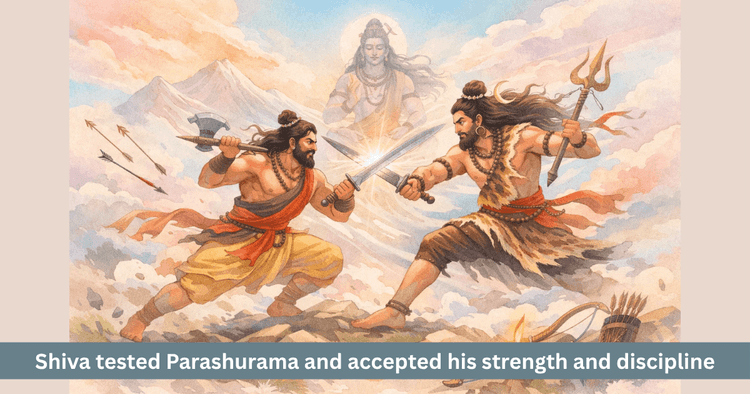
Table of Contents
The life of Bhagavan Parashurama is not confined only to stories of war, punishment and vengeance. It also contains deep dimensions of sadhana, devotion to the guru, discipline and the gradual unfolding of inner power. One such profoundly meaningful episode is the story in which Lord Shiva himself enters into a duel with his disciple Parashurama in order to test him. This is not merely a display of strength. It is the story of that rare moment in which the guru examines the disciple, elevates him and finally becomes deeply pleased with his attainment.
The beauty of this episode lies in the fact that the battle here does not mean hostility. The use of weapons is not meant for destruction but for the confirmation of worthiness. From an ordinary perspective, the idea of a duel between Shiva and Parashurama itself appears astonishing, because on one side stands Mahadeva, the supreme source of weapons, tapas, dissolution and grace and on the other stands his devoted disciple Parashurama, who had used the knowledge granted by his guru for the protection of dharma. Thus this duel becomes not an outer conflict but a spiritual test.
Why was the relationship between guru and disciple so special here
Parashurama was not only a worshipper of Shiva. He was a disciple who did not merely hear his guru’s teachings but absorbed them into his very being through tapas and practice. Shiva did not teach him only the handling of weapons. He also taught him the balance of battle, self restraint, the dignity of strike, the responsibility of power and the moral awareness that must stand behind force. This is why Parashurama’s martial brilliance was unlike that of ordinary warriors. It contained not only velocity but also discernment.
The relationship between guru and disciple becomes complete only when the disciple does not merely receive the guru’s wisdom with reverence but transforms it into living reality within himself. That is what Parashurama did. Within him, Shiva’s teaching was alive not only as external skill but as a principle of life. therefore when Shiva decided to test him, it was not merely a question of technical mastery. It was also a question of whether the disciple had truly absorbed restraint and devotion along with power.
Why did Shiva decide to test Parashurama
According to the tradition, there came a moment when Lord Shiva wished to know how far his disciple had now progressed. The purpose of a guru is never to humiliate a disciple. A true guru wants to bring out the hidden height within the disciple. Often the guru knows that the disciple is ready, yet the disciple himself does not fully recognize his own completeness until he is made to pass through a difficult trial. Shiva’s decision must be understood in exactly this spirit.
The test was necessary for another reason as well. Parashurama’s life was not meant to remain in meditation alone. He was destined to confront great crises in the protection of dharma. For that, it was essential that his strength should not remain only learned but become proven. That is why Shiva himself challenged him to battle. The guru here appears in a wonderful form. He does not only teach. He leads the disciple to that final point where his worthiness becomes unmistakable.
Was this only an external battle
If this episode is read only as a clash of weapons, then only a small part of its meaning becomes visible. In truth, it was also an inner conflict. Before Parashurama stood the very guru from whom he had learned everything. therefore his greatest challenge was not merely to attack. His greatest challenge was to preserve both reverence and duty at the same time. He could not disrespect his guru, yet he also could not allow himself to appear weak before the challenge given by that guru.
That is the depth of this episode. On the battlefield, Parashurama faced not only Shiva but also the hesitation within himself that naturally arises from deep devotion to one’s teacher. Yet a true disciple is one who internalizes the guru’s teaching so completely that, when tested, he can use it with full power. That is exactly what Parashurama did. He preserved reverence but did not restrain his own capability. That balance is what makes him great.
What did Parashurama reveal in this duel
When Parashurama accepted the challenge, he revealed not merely bravery but control, the mark of a fully accomplished warrior. Each of his strikes carried skill, yet none of them were blindly violent. Every movement contained force, yet not imbalance. In this way he proved that the guru’s teaching was alive within him not as memory alone but as living mastery.
Parashurama’s accomplishment in this episode may be understood through several points
- He stood before his guru not in fear but in devoted courage
- He did not suppress his power, because that would have insulted the very teaching he had received
- He maintained balance throughout the duel, revealing self mastery
- He showed that the grace of the guru becomes meaningful only when the disciple can live it fully
That is why this episode becomes not merely a story of valor but a story of ripened power.
The moment when Parashurama’s strike reached Shiva’s forehead
One of the most fascinating and profound points of the story is the moment when one of Parashurama’s strikes became so powerful that it touched the forehead of Lord Shiva and left a wound like mark there. The ordinary mind is startled by such an image. Mahadeva, before whom gods, demons and perfected beings bow, whose defeat is unimaginable, is touched by the blow of his disciple. This is no small detail.
Yet this is precisely the secret of the episode. The purpose here was never to defeat Shiva. The purpose was to reveal that the disciple had reached a state where his knowledge had become accomplished power. This is also where the mystery of Shiva’s joy is hidden. Shiva did not become angry. He became pleased. Why. Because he saw that his disciple was no longer merely learning. He had become a being capable of standing before his guru himself without fear and with complete mastery.
This episode reveals a beautiful truth. A true guru is not threatened by the excellence of the disciple. He is delighted by it. The real greatness of a guru lies in preparing such a disciple who can stand even before the guru and demonstrate the radiance of that teaching.
What is the real meaning of Shiva’s joy
Shiva’s joy did not arise merely because Parashurama had become powerful. He was pleased because Parashurama had not allowed that power to turn into ego. He fought with complete mastery, yet without irreverence. He displayed his strength, yet did not forget his limit. It was this balance that was dear to Shiva.
The meaning of Shiva’s joy is also that Parashurama had become ready for the next stage. The test of the guru is considered fulfilled only when three elements appear together in the disciple
| Quality | Meaning |
|---|---|
| Strength | The actual force of realized capability |
| Balance | Restraint and dignity in the use of power |
| Devotion | Reverence for the guru even in the moment of excellence |
When these three come together, the disciple is not merely skilled. He becomes accomplished.
Why is the guru’s test necessary in life
This episode points toward a very deep principle of life. Without testing, neither the truth of knowledge becomes clear, nor can capacity fully unfold. Often a person feels that he has understood much. Yet until he lives that knowledge in a difficult moment, in a real challenge or under pressure, his attainment remains incomplete. The guru’s test transforms this incompleteness into ripeness.
For Parashurama this duel was not merely an external challenge. It was the final testing of all that had been prepared within him. Shiva offered him the opportunity to recognize the fullness that had already awakened in him. That is why this battle appears not as punishment but as the final stage of initiation. The work of a guru is not only to shelter. Sometimes it is also to place the disciple in a situation where he must face his own highest capacity.
What does this story reveal about respect and confidence
People often imagine that respect means reducing oneself, while confidence means standing as an equal before another. But this episode shows that the two can walk together. Parashurama did not abandon his reverence for Shiva, yet he also did not suppress his own attained power. That is the mark of a true disciple. He does not stand before the guru in self diminishment but in worthy humility.
This balance remains deeply relevant even today. To honor a teacher, guide or elder while also expressing one’s fully developed ability with courage are not opposing attitudes. When such balance arises, a person remains free from both arrogance and inferiority. The duel of Parashurama and Shiva stands as a radiant example of that truth.
What does this story teach life today
This is not merely an ancient tale of divine combat. Even today its meaning remains alive. In every field, the role of teacher, mentor, guide and guru remains important. And in the life of every seeker, student or practitioner, a moment comes when a real test appears. In that test, memory alone is not enough. One needs confidence, balance, devotion and applied mastery all together.
Several enduring lessons emerge from this story:
- True education is that which remains alive in testing
- The love of the guru may sometimes appear in the form of challenge
- Power is sacred only when joined with restraint and dignity
- The greatest success of the disciple is that which gives joy to the guru, not humiliation
- Confidence and humility can exist together
Where the test gave the disciple power and the guru joy
Ultimately it may be said that the duel between Parashurama and Shiva is not merely a mythic tale of wonder. It is the story of that rare bond between guru and disciple in which teaching is not merely given but proven. Shiva did not only grant Parashurama martial knowledge. He also made him capable of entering the highest test of that very knowledge. And Parashurama proved that the true disciple is one who fulfills the grace of the guru through courage, balance and devotion.
This is the deepest secret of the story. The joy of the guru becomes complete when the disciple himself becomes the living proof of the teaching received. That is what Parashurama became. This is why the story still teaches us that the aim of spiritual and disciplined life is not merely to receive knowledge but to live it so fully and so beautifully that it itself begins to shine as divine power.
FAQs
Why did Shiva engage Parashurama in a duel
Shiva did so to test the worthiness, balance and accomplished martial mastery of his disciple Parashurama.
Was this battle motivated by hostility
No. It was not born of enmity but was a means by which the guru examined the disciple’s readiness and fullness.
What does Parashurama’s strike reaching Shiva’s forehead signify
It signifies that Parashurama had become so fully accomplished in his learning that he could stand fearlessly before his own guru.
Why did Shiva not become angry at this strike
Because he saw in it not ego but attainment, balance and the successful flowering of his own teaching and therefore he was pleased.
What is the main message of this story
That true education makes the disciple capable of revealing his fullest ability while still preserving reverence, restraint and humility.
Get your accurate Kundali
Generate KundaliDid you like it?
Author

Aparna Patni (63)
Experience: 20
Consults About: Family Planning, Career
Clients In: Punjab, Haryana, Delhi
Share this article with friends and family
About ZODIAQ
ZODIAQ is an online Vedic Astrology platform. It connects clients seeking astrological advice to experienced astrologers with deep knowledge. Our users also generate kundali and perform kundali milan for free. ZODIAQ also offers services to the Astrologers. Astrologers utilize various offerings by ZODIAQ to serve their clients effectively.
If you are a User
Consult with experienced astrologers and seek their guidance. You can also order handwritten Janm Patrika report with life prediction prepared by experienced astrologers. Generate accurate Kundali, perform Kundali Matching and check horoscope and muhurat. Utilize our online library for all the necessary astrological and spiritual information.
If you are an Astrologer
Create accurate kundali for your clients and perform Kundali Matching for up to 5 people at a time. Write comprehensive Janm Patrika report for your clients with ZODIAQ. Check client details anytime by saving it in client directory. Become more productive by tracking how many clients you guide every day.
WELCOME TO
ZODIAQ
Right Decisions at the right time with ZODIAQ
