End of Sahasrarjuna’s 1000 Arms: Parashurama and the Fall of Arrogance
By Pt. Sanjeev Sharma
When power turns into arrogance, downfall becomes inevitable
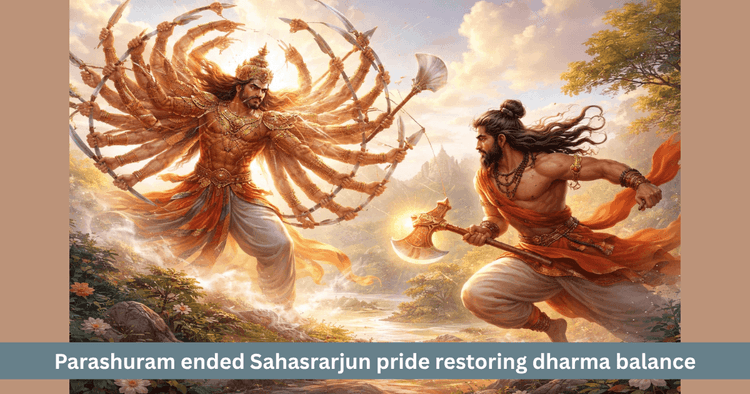
Table of Contents
Among the many battles associated with Bhagavan Parashurama, the conflict with King Kartavirya Arjuna, known as Sahasrarjuna, is one of the most famous and symbolic. This is not merely the story of two powerful beings facing each other in war. It is a decisive confrontation between dharma and arrogance, between restraint and abuse of power, between duty and domination. Sahasrarjuna, because of his thousand arms and immense strength, was considered invincible. Yet this story reveals that when power becomes separated from humility, that very power becomes the cause of downfall.
This episode should not be understood only as an external battle. It is also the portrait of a ruler’s inner journey, one that moves from blessing to greatness, from greatness to pride and from pride to destruction. On the other side stands Parashurama, representing the kind of strength that rises not for personal gain but for the protection of dharma. That is why the story remains relevant even today. Whenever power becomes detached from responsibility, the memory of Sahasrarjuna returns.
Who was Sahasrarjuna and why was he called by that name
King Kartavirya Arjuna was regarded as a ruler of extraordinary force and influence. He came to be known as Sahasrarjuna because he possessed a thousand arms. This power was not something ordinary. It had come to him through a boon and because of it he enjoyed exceptional authority, fame and strength. In the early phase of his life, his power was associated with protection, kingship and order. He was not only strong but also capable.
Yet it is here that the deeper part of the story begins. Every boon carries within it a test. The greater the power, the greater the responsibility attached to it. When a person understands this responsibility, strength becomes a means of protection. When he does not, the same strength gradually gives rise to inner tendencies that pull him away from balance. That is what happened with Sahasrarjuna. His thousand arms were not only a sign of physical strength. They also became a symbol of how extraordinary capacity can give birth to ego.
How did blessed strength turn into the foundation of arrogance
At first, Sahasrarjuna’s life may be seen in the light of an ideal ruler but over time his power gave rise to the belief that he was invincible, supreme and beyond all limits. This is the point where departure from dharma begins. As long as strength remains in the service of protection, it is worthy of respect. When it becomes a means of domination, display and control, it begins moving toward adharma.
The deeper message here is that downfall does not usually arrive in a single instant. It grows gradually. First a person recognizes his power, then he begins to enjoy it, then he begins to trust it absolutely and finally that very power covers his vision. Sahasrarjuna passed through the same process. He came to believe himself so great that he could no longer respect the sanctity of a sage’s hermitage, the right of a seer or the dignity of a divine gift. That inward distortion prepared the ground for his outer fall.
What happened in the hermitage of Maharishi Jamadagni
According to the story, Sahasrarjuna once came to the hermitage of Maharishi Jamadagni. The hermitage was filled with the force of austerity, simplicity, sacred peace and living dharma. There he saw the miraculous power of Kamadhenu, the divine cow who could produce resources according to need and was deeply connected with the life of the sage and the performance of sacred duties. She was not merely property. She represented the blessing of tapas, righteousness and divine grace.
When Sahasrarjuna saw the power of Kamadhenu, greed arose within him. This was not merely material desire. It was the mentality that believes that wherever power can be seen, it may be claimed. He decided to take Kamadhenu away by force. This is where the story reaches its turning point. It was not merely the seizure of a cow. It was a violation of the right of a sage, the dignity of tapas and the sacred domain of dharma. That is why this act is seen not as a simple injustice but as a clear crossing of the line between dharma and adharma.
This was not only a seizure. It was an insult to dharma
In many sacred narratives, outwardly small acts carry a far deeper meaning. The taking of Kamadhenu by force is one such act. On one side stood royal power. On the other stood the power of austerity. On one side was physical might. On the other was spiritual authority. Sahasrarjuna assumed that because he possessed great strength, he could claim anything, control anyone and override any boundary. That was his greatest delusion.
This episode teaches that dharma is not limited to ritual or worship. Dharma also means respect for limits. To seize what is not yours is adharma. To snatch what has been gained through tapas is adharma. To use the divine for personal greed is adharma. Sahasrarjuna violated all these limits. therefore what stood before him now was not merely another warrior but Parashurama as the protector of dharma.
How did Parashurama see this injustice
When Parashurama came to know of the घटना, he did not see it merely as a personal insult. It was indeed connected to his father’s hermitage but beyond that it was a matter of protecting dharma. This is the defining trait of Parashurama’s character. His anger is never merely personal. It rises when a sacred limit has been crossed, when injustice begins to normalize itself and when power starts destroying moral order.
Parashurama’s decision is important because he never makes war his first instinct. He uses strength only when it can no longer be avoided. In this episode as well, he confronted Sahasrarjuna because it had become clear that the king was using his boon and power against the foundations of dharma. Thus Parashurama rose not merely as a son defending honor but as a warrior representing disciplined force.
Why is the battle scene so deeply symbolic
The war between Sahasrarjuna and Parashurama is not merely a clash of great powers. It is filled with profound symbols. On one side stands Sahasrarjuna with his thousand arms, which signify not only power but also the vast spread of his arrogance. On the other side stands Parashurama, armed with the divine axe received from Shiva, with the radiance born of tapas and with unwavering commitment to dharma.
Sahasrarjuna attacked with the full force of his many arms. Each strike carried the confidence that he could not be defeated. Parashurama, however responded not only with strength but with patience, mastery, focus and balance. This is the central message of the story. Outer expansion is not always true power. Sometimes concentrated, disciplined and dharmic force is stronger than vast display.
What is the meaning of cutting off one arm after another
The most famous part of the story is that Parashurama began cutting off Sahasrarjuna’s arms one by one, until all of them had fallen and the king was defeated. This should not be read only as a display of martial skill. It is also a powerful symbolic act. Sahasrarjuna’s thousand arms represent his arrogance, his expansion, his desire to dominate and his misuse of divine strength. To cut those arms away is not merely to weaken the body. It is to destroy the layers of ego that had joined themselves to his power.
This is why the image remains so striking. Parashurama did not merely kill a king. He dismantled the inner pride that believed that extraordinary power gave a person the right to seize, control and violate all boundaries. Thus the thousand arms become symbols not only of strength but also of the distortions that accompanied it.
What is the philosophical meaning of this story
This episode can be read at many levels but its deepest meaning is that arrogance carries the seed of its own destruction. Power in itself is not the problem. The problem begins when power is separated from humility, restraint and awareness of dharma. Sahasrarjuna fell because he no longer connected his strength with responsibility. The same boon that made him great became the cause of his downfall.
On the other side, Parashurama shows that even limited means can overcome vast force, if they are joined with self mastery, truthfulness and right purpose. In this story he appears not merely as a victor but as a restorer of balance.
What does this episode teach present life
This story is not only a memory of ancient battle. It remains deeply relevant even now. In modern life, a thousand arms may appear in many symbolic forms. Wealth, position, political influence, technology, popularity, intellectual pride and institutional control can all become such arms. The real question is not how much power someone has. The real question is what that power is being used for.
This episode offers five enduring insights:
- Power becomes destructive when separated from moral restraint.
- Arrogance blinds a person to the difference between right and domination.
- Strength born of tapas and discipline is greater than the mere expansion of force.
- One who does not respect the limits of others will eventually meet the limit of his own power.
- The victory of dharma comes not only through force but through balanced consciousness.
Where the end of a thousand arms becomes a warning against self destruction
Ultimately it may be said that the battle between Sahasrarjuna and Parashurama is not merely mythic drama. It is a story that compels inward reflection. Sahasrarjuna may have been a king outwardly but his real fall began within. Parashurama may have won the battle outwardly but his real strength came from the power of dharma within. That is the final and lasting message of the story.
When power becomes separated from service, it turns into arrogance. When power becomes joined with dharma, it becomes protection. The end of Sahasrarjuna’s thousand arms is the declaration of this eternal truth, that however vast arrogance may become, it cannot endure before dharma.
FAQs
Who was Sahasrarjuna
Sahasrarjuna was King Kartavirya Arjuna, who came to be known by that name because he possessed a thousand arms.
Why did he come into conflict with Parashurama
He tried to take Kamadhenu from the hermitage of Maharishi Jamadagni by force, which was an insult to dharma and tapas.
What do the thousand arms symbolize
They symbolize not only power but also expanding arrogance and the desire for control.
Why did Parashurama cut off his arms
This was not only a battle act. It also symbolized the destruction of misused power and arrogant pride.
What is the main message of this story
It teaches that power without dharma, humility and restraint is destined to fall.
Get your accurate Kundali
Generate KundaliDid you like it?
Author

Pt. Sanjeev Sharma (63)
Experience: 20
Consults About: Family Planning, Career
Clients In: Punjab, Haryana, Delhi
Share this article with friends and family
About ZODIAQ
ZODIAQ is an online Vedic Astrology platform. It connects clients seeking astrological advice to experienced astrologers with deep knowledge. Our users also generate kundali and perform kundali milan for free. ZODIAQ also offers services to the Astrologers. Astrologers utilize various offerings by ZODIAQ to serve their clients effectively.
If you are a User
Consult with experienced astrologers and seek their guidance. You can also order handwritten Janm Patrika report with life prediction prepared by experienced astrologers. Generate accurate Kundali, perform Kundali Matching and check horoscope and muhurat. Utilize our online library for all the necessary astrological and spiritual information.
If you are an Astrologer
Create accurate kundali for your clients and perform Kundali Matching for up to 5 people at a time. Write comprehensive Janm Patrika report for your clients with ZODIAQ. Check client details anytime by saving it in client directory. Become more productive by tracking how many clients you guide every day.
WELCOME TO
ZODIAQ
Right Decisions at the right time with ZODIAQ
