Lakshmana and Parashurama in Sita Swayamvara: Emotional Contrast in Two Texts
By Pt. Narendra Sharma
When the same episode is portrayed in different emotional tones in Ramcharitmanas and Valmiki Ramayana
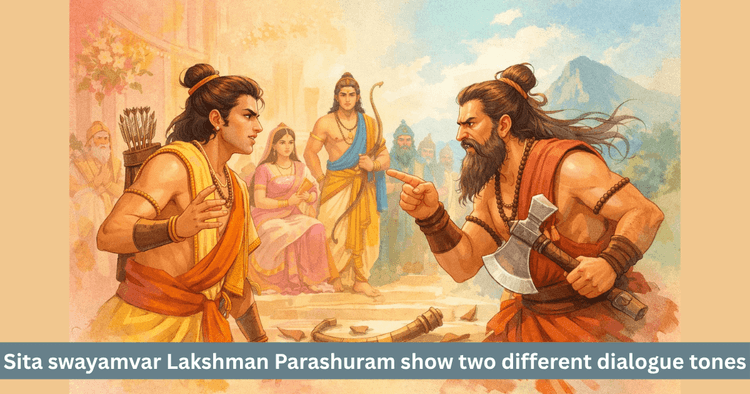
Table of Contents
The episode of Sita Swayamvara is not merely a scene of marriage in the Ramayana. It is a meeting point of many powerful emotions where valor, dharma, honor, self restraint, sacred power and divine destiny appear together. After Bhagavan Rama breaks the bow of Shiva, events begin to unfold rapidly. Among them, the arrival of Bhagavan Parashurama and his exchange with Lakshmana becomes one of the most memorable moments. It is the point at which celebration in the royal assembly suddenly turns into gravity, tension and blazing intensity. That is why this scene has held such a strong place in the minds of readers and listeners.
Yet this episode has another important feature. It is presented differently in different sacred texts. In particular, the emotional tone, sharpness and style of the dialogue between Lakshmana and Parashurama differ clearly in Ramcharitmanas and Valmiki Ramayana. The event is the same, yet the feeling surrounding it changes. That is what makes this scene not only dramatic but also deeply meaningful from literary and philosophical perspectives.
Why does this episode become so powerful
The breaking of Shiva’s bow was no ordinary event. It was not merely a display of strength. It was a clear sign that among all the kings and warriors present, no one else possessed the divine worthiness that Bhagavan Rama revealed so effortlessly. The moment the bow breaks, an epoch making turn is born within the assembly itself. The arrival of Parashurama at that very moment makes the scene even more intense, because he is a great ascetic, a peerless warrior and a supreme devotee of Shiva. For him, Shiva’s bow was not just an object. It was tied to the honor of the worshipped Lord.
When he enters the assembly in anger, everyone is stunned. At that very moment the voice of Lakshmana rises. This is where the two texts begin shaping the same episode in their own way. On one side there is youthful fire, boldness and sarcasm. On the other side there is restraint, seriousness and dignified response. This duality makes the episode especially rich for literary study.
Why does the dialogue feel so sharp and dramatic in Ramcharitmanas
In Ramcharitmanas, Tulsidas presents this episode in an intensely vivid, dramatic and emotion charged manner. Here Lakshmana does not appear as a silent younger brother. He stands forth as a radiant young warrior who is ready to defend the honor of his elder brother without hesitation. In front of the anger of Parashurama, he does not retreat. He replies, and in his words one can hear not only clarity but also sarcasm, youthful force, fearlessness and fiery self confidence.
One important feature of Tulsidas is that he does not merely narrate events. He brings them close to the emotional heart of the people. That is why the dialogue becomes more colorful, more intense and more dramatic in his telling. When Lakshmana speaks, the reader does not hear only words. One also feels the blazing sharpness of his spirit. For this reason, this scene became especially beloved in public recitation, storytelling and folk memory.
The effect of this passage in Ramcharitmanas may be understood through a few key points:
- Lakshmana’s tone is fearless and direct
- Parashurama’s anger appears in an intensely blazing form
- The atmosphere of the assembly becomes full of tension and dramatic excitement
- The dialogue carries both sarcasm and challenge
- Tulsidas brings out the inner energy of the characters very clearly
That is why this version of the episode immediately captures attention. The emotional charge is strong, and the reader feels almost as if present in the royal assembly.
Why does the same scene appear calmer and more balanced in Valmiki Ramayana
In Valmiki Ramayana, the same scene assumes a different tone. The anger of Parashurama is certainly present, yet it does not appear in as dramatic a form as in Ramcharitmanas. Lakshmana also responds but his words do not carry the same degree of sharp sarcasm found in Tulsidas. Here the style is more classical, measured and restrained.
Valmiki presents characters in a way that preserves their essential dignity and narrative seriousness. The purpose is not merely to heighten conflict but to show how even a tense and charged moment can still move forward through composure, restraint and understanding. The emotions are not absent but they are held within a more controlled structure.
Valmiki’s style is fundamentally more grave and epic in nature. The behavior of the characters aligns with that structure. Therefore the episode appears more philosophical and closer to the original epic dignity, while in Ramcharitmanas the same moment becomes more emotionally heightened and dramatic.
Two texts, two styles, one truth
The most important thing to understand is that the two texts are not opposing one another. They are shaping the same event according to their own literary duty, emotional vision, historical setting and intended audience. Valmiki writes in a more original, epic and classical mode. Tulsidas writes in a more devotional, people centered and emotionally expressive mode. Therefore it is natural that the same episode takes different forms in each work.
This difference may be viewed in a brief comparative way:
| Aspect | Ramcharitmanas | Valmiki Ramayana |
|---|---|---|
| Tone of the dialogue | Sharp and dramatic | Balanced and serious |
| Lakshmana’s emotional presence | Fearless, sarcastic, blazing | Restrained, dignified, measured |
| Form of Parashurama | Fiery and immediately reactive | Angry, yet more epic and formal |
| Reader’s experience | Emotional and theatrical | Philosophical and steady |
| Style | Popular, rasa filled | Classical and foundational |
This comparison is not meant to declare one higher and the other lesser. Each possesses its own independent greatness. Together they make the episode broader and richer.
What does this difference reveal about Lakshmana’s character
Through this episode, Lakshmana appears in different shades in the two texts. In Ramcharitmanas he seems more energetic, blazing, protective of his brother’s honor and quick to respond. This form makes him especially beloved in popular devotional memory, because it joins youthful force with complete loyalty.
In Valmiki Ramayana, Lakshmana appears more controlled, structured and inclined toward restrained response. His brilliance is not less but its expression is more disciplined. This shows that in literature, characters are not always presented in one fixed image. Their expression may change according to the author’s vision, even when their essential dharma remains the same.
What does this episode teach us about Parashurama
Parashurama too should not be seen here merely as an angry sage warrior. He is not only a symbol of wrath but also a figure deeply sensitive to the honor of his chosen Lord. When he learns that Shiva’s bow has been broken, his anger is not merely personal. Behind it stands reverence, dharmic feeling and a fierce awareness of sacred dignity. That is why his anger should be understood not only as intensity but also as devotion charged with principle.
In both texts his form is brought forth in different proportions. Ramcharitmanas gives him stronger dramatic fire, while Valmiki Ramayana presents him in a more epic and dignified manner. This helps us see that great figures should never be reduced to only one dimension.
Why does literature show us this difference
This episode offers another deeper lesson. Literature does not merely inform us about events. It also allows us to view the same event through different lenses. The emotion of an event, its effect, its expression and even its moral texture may change according to the author’s mind, the cultural world of the audience and the purpose of the composition. therefore when we notice the difference between Ramcharitmanas and Valmiki Ramayana in this episode, we are actually witnessing two distinct literary sensibilities.
From this emerges a profound teaching. Truth may remain one, while its expression may appear in many forms. This is one of the great beauties of the Indian sacred tradition. It allows a single episode to be lived and understood through many emotional worlds. In that way, the reader travels not only through the narrative but through layers of feeling and insight as well.
Is this difference a contradiction or an expansion
This difference is not a contradiction. It is an expansion. Ramcharitmanas connects the scene with popular emotional experience. Valmiki Ramayana places it within the dignity of the original epic. Together they show how dharma, honor, radiance, devotion and loyalty can work on multiple levels within the same event. That is the real richness of the scene.
If one reads only Ramcharitmanas, one is struck by the dramatic fire of the moment. If one reads only Valmiki Ramayana, the same moment appears as a grave and balanced exchange. But when the two are read together, the episode becomes fuller. One then understands that in Indian tradition, a story is not merely told once. It is reborn in different forms of consciousness.
Where one episode reveals its truth in two different emotional lights
Ultimately it may be said that the dialogue between Lakshmana and Parashurama during Sita Swayamvara is not merely a memorable event. It also reveals the difference of style, emotional setting and modes of expression between two great sacred texts. Ramcharitmanas presents the scene in a sharper, more people centered and emotionally heightened way, while Valmiki Ramayana presents it with seriousness, restraint and classical dignity.
This is the deepest message of the episode. Truth does not change, yet its expression may change according to time, author and emotional vision. That is why the same event shines in two different lights in two different texts, and both forms carry complete meaning in their own place.
FAQs
In which context does the dialogue between Lakshmana and Parashurama occur
It takes place after Bhagavan Rama breaks Shiva’s bow during Sita Swayamvara, when Parashurama arrives in anger.
Why does the dialogue seem sharper in Ramcharitmanas
Because Tulsidas presents it with stronger emotion, dramatic force and popular expressive energy, which highlights Lakshmana’s fiery nature.
Why does the same scene appear different in Valmiki Ramayana
Valmiki’s style is more classical, balanced and serious. Therefore the exchange appears more restrained and dignified there.
Should the difference between the two texts be seen as contradiction
No. It is not contradiction but a difference of literary expression. Both present the same truth in distinct emotional and stylistic forms.
What is the main message of this episode
It teaches that the expression of one event may differ, while the core truth remains the same. That is one of the great beauties of sacred literature.
Get your accurate Kundali
Generate KundaliDid you like it?
Author

Pt. Narendra Sharma (63)
Experience: 20
Consults About: Family Planning, Career
Clients In: Punjab, Haryana, Delhi
Share this article with friends and family
About ZODIAQ
ZODIAQ is an online Vedic Astrology platform. It connects clients seeking astrological advice to experienced astrologers with deep knowledge. Our users also generate kundali and perform kundali milan for free. ZODIAQ also offers services to the Astrologers. Astrologers utilize various offerings by ZODIAQ to serve their clients effectively.
If you are a User
Consult with experienced astrologers and seek their guidance. You can also order handwritten Janm Patrika report with life prediction prepared by experienced astrologers. Generate accurate Kundali, perform Kundali Matching and check horoscope and muhurat. Utilize our online library for all the necessary astrological and spiritual information.
If you are an Astrologer
Create accurate kundali for your clients and perform Kundali Matching for up to 5 people at a time. Write comprehensive Janm Patrika report for your clients with ZODIAQ. Check client details anytime by saving it in client directory. Become more productive by tracking how many clients you guide every day.
WELCOME TO
ZODIAQ
Right Decisions at the right time with ZODIAQ
