Bharata Tapasya and Nandigram: When Love Chose Dharma
By Pt. Sanjeev Sharma
A profound Ramayana episode: renunciation, devotion, and righteous living
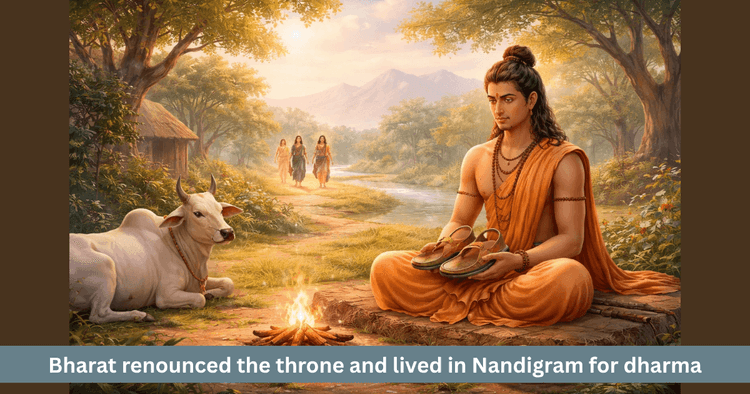
Table of Contents
Among the great characters of the Ramayana, Bharata holds a place of extraordinary depth. His life cannot be understood merely as the love of a younger brother. That love is certainly present but far beyond it one sees renunciation, devotion to dharma, humility, inner discipline and a complete freedom from ego. Bharata’s life in Nandigram proves that true greatness does not lie only in wearing a crown but also in recognizing the rightful place of another and stepping back with dignity.
When Shri Rama was sent into exile, the deepest pain in Ayodhya was not only in the grief of King Dasharatha or the crisis of the kingdom. It was also in the rupture of a sacred bond between brothers. With Rama’s departure, Ayodhya seemed to lose its living soul. It is in this setting that Bharata’s character begins to shine and the more one reflects on him, the clearer it becomes that the Ramayana is not only a story of war and victory but also of relationships governed by dharma.
What Truth Did Bharata Face When He Returned
Bharata was not present in Ayodhya when Kaikeyi asked for her boons and Rama was sent to the forest. When he returned and heard what had happened, he was not confronted with a mere painful event. He stood before a truth that shook his heart completely. He learned that because of his mother’s demands, Rama had gone to the forest, his father had died in sorrow and Ayodhya was covered in grief.
On hearing this, Bharata felt no delight in the possibility of kingship. There was no joy, no greed for power, no attraction toward authority. His heart filled instead with pain, shame, repentance and an immeasurable love for Rama. This is the first mark of his greatness. What the world could call royal fortune, Bharata saw as a reason for sorrow.
He understood immediately that as long as Rama lived, no one else could be the rightful ruler of Ayodhya. This truth became the foundation of all his later decisions.
Why Did Bharata Try to Bring Rama Back
Bharata did not believe that grief alone fulfilled his duty. He immediately resolved to go into the forest and request Rama to return and take up the kingdom. This was not only the act of a loving brother. It was also an expression of true political and moral understanding. He knew that rulership is not determined by accident or opportunity but by righteousness and worthiness and from that perspective Rama alone was the true king.
When Bharata reached Rama, his appeal was not merely emotional. It was rooted in truth. He told Rama that Ayodhya belonged to him, the people belonged to him and the throne belonged to him. This shows that for Bharata, love and dharma were not separate currents. They flowed as one.
But Shri Rama, holding firmly to his vow and his sense of duty, refused to return. It is here that Bharata faced the greatest test of his life.
What Was Bharata’s Greatest Test
Bharata stood before two truths at once. On one side, the kingdom had to be governed in Rama’s absence. On the other, accepting that kingdom as his own was impossible for him. He could neither disobey Rama’s command nor take Rama’s place.
This was Bharata’s deepest test. It was not a test of battle but of the inner life. It was the test of a man to whom power was available but who had already renounced it in his heart. Many people struggle to gain authority. Only a rare few receive authority and still consider it not rightfully theirs. Bharata belongs to that rare category.
The way he resolved this test is what gives him an immortal place in sacred memory.
What Was the Deeper Meaning of Placing Rama’s Sandals on the Throne
Bharata placed Shri Rama’s sandals upon the throne of Ayodhya and regarded himself only as Rama’s representative. This was not merely an emotional gesture. It was a clear declaration that Rama alone was the king, not Bharata. Bharata would administer the kingdom but sovereignty belonged only to Rama.
The sandals were not just footwear. They symbolized Rama’s presence, his right, his dharma and his authority. Bharata deliberately kept himself below the throne and demonstrated that the true servant is the one who refuses to claim ownership even when opportunity offers it.
This episode still stands as one of the highest models of leadership. Leadership is not simply occupying a seat. True leadership means serving a trust one does not own. Bharata’s life is a radiant example of this truth.
Why Did Bharata Refuse to Live in the Royal Palaces
Had Bharata wished, he could have reasoned that since he was ruling in Rama’s name, there was nothing wrong in staying within the palace. Yet he refused not only the throne but also the comforts and luxury associated with it. He did not want to remain amidst royal splendor while Rama lived in hardship. For him, such a contrast was unbearable.
That is why he chose to live in Nandigram, away from the city, away from the palace, away from all signs of privilege. There he adopted a life of simplicity and austerity. This was not for display. It was the outer shape of the truth already established in his heart. He could not let Rama bear exile while he himself enjoyed royal ease.
Here Bharata’s renunciation stops being an idea. It becomes a way of life.
What Was Bharata’s Life in Nandigram Like
Nandigram was not merely a place of residence for Bharata. It became a place of sacred discipline. Traditions say that he lived there in great simplicity. He remained on the ground, rested on grass, avoided royal garments and lived almost like an ascetic. This was not mere outward hardship. It was the visible expression of his inward vow.
He constantly reminded himself that he was not enjoying the kingdom but carrying its responsibility as a servant appointed in Rama’s absence. The years in Nandigram were not merely years passing by. They were years of waiting, years of fidelity, years of remembrance and years of restraint.
This is where Bharata’s love shines most clearly. He did not live Rama’s absence merely as sorrow. He lived it as tapasya.
Was Bharata’s Tapasya Only External or Also Inner
Bharata’s tapasya was not limited to his dwelling, clothing or bed. Its deepest form was inward. To wait for a beloved for fourteen years and yet never let that waiting turn into bitterness, self pity or selfish desire is no ordinary thing. Bharata kept alive the hope of Rama’s return each day but he did not let that hope become restless insistence. That was his inner tapasya.
Before him stood the kingdom, the people, the daily responsibilities and the visible machinery of rule. He could gradually have begun to see himself as king. But he never allowed that subtle shift to take place. He remained awake to the truth that everything he did was in Rama’s name. That remembrance was his mental discipline.
This form of tapasya is as difficult as battle. It is often easier to confront an outward enemy than to confront subtle ego, ownership and satisfaction within oneself. Bharata won that inner battle.
Why Is Bharata’s Love Considered So Elevated
Bharata’s love is extraordinary because it does not demand possession. It is made of surrender. Many times what people call love is only the desire to keep the beloved near. But Bharata’s love seeks only to place Rama where he rightfully belongs. That is a much higher form of love.
He asked Rama to return because it was the rightful thing. When Rama refused, Bharata did not place his own emotion above Rama’s dharma. This is a very exalted state. Here love does not become stubborn. It bows before dharma. That is what makes Bharata so great.
His life proves that true love does not lie only in closeness. It also lies in honoring the truth of the beloved. If love goes against dharma, it becomes attachment. Bharata’s love remains holy because it is governed by dharma.
Can Bharata Also Be Seen as an Ascetic
Certainly. Normally the word ascetic calls to mind forests, hermitages, chanting and visible austerity. But Bharata shows that tapasya does not belong only to the forest. It also belongs wherever a person has every chance to enjoy power and yet chooses voluntary restraint. Bharata was a prince of Ayodhya. Authority, honor and luxury were all available to him. Yet he limited himself willingly. This too is ascetic greatness.
What makes his asceticism even higher is that it arises not from world weariness but from love shaped by dharma. This gives it a purity of a very high order.
What Is the Spiritual Meaning of the Fourteen Years in Nandigram
The fourteen years in Nandigram are years of waiting but they are much more than that. They show that time does not merely pass. It can be sanctified. Bharata did not lose those years in grief. He transformed them into the discipline of dharma. This transformation is what makes his life so great.
He governed but did not enjoy ruling. He carried responsibility but did not take pride in it. He administered but never thought of himself as sovereign. Because of this, Nandigram becomes more than a place. It becomes a symbol of inward discipline.
Spiritually, Nandigram is the ground where love and restraint become one. Bharata was not merely waiting there. He was keeping himself inwardly aligned with Rama even in Rama’s absence.
What Does This Episode Teach About Leadership
Bharata’s life offers one of the deepest lessons in leadership. True leadership is not one that uses position for personal glory. True leadership sees position as responsibility, not ownership. Bharata did not consume power. He safeguarded it. That is a profound difference.
Even today, Bharata remains a model for understanding leadership. He proved that a person can remain humble even while holding authority, provided that authority is held in the spirit of service. He did not make himself the center. He made Rama the center. That is why Bharata is not only an ideal brother but also an ideal ruler.
What Does This Story Mean for Life Today
In a time when power, recognition and personal entitlement are often treated as marks of success, Bharata offers an entirely different vision. He shows that renunciation is not weakness, humility is not defeat, waiting is not passivity and service is not a lesser path. If these are rooted in love and dharma, they become the very things that make life noble.
Bharata teaches that how a person handles available power defines character. The one who does not abandon righteousness even when opportunity tempts him is the truly trustworthy one. In this sense Bharata is not merely a figure of the past. He remains a living ideal for the present.
The Deeper Essence of This Episode
Bharata’s tapasya and life in Nandigram tell us that the highest form of love does not seek possession. It seeks righteous surrender. The highest form of renunciation does not advertise itself. It quietly fulfills duty. The highest form of leadership does not claim ownership. It sees itself as the servant of a greater truth.
That is the essence of this episode. When a person lets go of ego and embraces love and dharma, life itself becomes an ideal. Bharata proved through his years in Nandigram that true renunciation is the one performed without display, only for love, duty and sacred waiting.
Frequently Asked Questions
1. Why did Bharata place Rama’s sandals on the throne
Because he wanted it to be clear that Rama alone was the rightful king of Ayodhya and that he himself was only a representative.
2. Why did Bharata live in Nandigram
He renounced palace life and royal comfort so that he could live as a servant and ascetic in Rama’s absence.
3. Did Bharata ever consider himself king
No, he regarded himself only as Rama’s servant and caretaker of the kingdom.
4. What was Bharata’s greatest tapasya
His greatest tapasya was to remain far from power, comfort and ego while waiting for Rama for fourteen years.
5. What is the greatest lesson of this story
It teaches that true love, renunciation and dharmic leadership make a person truly great.
Get your accurate Kundali
Generate KundaliDid you like it?
Author
Pt. Sanjeev Sharma (63)
Experience: 20
Consults About: Family Planning, Career
Clients In: Punjab, Haryana, Delhi
Share this article with friends and family
About ZODIAQ
ZODIAQ is an online Vedic Astrology platform. It connects clients seeking astrological advice to experienced astrologers with deep knowledge. Our users also generate kundali and perform kundali milan for free. ZODIAQ also offers services to the Astrologers. Astrologers utilize various offerings by ZODIAQ to serve their clients effectively.
If you are a User
Consult with experienced astrologers and seek their guidance. You can also order handwritten Janm Patrika report with life prediction prepared by experienced astrologers. Generate accurate Kundali, perform Kundali Matching and check horoscope and muhurat. Utilize our online library for all the necessary astrological and spiritual information.
If you are an Astrologer
Create accurate kundali for your clients and perform Kundali Matching for up to 5 people at a time. Write comprehensive Janm Patrika report for your clients with ZODIAQ. Check client details anytime by saving it in client directory. Become more productive by tracking how many clients you guide every day.
WELCOME TO
ZODIAQ
Right Decisions at the right time with ZODIAQ
