Hanumad Ramayana: When Devotion Renounced Its Own Creation
By Pt. Suvrat Sharma
The Ramayana Written by Hanuman and the Grandeur of Devotion
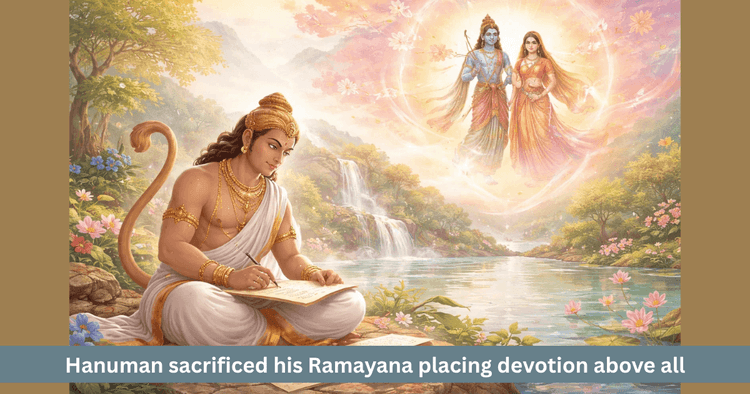
Table of Contents
The tradition of the Ramayana is as vast as it is deep. Usually, when the story of Rama is remembered, the name of Maharshi Valmiki comes first, because he gave this divine narrative its immortal literary form for all ages. Yet within this sacred tradition there is another extraordinary episode, one that reveals such a height of devotion that surrender becomes greater than creation itself. This is the story of Hanumad Ramayana, the Ramayana said to have been written by Hanuman himself through experience, love and complete devotion to Rama.
This is not merely the story of a lost text. It is the story of that deeper truth in which a devotee gives words to what he has lived and when the moment demands it, renounces even those very words. That is why the episode of Hanumad Ramayana is not only the story of a hidden composition but the revelation of devotion in its purest form.
What Was Hanumad Ramayana
According to traditional accounts, Hanuman wrote the glory of Shri Rama on the basis of his direct experience. He did not write it on paper or palm leaves but engraved it upon stones. This detail is highly meaningful, because writing on stone suggests permanence. It also expresses the feeling that what Hanuman wrote was not merely literature but an indelible imprint of his heart.
Every word he wrote held more than narrative. It contained vision, experience, the heat of service, separation, union, battle, surrender and above all a love for Rama that only one who had not merely seen Rama but inwardly lived him, could truly express.
For this reason, Hanumad Ramayana was not considered just another telling of Rama’s story. It was a Ramayana of experienced devotion.
Why Is Hanuman’s Ramayana Considered So Extraordinary
Maharshi Valmiki saw the story of Rama through divine vision. He shaped it into a mahakavya in which history, dharma, ethics, emotion and the depths of human life all find expression. Hanuman, on the other hand, did not merely see Rama. He lived with him. He walked with him, fought for him, carried his message, remained immersed in his name and knew both his nearness and his separation.
That is why it is said that Hanuman’s Ramayana carried an inner truth that only one who participated in the story could express. He did not write from distance. He wrote from the fire of his own lived reality. What emerged there was less description and more realization.
When a devotee writes of the Beloved, language receives not only beauty but life. The greatness of Hanumad Ramayana should be understood in this sense.
What Happened When Maharshi Valmiki Saw Hanumad Ramayana
The tradition says that at the same time, Maharshi Valmiki was also engaged in composing his own Ramayana. When he saw the Ramayana written by Hanuman, he fell silent for a few moments. In it he witnessed such depth, such vitality and such love that one could feel that these were not only words but a living stream of devotion.
This moment must be understood with care. Valmiki’s silence did not arise from ordinary comparison. It arose from a subtle realization in which a great poet feels that the truth he is shaping into verse has been lived in a way that only a true devotee could express.
The slight sadness that arose within him was not born of rivalry. It was born of humility. It was the feeling that the Ramakatha flowing from Hanuman’s devotion possessed such depth that even his own great work seemed smaller before it.
Here the greatness of both is revealed. One in devotion, the other in humility.
Did Valmiki Feel Jealousy
It would not be right to say that Valmiki felt jealousy. What arose within a sage like Valmiki was much deeper than that. It was the response of inner humility, something possible only in true greatness. Only a great creator can genuinely recognize the greatness of another creation.
He realized that Hanuman’s Ramayana carried a heat, a heart and a proximity that could not be easily reached by anyone else. That feeling touched him inwardly. In the tradition, this appears as a brief sorrow or silence.
In that one moment, the nobility of both becomes visible. One through devotion, the other through selfless honesty.
Why Did Hanuman Offer His Entire Work to the Ocean
This is the point where the episode rises to the highest peak of devotion. When Hanuman understood the subtle feeling in Maharshi Valmiki’s heart, he made an extraordinary decision without delay. He lifted his entire composition and offered it to the ocean.
This decision is not merely astonishing. It is spiritually overwhelming. That work, which may well have been incomparable, which carried the most beautiful expression of his personal realization, which the world could have revered as a supreme scripture, was renounced by him with complete ease.
This renunciation was not the result of defeat. It was not the result of pressure. It was born purely from love and humility. For Hanuman, what mattered was not that his own work should be celebrated. What mattered was that Rama’s story should live and that it should live in a way that did not wound the heart of another great soul.
What Form of Devotion Appears in This Renunciation
In Hanuman’s action, one sees one of the highest forms of devotion. A human being usually becomes attached to personal creation, labor and achievement. One wishes to be seen, appreciated and remembered. But in Hanuman’s devotion, none of this remained. For him the glory of Rama stood first and his own name stood last.
This is true selfless devotion. It is the state in which personal credit loses all value and the greatness of the Beloved becomes everything. Hanuman did not renounce his Ramayana because it was lesser. He renounced it because for him, protecting the tenderness of another heart was also a form of service to Rama.
Here Hanuman’s greatness appears not merely as that of a writer but as that of a renouncing devotee.
How Should One Understand the Difference Between Hanumad Ramayana and Valmiki Ramayana
Both Ramayanas must be seen as complete in their own place. Valmiki Ramayana is the vast scripture of vision, wisdom, poetry, history and dharma. In it the story of Rama opens into a profound portrayal of life itself. Hanumad Ramayana, on the other hand, is understood as the narrative of experience, love, service and inner nearness. If one carries scriptural breadth, the other carries devotional depth.
These two should not be seen as rivals but as complementary. One presented Rama before the world. The other dissolved Rama into the heart. One immortalized the narrative. The other immortalized love.
And then, Hanuman’s renunciation removed even the possibility of comparison. That is the most beautiful resolution of the episode.
Can the Greatest Creations Sometimes Remain Hidden
Yes, this is one of the most moving aspects of this story. It is possible that the world never saw the Ramayana that was most filled with direct emotion. It is possible that the greatest words sank into the depths of the sea. But that is precisely the beauty of devotion. It does not need public memory in order to preserve itself.
Some creations remain in libraries. Some in the memory of people. And some remain only in the heart of the Divine. Hanumad Ramayana may be understood as such a creation. It remains immortal without being visible, because its essence lay not in the text alone but in Hanuman’s feeling.
This story also teaches that not every great creation is meant for fame. Sometimes its purpose is only the fullest expression of love.
What Does This Episode Teach About Love and Devotion
This story teaches that where true devotion exists, comparison comes to an end. Where there is pure love, the distinction between self and other becomes subtle. For Hanuman, it was not necessary that the world declare his Ramayana to be the greatest. It was enough that Rama’s story should reach people and that the heart of a great sage should not remain burdened.
The most beautiful form of love appears here. It desires nothing for itself. It only gives. It can leave even its finest offering if by doing so another heart becomes light. When such love joins devotion, it becomes a form of renunciation remembered through ages.
That is why this is not merely a literary episode in the Ramayana tradition. It is an ideal of egolessness, perfect surrender and the purest love.
The Deeper Message of This Story
The episode of Hanumad Ramayana teaches that true devotion does not advertise its own greatness. It remains quiet, yet radiant. It creates, yet does not become bound by its own creation. It loves, yet does not seek recognition in return. That is why Hanuman could renounce even his own Ramayana and through that renunciation his devotion became even greater.
This story teaches that the love which keeps nothing for itself becomes the greatest of all. When devotion reaches that height, it no longer remains only a feeling. It becomes an eternal story in itself.
Frequently Asked Questions
1. What was Hanumad Ramayana
According to tradition, Hanuman engraved the glory of Shri Rama upon stones based on his direct experience and that sacred composition is called Hanumad Ramayana.
2. Why is Hanumad Ramayana considered special
Because it is believed to contain not only narrative but Hanuman’s direct experience, devotion and living service to Rama.
3. Why did Valmiki fall silent after seeing Hanumad Ramayana
He perceived in it a depth of devotion and truth that only one who had truly lived with Rama could express.
4. Why did Hanuman offer his Ramayana to the ocean
He understood the delicate feeling in Valmiki’s heart and renounced his own work, because for him the glory of Rama mattered more than his own name.
5. What is the greatest lesson of this story
It teaches that true love and true devotion do not seek praise, comparison or fame but live only in surrender and giving.
Get your accurate Kundali
Generate KundaliDid you like it?
Author

Pt. Suvrat Sharma (63)
Experience: 20
Consults About: Family Planning, Career
Clients In: Punjab, Haryana, Delhi
Share this article with friends and family
About ZODIAQ
ZODIAQ is an online Vedic Astrology platform. It connects clients seeking astrological advice to experienced astrologers with deep knowledge. Our users also generate kundali and perform kundali milan for free. ZODIAQ also offers services to the Astrologers. Astrologers utilize various offerings by ZODIAQ to serve their clients effectively.
If you are a User
Consult with experienced astrologers and seek their guidance. You can also order handwritten Janm Patrika report with life prediction prepared by experienced astrologers. Generate accurate Kundali, perform Kundali Matching and check horoscope and muhurat. Utilize our online library for all the necessary astrological and spiritual information.
If you are an Astrologer
Create accurate kundali for your clients and perform Kundali Matching for up to 5 people at a time. Write comprehensive Janm Patrika report for your clients with ZODIAQ. Check client details anytime by saving it in client directory. Become more productive by tracking how many clients you guide every day.
WELCOME TO
ZODIAQ
Right Decisions at the right time with ZODIAQ
