The Secret of Kheer and the Birth of Hanuman: Depth of a Divine Plan
By Aparna Patni
Exploring the Hidden Connection Between Divine Kheer, Putrakameshti Yajna, and the Birth of Rama and Hanuman
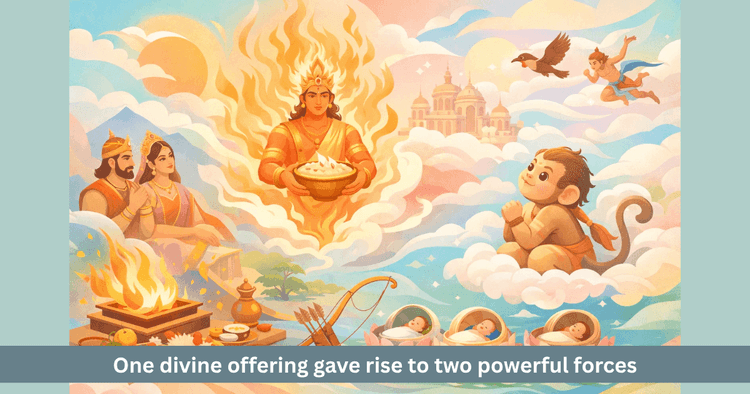
Table of Contents
The era of Treta was not merely a story of a royal lineage but a preparation to establish balance in creation. King Dasharatha of Ayodhya had remained without children for many years. This was not only a personal concern but also the waiting for a divine incarnation necessary for the restoration of dharma. For this purpose, the Putrakameshti Yajna was performed, invoking the presence of divine forces.
As the yajna moved toward completion, a rare moment unfolded. Agni Dev appeared himself. The kheer in his hands was not ordinary food. It was a divine offering prepared by the gods, carrying the power to restore balance in creation. This kheer became the medium through which the birth of Lord Rama and his brothers was ensured.
Was the Distribution of Kheer a Simple Event
King Dasharatha distributed the divine kheer among his queens with deep reverence. This distribution was not the result of ordinary calculation. Each portion carried a specific purpose within it. It was part of a plan beyond ordinary understanding.
The differences in portions given to each queen were not accidental. They reflected a structured divine intention through which different forms of dharma would manifest.
Was the Eagle Taking the Kheer Just a Coincidence
At the moment of distribution, an eagle descended and carried away a portion of the kheer. On the surface, this may appear as a random natural occurrence. however a deeper view reveals it as a planned process.
That eagle was not merely a bird. It served as a medium of the divine plan. Carrying the kheer upward, it eventually dropped a part of it over Anjana mountain.
Tapasya on Anjana Mountain and Divine Acceptance
On Anjana mountain, Mata Anjani was deeply immersed in intense penance. Her tapasya was not for personal gain. It was a preparation to hold a divine force destined to serve a greater purpose. Her mind was completely focused, devoted to Lord Shiva.
When the kheer fell into her hands, she did not see it as coincidence. In her state of penance, she accepted it as prasad. At that very moment, a divine energy flowed within her, leading to the birth of Hanuman.
Do Lord Rama and Hanuman Share the Same Origin
The most profound aspect of this story is that both Lord Rama and Hanuman emerged from the same source. The same kheer, the same divine essence, manifested in two different forms. One embodied maryada, while the other represented boundless devotion and strength.
This is not merely a story of two beings but of one energy expressing itself in dual forms.
Why Is the Meeting of Rama and Hanuman So Unique
When Rama and Hanuman meet, it is not just a meeting of a king and a devotee. It is the reunion of two expressions of the same energy. That is why Hanuman’s devotion is not external. It arises from deep inner recognition.
His attraction toward Rama was not learned. It was natural. Upon seeing Rama, he recognized the very essence from which he himself had emerged.
What Does This Story Teach About Creation
This story reveals that nothing in creation is without purpose. Every event carries meaning. The eagle taking the kheer, its fall on Anjana mountain and its acceptance by Mata Anjani were all part of a predetermined sequence.
Events that seem ordinary can become causes of great transformation. It teaches that divinity is present not only in grand miracles but also in subtle moments.
The Depth of Devotion and the Divine Connection
The bond between Rama and Hanuman is not limited to devotee and deity. It reflects a deeper unity where devotion and divinity flow together.
Rama’s role remains incomplete without Hanuman and Hanuman’s identity finds its completeness through Rama. This is why Hanuman is said to hold Rama within his heart.
What Does This Story Indicate for Life
This narrative is not just a religious account. It is a way to understand the deeper design of life. Every event carries an unseen intention. When one begins to perceive that design, the meaning of life becomes clearer.
The divine kheer was not just an offering. It was a thread that gave birth to two powerful forces. One established dharma while the other protected it through complete surrender.
The Deeper Meaning of This Story
When an action is guided by divine intention, even the smallest event becomes a cause for great outcomes. This story reflects that when devotion and strength arise from the same source, their union creates the most balanced harmony in existence.
Frequently Asked Questions
1. What was the purpose of Putrakameshti Yajna
It was performed to invite divine incarnation necessary for the establishment of dharma.
2. What was the importance of the kheer
The kheer was a divine offering carrying the energy required for the birth of incarnations.
3. Why is the eagle taking the kheer important
It was part of a divine process that led to the birth of Hanuman.
4. Why did Mata Anjani accept the kheer
In her state of penance, she accepted it as prasad which allowed divine energy to flow within her.
5. What is the deeper meaning of Rama and Hanuman’s bond
They represent two forms of the same divine energy expressed as devotion and righteousness.
Get your accurate Kundali
Generate KundaliDid you like it?
Author

Aparna Patni (63)
Experience: 20
Consults About: Family Planning, Career
Clients In: Punjab, Haryana, Delhi
Share this article with friends and family
About ZODIAQ
ZODIAQ is an online Vedic Astrology platform. It connects clients seeking astrological advice to experienced astrologers with deep knowledge. Our users also generate kundali and perform kundali milan for free. ZODIAQ also offers services to the Astrologers. Astrologers utilize various offerings by ZODIAQ to serve their clients effectively.
If you are a User
Consult with experienced astrologers and seek their guidance. You can also order handwritten Janm Patrika report with life prediction prepared by experienced astrologers. Generate accurate Kundali, perform Kundali Matching and check horoscope and muhurat. Utilize our online library for all the necessary astrological and spiritual information.
If you are an Astrologer
Create accurate kundali for your clients and perform Kundali Matching for up to 5 people at a time. Write comprehensive Janm Patrika report for your clients with ZODIAQ. Check client details anytime by saving it in client directory. Become more productive by tracking how many clients you guide every day.
WELCOME TO
ZODIAQ
Right Decisions at the right time with ZODIAQ
