Kaushalya and Dasharatha in Their Previous Birth: When Tapasya Brought the Lord as Their Son
By Pt. Amitabh Sharma
Discover how past-life tapasya and devotion led to the divine birth of Lord Rama
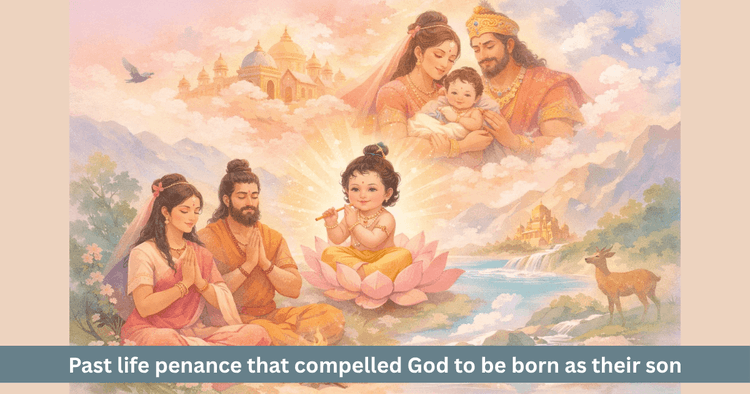
Table of Contents
In Treta Yuga, the birth of Lord Rama was not merely an event within the royal palace of Ayodhya. It was the fulfillment of a divine promise made long before. This is not only a story of incarnation but also of that deep tapasya which moved the Lord himself to bow before the love of his devotees. When the birth of Rama is understood deeply, it becomes clear that it was not merely about the continuation of a royal lineage. Behind it stood ages of accumulated devotion, austerity and waiting.
From an ordinary point of view, King Dasharatha and Mother Kaushalya appear as an ideal king and queen. They embody duty, dignity, compassion and dharma. Yet the history of their souls is far deeper. They were not merely characters of one lifetime. Behind their present birth stood an ancient spiritual preparation that made them worthy of becoming the parents of the Lord himself. This is the point at which the narrative becomes profoundly emotional and spiritual.
Were Kaushalya and Dasharatha Only Figures of This Birth
According to ancient traditions, in their previous birth they were known as Manu and Shatarupa. In some other traditions, they are remembered as Sutapa and Prishni. The names may differ but the purpose of their tapasya remained the same. They did not want only to worship the Lord from a distance. They wanted to experience him in the closest possible way. Their resolve was not limited to divine vision. Their love had become so intimate that they desired the Lord as a part of their own life.
That is why this story is not merely about receiving a boon. It is about sacred intimacy. The desire to receive the Lord as one’s own son arises only when devotion transforms from reverence into living, personal love.
Why Is Their Tapasya Regarded as So Great
Whether one follows the tradition of Manu and Shatarupa or Sutapa and Prishni, their austerity was not ordinary. They performed severe tapasya for thousands of years. This was not merely physical hardship. It was a discipline of mind, senses and desire. They centered their entire life around a single resolve and that resolve was to attain the direct presence of the Lord.
True tapasya is known not only by effort but by constancy. Time may grow long, the path may remain difficult but the resolve does not break. This was the greatest strength of their spiritual life. They did not keep changing their prayer. They did not ask for wealth, fame, kingdom or heaven. They asked only for the Lord. That is what makes their tapasya exceptional.
When a human being gathers all desires into one higher aim, a fire of spiritual power is born. It is this power that later becomes capable of reaching the divine. The tapasya of Kaushalya and Dasharatha in their previous birth became the foundation upon which the incarnation of Lord Rama was made possible.
What Boon Did They Ask From the Lord
When their tapasya reached its highest point, the Lord appeared before them. This was the moment for which they had offered countless years of austerity, patience and surrender. The Lord asked them to request a boon. It is here that the story becomes truly extraordinary.
They did not ask for prosperity, not for power, not for heavenly pleasures and not for immortality. They expressed only one wish, that they might receive a son equal to the Lord himself. This desire was not ordinary. It was not merely the longing to become parents. It was the expression of a love in which the devotee wishes to experience God in the nearest and most intimate form.
This is the tender and profound beauty of the story. Here the relationship between devotee and God does not remain one of worship alone. It turns into belonging.
Why Did the Lord Promise to Be Born as Their Son
The Lord understood the depth of their feeling. He did not say that they would receive someone like him. He said that since there is none equal to him in creation, he himself would be born as their son. This response was not merely an act of grace. It was a divine commitment. It was the highest form of the Lord accepting the love of his devotees.
A deep spiritual truth is hidden here. When devotion becomes pure, patient and free from selfishness, the Lord does not only grant blessings. He offers himself. That is why this narrative should not be seen only as the preparation for an incarnation. It is also the story of a love and tapasya so powerful that it bound even the Lord in promise.
The fulfillment of that promise did not happen immediately. Ages passed. Time changed its form. Yet a divine promise never fades. The same vow ripened later in Treta Yuga.
How Was This Promise Fulfilled in Treta Yuga
With the flow of time, those same souls were born again as Dasharatha and Kaushalya in Treta Yuga. When Lord Rama was born in Ayodhya, it was not merely the birth of a prince in a royal household. It was the fulfillment of an ancient promise once spoken between the Lord and his devotees.
Seen in this way, the event of Rama’s birth becomes far more vast. The Putrakameshti Yajna, the divine kheer, the waiting of King Dasharatha and the motherhood of Kaushalya were not only events of that moment. Behind them stood an old current of tapasya and love.
That is why the bond between Rama and Kaushalya is not merely biological motherhood. It is the fruit of previous birth austerity. In the same way, the relationship between Rama and Dasharatha is not only social fatherhood. It is the result of a love that the Lord himself had once accepted.
Does Incarnation Happen Only Because the Gods Desire It
This story makes it clear that divine incarnation is never a casual decision. Many layers of preparation stand behind it. The prayer of the gods, the need of the earth, the rise of adharma and also the tapasya of those devotees through whom the Lord will descend all work together.
The previous birth of Kaushalya and Dasharatha teaches that incarnation is not only something that descends from above. It is also the result of a long relationship between devotee and the Divine. When on earth a soul holds such love and worthiness, it becomes a vessel for the Lord’s play.
For this reason, the story of Rama’s birth should not be understood only through outer events. One must also understand the inner qualification of the devotees involved.
What Is the Deepest Form of Devotion in This Story
Many forms of devotion are described in tradition. Some relate to the Lord as master, some as friend, some as the Supreme Being. But when the devotee longs for the Lord in the form of a son, devotion becomes deeply intimate. It goes beyond worship into tenderness, affection and complete surrender.
This is the greatest beauty of the previous birth of Kaushalya and Dasharatha. They did not merely attain God. They wished to make him the innermost part of their life. That is why the Lord did not only appear to them. He gave the promise of birth.
A subtle truth also emerges here. The highest path to God is not knowledge alone. It can also be patient love. When love is free from insistence, devotion is steady and tapasya is deep, even the Lord is drawn toward it.
What Does This Story Teach For Life Today
This story is not merely a memory of Treta Yuga. It remains equally relevant now. Human beings often seek immediate results. They pray, they practice, they hope, yet patience is weak. The story of Kaushalya and Dasharatha in their earlier birth teaches that true tapasya never goes in vain, even if its fruit does not arrive immediately.
Not every deep desire receives an instant answer, because some desires demand not time alone but worthiness. When a person keeps love, patience and faith steady, then such outcomes arise in life that go beyond ordinary understanding. This is one of the greatest lessons of this story.
It is also important to understand that attaining the Lord is not merely a matter of going outward toward worship. It is an inward journey. When devotion and austerity move together, even the impossible can become possible. That is why this narrative is not merely emotional religion. It is a great example of spiritual patience.
The Love Hidden Behind Rama’s Birth
When Lord Rama entered the lap of Kaushalya, it was not only the birth of an incarnation. It was the answer to a love that had been calling the Lord for ages. When Dasharatha looked upon Rama, he was not seeing only an heir. He was seeing the fulfillment of a vow whose seed had been planted long ago.
This moment is deeply moving because here no distance remains between God and devotee. The Lord is not only worshipped. He becomes family. This is the sweetness of the story. Here devotion becomes motherhood and God becomes son.
The Final Spiritual Indication of This Story
The previous birth of Kaushalya and Dasharatha teaches that when love, tapasya and patience move together, even the Lord does not remain untouched by that call. He does not only offer blessings and leave. He enters life himself. This story also shows that divine grace does not descend upon momentary emotion. It responds to deep resolve and long sustained spiritual effort.
The preparation for Rama’s incarnation was not made only by the gods. It was also made possible by those devotee souls who waited for ages, performed tapasya and kept their love unwavering. That is why the truth of this story is not only that Lord Rama was born. Its deeper truth is that tapasya and love together create the path for incarnation.
Frequently Asked Questions
1. Who are Kaushalya and Dasharatha believed to have been in their previous birth
According to ancient traditions, they are remembered as Manu and Shatarupa, while some traditions describe them as Sutapa and Prishni.
2. What boon did they ask from the Lord
They did not ask for wealth or kingdom but expressed the wish to receive a son equal to the Lord himself.
3. Why did the Lord promise to be born as their son
Because he said there is none equal to him in creation, so he himself would take birth as their son.
4. What is the deepest spiritual meaning of this story
It shows that pure love, long tapasya and patient devotion can draw even the Lord into intimate closeness with the devotee.
5. What lesson does this story offer for life today
It teaches that true spiritual effort never goes in vain and when devotion and patience move together, even the impossible can become possible.
Get your accurate Kundali
Generate KundaliDid you like it?
Author
Pt. Amitabh Sharma (56 Years)
Experience: 20
Consults About: Family Planning, Career
Clients In: Punjab, Haryana, Delhi
Share this article with friends and family
About ZODIAQ
ZODIAQ is an online Vedic Astrology platform. It connects clients seeking astrological advice to experienced astrologers with deep knowledge. Our users also generate kundali and perform kundali milan for free. ZODIAQ also offers services to the Astrologers. Astrologers utilize various offerings by ZODIAQ to serve their clients effectively.
If you are a User
Consult with experienced astrologers and seek their guidance. You can also order handwritten Janm Patrika report with life prediction prepared by experienced astrologers. Generate accurate Kundali, perform Kundali Matching and check horoscope and muhurat. Utilize our online library for all the necessary astrological and spiritual information.
If you are an Astrologer
Create accurate kundali for your clients and perform Kundali Matching for up to 5 people at a time. Write comprehensive Janm Patrika report for your clients with ZODIAQ. Check client details anytime by saving it in client directory. Become more productive by tracking how many clients you guide every day.
WELCOME TO
ZODIAQ
Right Decisions at the right time with ZODIAQ
