Kevat’s Bond From a Previous Birth: Unfulfilled Desire for Divine Touch
By Pt. Nilesh Sharma
A profound Ramayana episode: devotion, waiting, and lifetimes of longing
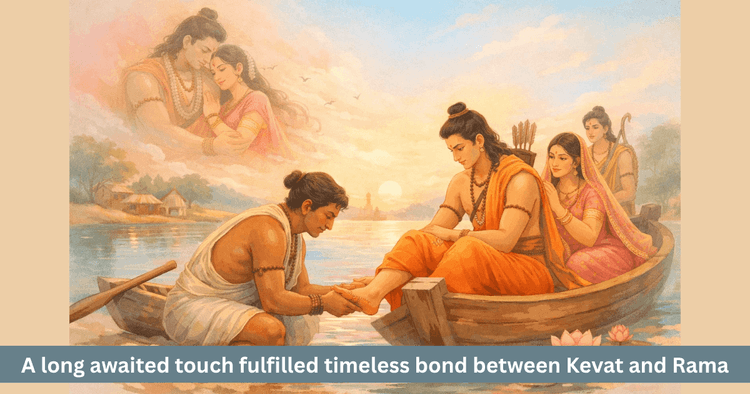
Table of Contents
In the Ramayana, the episode of Kevat appears simple on the surface, yet the feeling and mystery hidden within it are profoundly deep. At first glance it seems to be only a meeting between a boatman and Shri Rama but in truth it is a story of devotion, waiting, unfulfilled longing and the fulfillment of a sacred feeling carried across lifetimes.
When Shri Rama, Sita and Lakshmana reached the bank of the Ganga during exile, they needed a boat to cross the river. There stood a boatman named Kevat. Outwardly he was an ordinary man but inwardly something far more extraordinary was unfolding. He was not merely about to ferry travelers across a river. He had received a moment in which he could touch the feet of his Lord with his own hands. That is what makes this episode one of the most tender and profound moments in the Ramayana.
Why Did Kevat Refuse to Let Rama Board the Boat Immediately
When Shri Rama asked for the boat, Kevat did not allow him to board at once. On the surface, this may seem unusual. If a simple boatman were to refuse noble travelers, it could even appear disrespectful. But here there was nothing of pride. Kevat’s refusal was not born of arrogance but of loving devotion.
With great humility he said that he first wished to wash Rama’s feet. His words carried gentle humor and deep reverence together. He suggested that the dust of Rama’s feet was so powerful that it could transform even a stone into living form, just as had happened in the episode of Ahalya. If Rama stepped into the boat without his feet being washed, perhaps the boat too might undergo a transformation. Behind this playful reasoning lay his real intention. He was not protecting the boat. He was trying to prolong the sacred moment that gave him the chance to approach Rama’s feet.
That is why this episode should not be read as merely charming dialogue. It is the subtle wisdom of a devotee who does not want to lose the opportunity of service.
Was Washing the Feet Only an Act of Service or Something More
When Kevat washed the feet of Shri Rama, it was not merely an outward act of service. It was a moment in which his soul experienced direct contact with the One he loved most. The water, the vessel, the riverbank and the boat were all outer forms. What happened inwardly was far greater. For Kevat, that sacred water was not merely water. It was the fulfillment of a love long left incomplete.
This was not ritual in the formal sense. There was no complexity of ceremony, no grandeur of sacrifice and no display of scripture. There was only a simple heart and the longing of that heart, fulfilled after a very long span of time. That is why Kevat’s act of washing the feet becomes one of the highest expressions of devotion.
There are moments in devotion when the visible action is small, yet its spiritual meaning is immeasurable. This is one such moment.
How Is This Episode Connected With a Previous Birth
According to traditional belief, Kevat’s feeling did not belong only to that one lifetime. It is said that in a previous birth he had been a tortoise who desired to touch the feet of the Lord during the time of the Kurma incarnation. Though near the Divine, he had not been able to fulfill that longing. He had proximity but not complete fulfillment. That unfulfilled desire remained within him as a subtle spiritual impression.
This belief adds a beautiful depth to the episode. Then Kevat’s behavior is no longer merely the spontaneous devotion of one life. It becomes the fulfillment of an unfinished yearning for divine touch carried across births. What was not completed then returned in another life as an opportunity of service.
A great spiritual principle is hidden here. A true feeling does not perish. If it is free of selfishness and full only of love and surrender, it remains quietly preserved. In time, it returns as grace.
Can Devotion Truly Continue Across Lifetimes
One of the most beautiful messages of this episode is that true devotion is greater than the limits of time. The body may change. The circumstances of life may change. Births may change. Yet if a pure feeling toward the Divine has once arisen in the soul, it does not go to waste. It remains in subtle form.
Kevat’s story teaches that even unfinished devotion is not lost. It waits. It returns. It creates another chance to reach the Beloved. In this sense, the episode is not merely about a devotee. It is about the eternal relation between the soul and the Divine.
This is also the essence of the devotional tradition. The bond between God and the devotee is not confined to one single life. It seeks continuity. That continuity is what appears in Kevat.
Why Is Kevat’s Love Considered So Unique
Kevat did not perform a grand sacrifice. He did not engage in austere penance. He did not display scriptural learning. What he possessed was only a guileless heart. That was his greatest wealth. That is why his love is considered unique.
The tradition of devotion repeatedly teaches that God is not won merely by wealth, status, lineage or learning. What draws the Divine most deeply is purity of feeling. Kevat represents that very purity. He becomes great not through social position but through inner love.
He did not see Rama only as a prince or noble traveler. He saw him as the answer to a longing his soul had carried through lifetimes. This is why his touch, his service and his washing of the feet feel so tender and so deep.
Does This Story Also Contain a Message of Spiritual Equality
Yes and that message is deeply important. Kevat was not a king, sage, warrior or scholar. In worldly terms, he was an ordinary boatman. Yet Rama accepted his devotion just as he would accept the devotion of a great sage. This makes clear that before the Divine, outer rank has little importance. What truly matters is purity of heart.
In this episode, Kevat does not merely serve. He also reveals that devotion dissolves social distance. Where there is love, the question of higher and lower falls away. Where one receives the chance to wash the Lord’s feet, the one serving does not remain ordinary. He comes near to the Divine.
In this sense, the Kevat episode is also a beautiful expression of spiritual equality.
What Does This Relationship Between Unfulfilled Longing and Fulfillment Teach
In life, many desires remain incomplete. But not all desires are of the same kind. Some arise from restless wanting and disappear with time. Others arise from the deepest center of the soul. Such desires do not seek outer possession. They seek only nearness to the Divine. Even when left incomplete, such longing does not vanish. It waits.
Kevat’s story shows that an unfulfilled sacred longing still reaches fulfillment one day. If its root is pure, it can travel across births. That is why this episode is not only a story from the past but also a spiritual reassurance. A true feeling is never wasted. Pure love never disappears.
It also teaches patience. Not everything is fulfilled in one lifetime. Some experiences need time. Some moments of grace arrive late. But if love is true, it inevitably flowers.
Why Is the Dialogue Between Kevat and Rama So Beloved
Many episodes in the Ramayana are full of emotion but the tenderness of the Kevat episode is especially unique. There is no war here, no fear, no royal grandeur and no political tension. There is only the joy of service. On one side is Shri Rama, the Lord of compassion and maryada. On the other stands Kevat, expressing love through simple words and gentle reasoning. In this meeting, the distance between the devotee and the Divine disappears.
Kevat’s humble intelligence, his emotional reasoning, his washing of the feet and then his act of ferrying Rama across, all together make this episode deeply beloved. Here the Lord is not seen in an overwhelming cosmic form but as the most cherished guest whom a devotee longs to serve.
That is why this episode is remembered with immense tenderness in the devotional tradition.
What Does This Story Mean for Life Today
In modern life, people often believe that what remained unfulfilled is lost forever. What did not happen once will never happen again. Kevat’s story offers another vision. It teaches that not everything reaches completion immediately. Some feelings ripen slowly. Some longings wait until the right moment to bear fruit.
This episode also teaches that the path to God does not always need to be complex. Simplicity, guilelessness and service are also great forms of spiritual practice. If the heart is true, even a small act of service becomes immense.
That is why the story of Kevat continues to reassure the human heart. True love is never wasted and sincere waiting eventually becomes grace.
The Deeper Essence of This Episode
Kevat’s bond from a previous birth tells us that the genuine call of the soul can continue across lifetimes. A pure feeling left incomplete does not disappear with time. It waits for its rightful moment. And when that moment arrives, the same feeling is fulfilled through service, touch and grace.
That is the essence of this episode: true devotion never ends. It remains even when the body changes. It waits even when time changes. And in the end, it reaches the feet of the Beloved.
Frequently Asked Questions
1. Why did Kevat not allow Rama to board the boat immediately
Because he first wished to wash Rama’s feet and express his devotion through that act of service.
2. What is the main feeling behind the washing of the feet
It is not only service but the fulfillment of devotion carried through lifetimes.
3. What is the traditional belief about Kevat’s previous birth
It is believed that in a previous birth he was a tortoise who longed to touch the feet of the Lord.
4. What is the greatest lesson of this story
A true and selfless feeling never goes to waste and is fulfilled in time.
5. Why is the Kevat episode so beloved
Because it reveals devotion, humility, service and innocent love for the Divine in an especially tender form.
Get your accurate Kundali
Generate KundaliDid you like it?
Author
Pt. Nilesh Sharma (63)
Experience: 20
Consults About: Family Planning, Career
Clients In: Punjab, Haryana, Delhi
Share this article with friends and family
About ZODIAQ
ZODIAQ is an online Vedic Astrology platform. It connects clients seeking astrological advice to experienced astrologers with deep knowledge. Our users also generate kundali and perform kundali milan for free. ZODIAQ also offers services to the Astrologers. Astrologers utilize various offerings by ZODIAQ to serve their clients effectively.
If you are a User
Consult with experienced astrologers and seek their guidance. You can also order handwritten Janm Patrika report with life prediction prepared by experienced astrologers. Generate accurate Kundali, perform Kundali Matching and check horoscope and muhurat. Utilize our online library for all the necessary astrological and spiritual information.
If you are an Astrologer
Create accurate kundali for your clients and perform Kundali Matching for up to 5 people at a time. Write comprehensive Janm Patrika report for your clients with ZODIAQ. Check client details anytime by saving it in client directory. Become more productive by tracking how many clients you guide every day.
WELCOME TO
ZODIAQ
Right Decisions at the right time with ZODIAQ
