Lakshmana’s Fourteen Years Without Sleep
By Pt. Sanjeev Sharma
The Untold Story of Love and Devotion
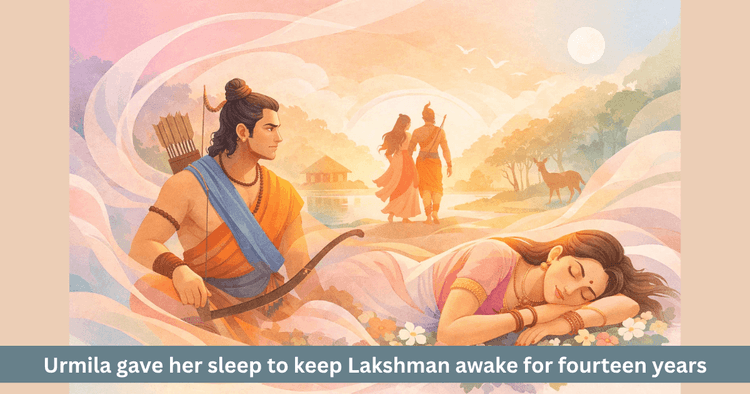
Table of Contents
In the Ramayana, many examples of sacrifice, service and devotion appear, yet some stories remain deeply hidden even though they carry extraordinary meaning. The story of Lakshmana and Urmila is one such story. It is not only about exile, sleeplessness or marriage. It is the story of a silent love in which there is no announcement, no demand, no complaint and yet surrender appears in its fullest form.
When Lord Rama was given exile, Lakshmana chose without hesitation to go with him. This was not only the act of a younger brother accompanying an elder brother. It was the choosing of the direction of his life. He resolved that throughout the years of exile he would serve Rama and Sita, protect them and keep his awareness constantly fixed upon their welfare. That resolve later became one of the most extraordinary forms of sacrifice in the Ramayana.
Why Did Lakshmana Choose to Go to the Forest
Lakshmana’s life is never truly seen apart from Rama. The love, loyalty and surrender within him were deeper than ordinary familial affection. His feeling for Rama was not only that of a brother. It held service, reverence, intimacy and such devotion that his own self seemed secondary before Rama.
When exile came and everything changed, Lakshmana did not pause to think about the comforts he would lose, the royal life he would leave behind or the hardship he would have to endure. He saw only one truth: Rama was going to the forest and where Rama was, that was where his own place must be. That one feeling led him from Ayodhya to the forest.
This decision may appear simple from the outside, yet within it lay a complete transformation of life. It was not only a renunciation of place. It was the decision to offer himself entirely into service.
Why Is Fourteen Years Without Sleep Considered So Extraordinary
The human body has its limits. It needs rest, sleep and renewal. To remain awake without sleep is difficult even for a short period, let alone for years. therefore when tradition says that Lakshmana did not sleep for the entire fourteen years, it no longer remains a matter of amazement alone. It becomes a matter of tapasya, devotion and sacred resolve.
Lakshmana’s wakefulness was not merely physical wakefulness. It was the symbol of unbroken alertness. In the forest he was not just a companion. He remained constantly vigilant for the protection of Rama and Sita. His mind was awake, his duty was awake and his love was awake.
For this reason, the episode should not be understood only as a miracle. It should be seen as the story of devoted consciousness. Some awakenings belong to the eyes and some belong to the heart. Lakshmana’s wakefulness was the union of both.
How Is Urmila’s Story Connected to This Wakefulness
It is here that the episode becomes even deeper. Lakshmana’s wife Urmila remained in Ayodhya when exile began. Usually, when the story of exile is told, attention moves to Rama, Sita and Lakshmana. Yet Urmila’s silent sacrifice is one of the most subtle and moving layers of the Ramayana.
According to traditional telling, as Lakshmana was leaving for the forest, he prayed to the Goddess of Sleep that she should not make him sleep for those fourteen years. His purpose was clear. He wished to spend every single moment in the service of Rama, without interruption, without rest.
It is then said that the Goddess of Sleep replied that this was possible but only if someone else accepted that sleep in his place. At that point Urmila stepped forward. Without resistance, without question and without expectation of recognition, she accepted upon herself the sleep that was to be Lakshmana’s. This is one of the quietest and greatest moments in the story.
Was Urmila’s Sacrifice Any Less Than Lakshmana’s
No, not at all. If Lakshmana served outwardly, Urmila made that service possible inwardly. If Lakshmana remained awake for duty, Urmila took upon herself the burden of that wakefulness through her silent acceptance. Her sacrifice may be less visible but emotionally and spiritually it is no less profound.
Urmila did not go to the forest, yet that does not mean she had no exile of her own. Her exile was an inner exile. She knew the pain of separation from her husband, accepted the distance and still allowed no bitterness to take root within her. She understood that Lakshmana’s duty was not apart from her but connected with her too. For that reason, she accepted that duty as her own in a silent way.
This is perhaps the greatest lesson of the story. True love is not always expressed by walking beside someone. At times it is expressed by allowing the beloved to fulfill a higher dharma, even from afar.
What Does It Mean That Urmila Accepted Fourteen Years of Sleep
The meaning of this episode is not merely that Urmila slept for long periods. Its symbolic and spiritual meaning is far deeper. It means that she lived those years in a state of silent sacrifice. Hers was a contribution not openly seen but without which visible service itself would remain incomplete.
By accepting Lakshmana’s sleep, Urmila accepted the loss of active companionship, the pause of ordinary married life, the absence of shared joy and the surrender of her own expected happiness. This sacrifice did not happen through any outward declaration. It arose from inward steadiness and deep love.
That is why this episode is not merely about sleep. It reveals that some people appear awake in history, while others support history through silence. Urmila belongs to the second and equally exalted category.
What Kind of Wakefulness Did Lakshmana Actually Live
During the exile, Lakshmana’s wakefulness was not limited to staying awake at night. He remained alert at every level. He guarded outward safety. He understood the gravity of every circumstance. He remained attentive to danger, to the protection of Sita and to the constant service of Rama. This was total vigilance.
But there was an even deeper dimension. Lakshmana was emotionally and spiritually awake as well. He transformed fatigue into service. He transformed personal life into duty. By giving up sleep, he offered not only his body but also his time at the feet of Rama.
This is why his wakefulness can be understood as one of the highest forms of devotion. When love rises above rest itself, wakefulness becomes tapasya.
Does This Story Reveal a Deeper Meaning of Marriage
Yes, very deeply. The relationship of Lakshmana and Urmila teaches that marriage is not merely the act of staying together. It is also the capacity to understand one another’s purpose, to accept it and, when needed, to surrender one’s own share of comfort so that the other may fulfill a higher calling. That is why this story presents a highly mature understanding of love.
Urmila did not stop Lakshmana. Lakshmana did not forget Urmila. Both, from their own places, accepted one larger purpose. This is the mark of a deep bond, where understanding is greater than possession, trust is greater than complaint and love remains alive even across distance.
Seen this way, Lakshmana and Urmila are not merely husband and wife. They are two souls engaged in the same silent cooperation, standing for the same dharma from different places.
What Is the Most Beautiful Form of Love in This Story
The most beautiful aspect of this story is that here love reaches its fullness not by appearing but by remaining hidden. Lakshmana’s love is visible in service. Urmila’s love is visible in renunciation. Lakshmana stays awake outwardly for Rama. Urmila remains inwardly silent for Lakshmana. One love is active, the other is still. Yet both are equally sacred.
This is the mark of true love. It does not seek nearness alone. It also honors the higher purpose of the one it loves. It can accept pain if that pain allows the beloved to fulfill dharma. That is why this story is not merely a secondary episode in the Ramayana. It is a timeless interpretation of love, sacrifice and fidelity.
What Does This Story Teach for Life Today
In today’s world, love is often understood mainly through presence, conversation and physical nearness. But this story reveals another level of love. It is love through understanding. It is love through purpose. It is love through sacrifice. It is the kind of bond in which two people understand not only one another’s circumstances but also one another’s soul.
The story of Urmila and Lakshmana also teaches that no great act stands alone. Behind the person visibly serving, there is often an unseen force making that service possible. To recognize hidden support behind visible sacrifice is also part of wisdom.
It reminds us too that quiet sacrifice can be the deepest form of contribution. The story that remains invisible on the outside may sometimes hold the greatest light within.
The Deeper Message of This Episode
The story of Lakshmana’s fourteen years without sleep and Urmila’s silent surrender teaches that true devotion is not only what the world can see. Very often the greatest sacrifice is the one for which no celebration is held, no noise is made and history itself remembers only faintly. Yet that very sacrifice can be the most life giving of all.
If Lakshmana remained awake, Urmila made that wakefulness possible. If one served openly, the other created the background of that service. If one fulfilled outer dharma, the other fulfilled inner dharma. That is the real completion of this story.
That is the essence of this episode. True love is that which can give up its share of comfort, rest and closeness so that the other may fulfill sacred duty. When love reaches that level, it is no longer merely a relationship. It becomes an ideal remembered for ages.
Frequently Asked Questions
1. Did Lakshmana truly remain awake for fourteen years
According to traditional telling, Lakshmana remained awake throughout the period of exile and did not take ordinary rest.
2. What was Urmila’s role in this story
Tradition says that Urmila accepted Lakshmana’s share of sleep upon herself, allowing him to remain constantly awake in Rama’s service.
3. What is the deepest meaning of this episode
It teaches that visible service and invisible sacrifice together make a great purpose possible.
4. Was Urmila’s sacrifice as important as Lakshmana’s
Yes, Urmila’s silent renunciation is equally profound, because without her acceptance Lakshmana’s wakefulness would not be possible in this narrative.
5. What does this story teach about love
It teaches that true love is expressed not only through companionship but through understanding, sacrifice and allowing the beloved to fulfill a higher dharma.
Get your accurate Kundali
Generate KundaliDid you like it?
Author

Pt. Sanjeev Sharma (63)
Experience: 20
Consults About: Family Planning, Career
Clients In: Punjab, Haryana, Delhi
Share this article with friends and family
About ZODIAQ
ZODIAQ is an online Vedic Astrology platform. It connects clients seeking astrological advice to experienced astrologers with deep knowledge. Our users also generate kundali and perform kundali milan for free. ZODIAQ also offers services to the Astrologers. Astrologers utilize various offerings by ZODIAQ to serve their clients effectively.
If you are a User
Consult with experienced astrologers and seek their guidance. You can also order handwritten Janm Patrika report with life prediction prepared by experienced astrologers. Generate accurate Kundali, perform Kundali Matching and check horoscope and muhurat. Utilize our online library for all the necessary astrological and spiritual information.
If you are an Astrologer
Create accurate kundali for your clients and perform Kundali Matching for up to 5 people at a time. Write comprehensive Janm Patrika report for your clients with ZODIAQ. Check client details anytime by saving it in client directory. Become more productive by tracking how many clients you guide every day.
WELCOME TO
ZODIAQ
Right Decisions at the right time with ZODIAQ
