The Battle Between Lava Kusha and Hanuman: Devotion Meets Valor
By Aparna Patni
A profound Uttara Kanda episode: duty, courage, and revelation of truth
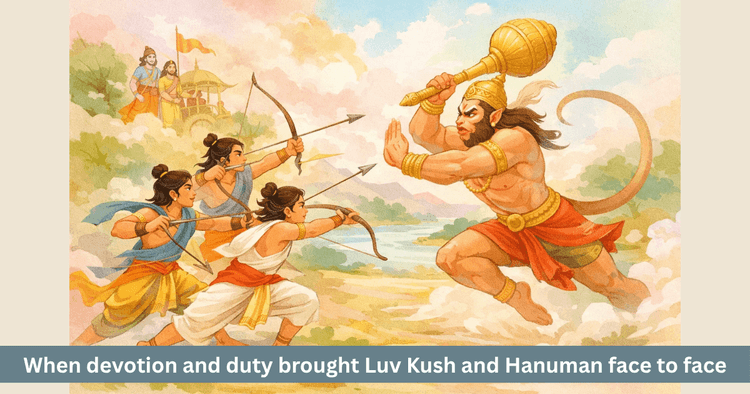
Table of Contents
The Uttara Kanda of the Ramayana is filled with many episodes that carry deep emotion, wonder and extraordinary events within them. The battle between Lava Kusha and Hanuman is one such remarkable episode. At first sight it may appear to be only a story of conflict but on deeper reflection it becomes clear that it is actually a story of devotion, valor, duty, conflict born of incomplete knowledge and finally the revelation of truth.
This episode becomes especially moving because there is no adharma at the center of either side. On one side stands Hanuman, the supreme servant of Shri Rama and the protector of dharma. On the other side stand Lava and Kusha, the sons of Shri Rama himself, although at that moment they do not know their own identity. They are acting according to their courage, education and sense of righteousness. For this reason, the encounter is not merely a clash of strength. It is a meeting of two sacred duties.
What Was the Background of the Ashwamedha Yajna
This event took place during the time when Shri Rama performed the Ashwamedha Yajna. In the Vedic tradition, the Ashwamedha was not only a sacred ritual. It was also a declaration of rightful kingship, sovereign authority and dharmic governance. In this ritual, a special horse was released. Wherever it traveled, the rulers of that region had two choices. They could either accept the sovereignty of the king who conducted the yajna or oppose it through battle.
Thus the horse of the Ashwamedha was not merely an animal. It was a moving symbol of royal authority, political dharma and sacred resolve. To stop it was never a casual act. Anyone who did so was, in effect, challenging the authority of the yajna performing ruler.
It is the arrival of this horse in the region where Lava and Kusha lived that leads to this extraordinary episode.
What Was the Situation of Lava and Kusha at That Time
Lava and Kusha had been raised in the hermitage of Maharshi Valmiki. They were not ordinary children. They had been nourished in an atmosphere of austerity, learning and discipline. They were trained in weapons, scripture, poetry, dharma and self respect. The education they received in Valmiki’s hermitage shaped them into radiant and noble young warriors.
Yet at that stage, they did not know that they were in fact the sons of Shri Rama. This fact makes the entire episode profoundly emotional. The horse they stop belongs to their own father’s yajna. The warriors they confront come from their own lineage. And the Hanuman whom they face is the very devotee of the Rama whose blood runs in their veins.
This hidden truth is what gives the story such depth. Reality is present but not yet revealed. That is why conflict becomes possible.
Why Did Lava and Kusha Stop the Horse
When the horse entered their region, Lava and Kusha did not see it merely as a wandering ritual horse. For them, it was a question of honor, dharma and the dignity of their land. They were not the kind of young men who would submit without thought. Their training had given them the courage to stand before imposed authority and question it through righteousness.
So they stopped the horse. This was not childish defiance. It was the expression of a self respecting moral intelligence that refused to accept sovereignty without understanding its basis.
This makes it clear that their act was not one of arrogance. It arose from dharma guided self respect.
What Happened When the Army of Ayodhya Arrived
When word reached Ayodhya that the horse had been stopped, the royal forces came to take it back. For them it was a matter of royal legitimacy. Yet what they encountered was beyond expectation. Before them stood two young boys but filled with astonishing brilliance, courage and martial skill.
Lava and Kusha confronted the incoming warriors and defeated them with extraordinary valor. This was not merely a display of combat ability. It was also a sign that these boys were far from ordinary. Within them were royal splendor, ascetic refinement and inherited power acting together.
The episode also teaches that age alone is never the final measure of capability. Sometimes character, training and inner radiance prove far greater than age itself.
Why Did Hanuman Come Personally
When Hanuman learned that the horse had been stopped and even the warriors of Ayodhya had been defeated, he came in person. For Hanuman this was not merely a battle. He was the supreme servant of Shri Rama. Protecting Rama’s yajna, preserving its honor and removing any obstacle in its path was his sacred duty.
Hanuman’s arrival deepens the entire episode. He is not only the embodiment of strength. He is also the embodiment of devotion, wisdom, humility, strategy and service to dharma. Therefore, when he enters the scene, it does not feel like merely another warrior arriving. It feels as though the spirit of Rama’s own devotion has come to resolve the situation.
Yet the situation is extraordinary, because those standing before him are the very children of his Lord, although this truth has not yet been disclosed.
Why Was the Meeting Between Hanuman and Lava Kusha So Unique
This scene is truly unparalleled. On one side stands Hanuman, whose strength and devotion know no limit. On the other side stand Lava and Kusha, young in age but filled with astonishing skill, discipline and courage. Neither side is acting from unrighteousness. Both are standing in their own rightful duty. This alone makes the episode different from ordinary war.
In most battles one side clearly represents aggression or wrong. Here that is not so. Hanuman has come to protect the yajna of his Lord. Lava and Kusha are standing to defend what they understand as dharma and dignity. So outwardly it is a conflict but inwardly it is duty meeting duty.
That is why even the battle retains a certain sacred purity. This is what makes it one of the most emotionally refined episodes in the Ramayana.
How Did Lava and Kusha Bind Hanuman
Traditional accounts describe that the battle began and Lava and Kusha, through their mastery of weapons, divine skill and radiant intelligence, succeeded in binding Hanuman. This is a startling event, because Hanuman is generally regarded as unconquerable. To bind him is no ordinary achievement.
This is why the episode is not merely surprising. It is full of meaning. It indicates that Lava and Kusha possessed extraordinary force. They were not merely talented boys. They were the bearers of divine lineage. Within them shone a power that could move beyond ordinary limits.
Yet another more subtle meaning lies hidden within this event.
Did Hanuman Truly Fight With Full Force
In many traditional tellings, one finds the suggestion that Hanuman, recognizing something unusual in these boys, did not engage in complete destructive force. He understood that these were no ordinary young warriors. There was a radiance in them, a depth and a nobility that could not be ignored. Therefore, some traditions hold that Hanuman eventually allowed himself to be subdued so that the hidden truth might move toward revelation.
This is not defeat. It is wise humility. Hanuman’s character always teaches that the truest hero does not seek victory at any cost. He also perceives when a greater truth is waiting behind the conflict. If that truth must come forward, he is capable of restraining even his own strength.
From this perspective, Hanuman’s binding may itself be seen as a sign of compassion and insight born of devotion.
How Did Truth Reveal Itself in This Episode
When this situation reached Shri Rama and the matter progressed further, the hidden truth finally emerged. It was revealed that Lava and Kusha were not ordinary boys but Rama’s own sons. This is the moment when the entire meaning of the conflict changes. What had appeared to be battle turns into recognition, reunion and revelation.
Here truth does not arrive merely as information. It restores every relationship to its rightful place. A father recognizes his sons. The army understands that those it faced were not enemies. Hanuman too sees clearly that the extraordinary radiance he witnessed belonged to the lineage of Rama himself.
This is the greatest spiritual beauty of the episode. The moment truth appears, the meaning of conflict is transformed. What seemed like opposition becomes a path toward recognition.
What Is the Emotional Meaning of This Battle
The emotional significance of this episode is very deep. In life, people often stand against one another while sincerely performing what they believe to be their duty. At that moment they do not fully understand each other. Conflict arises, pain emerges and questions deepen. But when truth reveals itself, it becomes clear that both sides were moving within a higher order.
Lava and Kusha were true to their duty. Hanuman was true to his duty. There was no hatred in either of them. No one was seeking private victory. That is why this battle is not a battle of hostility. It is a battle of incomplete knowledge awaiting truth.
The episode teaches that not every conflict comes from adharma. Sometimes conflict arises simply because the whole truth has not yet come into the light.
What Does Hanuman’s Conduct Teach in This Episode
Hanuman teaches here what he teaches everywhere. True devotion does not make a person merely strong. It makes him wise. It does not bind him to the victory of one side alone. It guides him toward the larger establishment of truth and dharma.
If Hanuman wished only to win, the episode could have unfolded very differently. But his aim is not personal triumph. His aim is the protection of dharma and the emergence of truth. Therefore, when he senses that something greater is hidden in this event, he allows that truth to unfold.
That is why his character appears not only heroic but spiritually mature. He knows that sometimes the greatest victory is not in winning the battle but in allowing the truth to appear.
What Message Does This Story Give for Life Today
Even in life today, people often come into conflict because of their limited perspective, their duty and their incomplete understanding. Later they realize that the root of the conflict was not hatred but partial truth. This story teaches that one should not always interpret conflict only at the outer level. Sometimes hidden behind it there is a deeper bond, an unrecognized relation or a truth that has not yet emerged.
This episode also teaches that the highest form of strength is not merely the ability to overpower but also the wisdom to pause, understand and give space to truth. The valor of Lava and Kusha, together with Hanuman’s devotion, proves that when courage and surrender are both rooted in dharma, truth will ultimately prevail.
The Deeper Essence of This Episode
The battle between Lava Kusha and Hanuman is not merely an astonishing narrative. It is the story of a profound truth. Sometimes devotion and valor appear to stand opposite each other, yet in reality they are not enemies. They are simply waiting for the moment when truth will appear and place them both in their rightful relationship.
That is the essence of this episode. A conflict born of duty becomes peaceful in the light of truth. Once identity is revealed, illusion disappears. Once relationship is known, opposition fades. And once dharma stands fully revealed, every character takes his true place in dignity.
Frequently Asked Questions
1. Why did Lava and Kusha stop the Ashwamedha horse
Because they saw it as a matter of honor, dharma and rightful independence.
2. Why did Hanuman come in this episode
As the servant of Shri Rama, he considered it his duty to protect the yajna horse and its honor.
3. Did Lava and Kusha really bind Hanuman
Traditional accounts describe that through their valor and divine weapons they succeeded in binding him.
4. Did Hanuman knowingly allow himself to be subdued
Some traditions suggest that he sensed the deeper truth in the situation and therefore did not unleash his full force.
5. What is the main lesson of this story
It teaches that many conflicts arise from incomplete truth and once truth is revealed, illusion and opposition both dissolve.
Get your accurate Kundali
Generate KundaliDid you like it?
Author

Aparna Patni (63)
Experience: 20
Consults About: Family Planning, Career
Clients In: Punjab, Haryana, Delhi
Share this article with friends and family
About ZODIAQ
ZODIAQ is an online Vedic Astrology platform. It connects clients seeking astrological advice to experienced astrologers with deep knowledge. Our users also generate kundali and perform kundali milan for free. ZODIAQ also offers services to the Astrologers. Astrologers utilize various offerings by ZODIAQ to serve their clients effectively.
If you are a User
Consult with experienced astrologers and seek their guidance. You can also order handwritten Janm Patrika report with life prediction prepared by experienced astrologers. Generate accurate Kundali, perform Kundali Matching and check horoscope and muhurat. Utilize our online library for all the necessary astrological and spiritual information.
If you are an Astrologer
Create accurate kundali for your clients and perform Kundali Matching for up to 5 people at a time. Write comprehensive Janm Patrika report for your clients with ZODIAQ. Check client details anytime by saving it in client directory. Become more productive by tracking how many clients you guide every day.
WELCOME TO
ZODIAQ
Right Decisions at the right time with ZODIAQ
