Ravana Blessing Rama: When the Enemy Himself Helped Prepare the Path to Victory
By Pt. Narendra Sharma
Ravana’s Divine Knowledge and the Blessing for Rama’s Victory
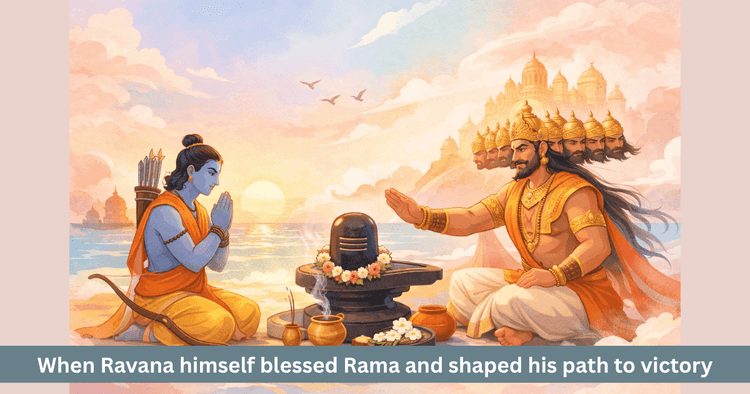
Table of Contents
In the Ramayana, Ravana is generally seen as a symbol of arrogance, adharma and downfall. This understanding is not false, because his life indeed moved toward such an end. Yet there is another side to his personality that is equally important to understand. He was not only the king of Lanka. He was also a knower of the Vedas, a great ascetic, a devotee of Shiva and a learned Brahmin. Because of this, the Ramayana tradition preserves a striking episode in which the very Ravana who was to stand against Rama in war appears in another moment as a priest and gives Rama a blessing of victory.
This episode is associated with Rameshwaram. Before the march toward Lanka, Shri Rama resolved to worship Lord Shiva. This was not merely a ritual act. It was a profound spiritual decision. Before a great war, Rama chose humility, sacred alignment and divine balance. He understood that even when one stands on the side of dharma, victory should not be sought through ego. For this reason, before the battle, he turned toward the worship of Shiva.
Why Did Rama Worship Shiva Before the War
The life of Shri Rama is shaped by maryada, balance and dharma. He is not only a warrior. He is the ideal being who gives every important action its spiritual foundation before bringing it into worldly form. The march to Lanka was not merely a military decision. It was the decisive confrontation between dharma and adharma. In such a moment, turning toward Lord Shiva signified that victory does not arise only from strength of arms. It also comes through divine grace, purity of resolve and righteous intention.
The episode of establishing the Shiva linga at Rameshwaram reveals this deeper vision. It shows that for Rama, even war was not separate from worship. Every great action first becomes an offering to the Divine and only then appears in the world. That is why this ritual cannot be reduced to formality. It is evidence of Rama’s humility and spiritual maturity.
Why Was Ravana’s Name Considered for the Ritual
The establishment of a Shiva linga is not treated as an ordinary ritual. It requires a highly qualified Brahmin who knows Veda, mantra, sacred procedure, purity of conduct and the subtleties of divine worship. This was not merely outer worship. It required mantric authority, scriptural knowledge and spiritual eligibility.
Thus the question arose: who was most fit for this task? And here the narrative takes an astonishing turn. The answer appears in the form of Ravana himself. At first this sounds surprising, yet when one understands the learned side of Ravana, it becomes less impossible.
Ravana was not only a ruler of immense power. He was a great knower of the Vedas. He was an intense devotee of Lord Shiva. He was believed to possess extraordinary command over scripture, ritual, mantra and sacred disciplines. From that point of view, it would have been difficult to find someone more qualified for such a specific rite.
Did Rama Truly Refuse to See Ravana Only as an Enemy
This is one of the deepest aspects of the episode. Shri Rama’s vision is not based only on outer conflict. He sees the person with all the layers of dharma and adharma within them. Ravana was an enemy on the battlefield but in the realm of knowledge and priestly eligibility he remained a great scholar. Rama recognized that side of him.
Here we see an important dimension of Rama’s character. He is not moved by hatred. He is able to recognize truth in another even when conflict exists. If a person is qualified in a certain sacred capacity, then to honor that qualification is itself part of dharma. For this reason, inviting Ravana to act as priest was not merely practical. It was the decision of a dharmic vision.
Rama showed that enmity does not require the denial of every quality in another. Where knowledge exists, knowledge must be honored. Where sacred procedure must be followed, it should be followed with integrity. This is what distinguishes Rama from an ordinary warrior.
Why Did Ravana Accept the Invitation
The answer lies again in the complex nature of Ravana’s personality. On one side he was full of ego, desire and adharma. On the other, he possessed scriptural knowledge, tapasya and the samskara of a Brahmin. When invited for this ritual, tradition says that he accepted without hesitation.
At that moment he was not only a king preparing for war. He was a learned Brahmin performing a Vedic rite. This episode reveals that a person can carry many layers within one being. One side may be moving toward downfall, while another still remains connected with certain principles of dharma.
Ravana’s acceptance of the invitation shows that in the realm of knowledge and priestly duty, he was able for a moment to rise above his personal hostility. This is one of the most striking and profound aspects of the story.
What Happened When Ravana Sat as Priest at Rameshwaram
According to traditional telling, Ravana came to Rameshwaram and performed the Shiva linga स्थापना with complete ritual correctness, devotion and scriptural discipline. In that moment there was no visible spirit of war. There was no tone of rivalry. There was only Vedic action, devotion to Shiva and reverence for sacred order.
The scene is remarkable. Shri Rama sits as the yajamana, the one for whom the rite is performed and Ravana, who will soon stand against him in war, sits as the priest. In this image, one sees a profound truth of Indian spiritual thought. Dharma can raise a person beyond narrow roles, even if only for a moment.
Ravana upheld the dharma of a priest. Rama honored the worth of knowledge. Each remained established in their own truth. That is why this episode is not merely a story. It becomes a rare expression of sacred balance.
Why Did Ravana Bless Rama
At the conclusion of the worship, Ravana, in the role of priest, gave a blessing to Shri Rama. This blessing is not seen as mere formality. It carries a subtle acceptance within it. When a priest blesses the yajamana, he does not utter empty words. He affirms the completion of the rite and the direction of its fruit.
This is why the episode is so powerful. Ravana knew that Rama was his enemy. He also knew that the coming war would be decisive. Yet as a priest he fulfilled his duty. He gave the blessing. This reveals not only knowledge but also fidelity to duty.
A subtle truth appears here. At times a person may fail in the direction of life, yet still appear great in the performance of a particular sacred duty. Ravana’s moment here is such a moment.
Does This Episode Prove Ravana Entirely Noble
No, that would not be correct. The purpose of this episode is not to reduce the reality of Ravana’s adharma. His downfall came because of arrogance, injustice and violation of maryada. That truth remains. Yet it is equally true that he was not a one dimensional being. He possessed learning, tapasya, devotion to Shiva and the संस्कार of Brahminhood.
This is the depth of Indian narrative tradition. It does not place every person into a single simple category. It recognizes that good and evil may both be present within the same person. Ravana is one of the clearest examples of that complexity. He was great and fallen, learned and arrogant, devoted and destructive.
So this episode does not make Ravana innocent. It simply shows that even within a fallen life, certain qualities may remain real in their own sphere.
What Does This Meeting Between Rama and Ravana Teach
The greatest teaching of this episode is that true dharma can rise above personal hostility. Where sacred knowledge must be honored, even the enemy’s qualification may be accepted. Where duty must be performed, personal dislike may be set aside for a moment.
Rama’s decision teaches us that knowledge deserves honor beyond circumstance. Ravana’s acceptance teaches that if a person remains true in even one aspect of dharma, there are moments when ego can step back before duty. That is the seriousness of this story.
It also teaches that no human being is limited to one role alone. A person may be a ruler, a father, a scholar, deeply flawed and yet capable of greatness in some moment. Without understanding that complexity, it is difficult to grasp the fullness of character.
What Does This Story Mean for Life Today
Today people often want to label a person as completely good or completely bad. But this episode teaches that life and character are rarely so simple. One may disagree with someone, struggle against them and yet still recognize a real quality in them. This is maturity. This is dharmic balance.
This story also teaches that when knowledge and duty are involved, one must rise above personal reaction. If the right action can only be completed by someone with whom one is in conflict, then right action must still be given priority. This lesson is meaningful not only in the Ramayana but in present moral, social and personal life as well.
The Deeper Message of This Episode
The episode of Ravana blessing Rama teaches that dharma is not only the raising of weapons upon a battlefield. Dharma also means recognizing true qualification, honoring sacred knowledge and fulfilling the right duty even in complex circumstances.
Here Rama’s humility is great and Ravana’s fidelity to sacred learning is also great. One honored the knowledge of an enemy and the other fulfilled priestly duty even for an opponent. That is the luminous power of this story.
That is the essence of this episode. When knowledge, dharma and duty stand together, personal conflict can withdraw for a while. And sometimes the very person who will stand before you in battle can, in another moment, become the source of blessing.
Frequently Asked Questions
1. Why did Ravana act as priest for Rama
According to tradition, the establishment of the Shiva linga required a highly qualified Brahmin and Ravana was considered the most suitable for that sacred role.
2. With what place is this episode associated
It is associated with Rameshwaram, where Shri Rama worshipped Lord Shiva before the march to Lanka.
3. Was Ravana truly a learned Brahmin
Yes, tradition remembers Ravana as a great knower of the Vedas, a devotee of Shiva and a highly learned Brahmin, even though his life was also filled with adharma.
4. What does Ravana’s blessing to Rama signify
It signifies that knowledge and sacred duty can, at times, rise above personal hostility.
5. What is the greatest lesson of this story
It teaches that true dharma honors right qualification, true knowledge and sacred duty, even when the situation is deeply complex.
Get your accurate Kundali
Generate KundaliDid you like it?
Author

Pt. Narendra Sharma (63)
Experience: 20
Consults About: Family Planning, Career
Clients In: Punjab, Haryana, Delhi
Share this article with friends and family
About ZODIAQ
ZODIAQ is an online Vedic Astrology platform. It connects clients seeking astrological advice to experienced astrologers with deep knowledge. Our users also generate kundali and perform kundali milan for free. ZODIAQ also offers services to the Astrologers. Astrologers utilize various offerings by ZODIAQ to serve their clients effectively.
If you are a User
Consult with experienced astrologers and seek their guidance. You can also order handwritten Janm Patrika report with life prediction prepared by experienced astrologers. Generate accurate Kundali, perform Kundali Matching and check horoscope and muhurat. Utilize our online library for all the necessary astrological and spiritual information.
If you are an Astrologer
Create accurate kundali for your clients and perform Kundali Matching for up to 5 people at a time. Write comprehensive Janm Patrika report for your clients with ZODIAQ. Check client details anytime by saving it in client directory. Become more productive by tracking how many clients you guide every day.
WELCOME TO
ZODIAQ
Right Decisions at the right time with ZODIAQ
