The Symbolism of Ravana’s Ten Heads
By Pt. Abhishek Sharma
When the Conflict of Ten Inner Directions Lived in One Personality
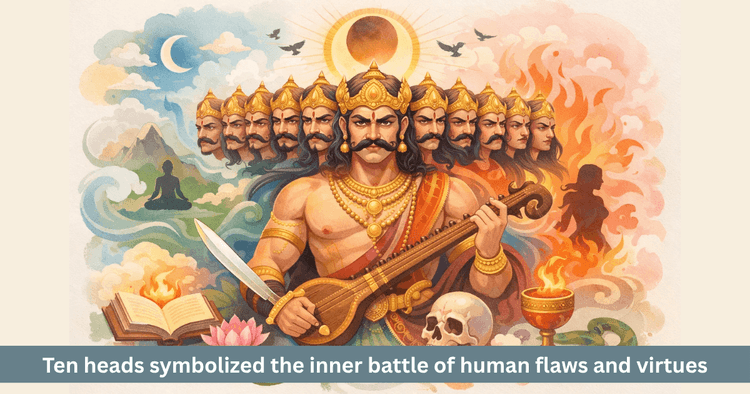
Table of Contents
In the Ramayana, Ravana is often recognized by his ten heads. Outwardly this appears as an extraordinary and unusual form, yet the meaning behind it is deeply philosophical. Ravana’s ten heads are not merely a display of power. They are understood as symbols of major human tendencies, forces and flaws that exist within the inner life of every person.
Ravana was not merely a demonic king. He was a great scholar, a profound devotee of Shiva and a master of sacred knowledge. Within him there was learning but there was also pride. This inner contradiction is what makes his personality so complex and worthy of reflection.
It is often said that his ten heads symbolize kama, krodha, lobha, moha, mada, matsara, manas, buddhi, chitta and ahamkara. These elements are not present only in Ravana. They exist in different forms within every human being. This is what gives the symbolism such enduring importance.
What Is the Deeper Meaning of Ravana’s Ten Heads
In the Indian philosophical tradition, Ravana’s ten heads have been interpreted in many ways. One significant understanding is that they represent the inner battlefield of the human being. Ravana thus becomes more than a mythic figure. He becomes a mirror of the mind itself. His story raises important questions. Why does a knowledgeable person still fall. Why does great strength fail to save a person from destruction. Why does wisdom lose direction even when it exists. The answers lie in the symbolism of the ten heads.
This is what makes Ravana so important as a character. He is not one dimensional. He is not darkness alone. He carries brilliance, discipline and devotion, yet he also carries inner imbalances that gradually overpower his higher qualities.
Was Ravana Only a Symbol of Evil
No and that is precisely what makes him so significant. If Ravana were only evil, his character would not invite such deep reflection. He was highly learned. He was devoted to Shiva. He understood music, scriptures and many branches of knowledge. Yet in spite of all this, he could not master the tendencies within himself.
That is the tragedy of Ravana. It is also his philosophical importance. He teaches that knowledge alone is not enough. Power alone is not enough. Even scholarship is not enough. If the distortions within the mind remain unchecked, then even the finest qualities of a person may fail to prevent downfall.
What Does the Head of Kama Represent
Kama does not mean only physical desire. In a broader sense it means any intense wanting, any strong longing, any attraction that pulls the person again and again toward an object, person or condition. Desire is not evil in itself. When balanced, it can become the basis of effort, progress and creativity.
But when desire exceeds restraint, it begins to cloud discrimination. In Ravana’s life, his uncontrolled attraction toward Sita becomes an example of desire that has lost all balance. He could not understand that a desire pursued through violation of another’s dignity is in truth a path toward destruction.
Thus this head teaches that desire needs direction. Without direction, it becomes the force of downfall.
What Truth Does the Head of Krodha Reveal
Krodha or anger, is the fire within that can burn years of wisdom in a single moment. In Ravana this anger rises repeatedly. Whenever he is opposed, whenever truth is spoken to him, whenever his pride is challenged, anger becomes stronger than understanding.
The greatest danger of anger is that it traps a person in immediate reaction. It destroys distance, perspective and reflection. It convinces the mind that what is being felt at that very moment is the only reality. Ravana’s decisions frequently reveal this fire. He loses the possibility of reconsideration because anger keeps him inwardly disturbed.
This head reminds us that anger is not merely an emotional outburst. It is an inner darkness that weakens the ability to make sound decisions.
How Does the Head of Lobha Operate
Lobha or greed, is the condition in which what one already has never feels sufficient. A person may possess wealth, power, prestige and abundance, yet the mind continues to say that something more is needed. Ravana had kingdom, strength, knowledge and glory. Yet his mind did not rest in contentment.
The nature of greed is that it never allows a person to rest. It drives the individual endlessly toward acquisition. In the end, one may have everything outwardly and still remain inwardly empty. Ravana’s life reflects this clearly. Instead of recognizing the value of what he already possessed, he kept moving toward what was not rightfully his.
This head teaches that contentment is not merely a moral virtue. It is also a form of inner protection.
Why Can the Head of Moha Become the Most Dangerous
Moha or delusion born of attachment, is that condition in which a person stops seeing reality clearly. One becomes so attached to a person, object, idea or emotion that the distinction between right and wrong begins to blur. Ravana’s attachment to Sita was not merely attraction. It was delusion strong enough to make repeated truth ineffective before him.
When Vibhishana advised him, when Mandodari warned him and when signs became increasingly clear, he still could not free himself from that delusion. This is the danger of moha. It blinds not from the outside but from within. It creates the illusion that whatever one wants must therefore be justified.
This head teaches that delusion imprisons a person within a reality of their own making.
What Does the Head of Mada Indicate
Mada means the intoxication that comes from power, knowledge, status or success. Ravana possessed this in great measure. He was proud of his penance, proud of his wisdom, proud of his strength and gradually that pride turned into inner imbalance.
The greatest danger of mada is that it prevents a person from seeing their own limit. It gives the false confidence that one cannot be defeated. This confidence eventually becomes destructive. Ravana’s life is a clear example. He was so capable that humility should have deepened in him. Instead, his greatness turned into self intoxication.
This head teaches that the greater the achievement, the greater the need for humility.
Why Does the Head of Matsara Disturb the Mind
Matsara or jealousy, is that subtle feeling through which one becomes disturbed by the excellence, success or dignity of another. It does not always appear outwardly, yet inwardly it robs the person of peace. Ravana’s personality was not filled with pride alone. It also carried the unrest that arises when one cannot gracefully accept the worth of another.
Jealousy keeps the mind trapped in comparison. Comparison destroys peace and the absence of peace weakens clarity. Thus this head shows that envy is not merely a social flaw. It is also a spiritual disturbance.
Ravana’s life teaches that accepting the radiance of others is itself part of inner maturity.
What Do Manas, Buddhi and Chitta Tell Us
Among Ravana’s ten heads, the inclusion of manas, buddhi and chitta is especially important. It shows that he did not possess only flaws. He also possessed inner centers of power. Manas is the field of thought and movement of desire. Buddhi is the faculty of discrimination and decision. Chitta is the subtle ground of memory, impression and inward holding.
Ravana had all three. He could think deeply. He knew the scriptures. He had the capacity for judgment. Yet the problem was that the distortions within him repeatedly overpowered these finer faculties. His mind wandered, his intellect became clouded and his chitta became attached.
That is the deeper meaning of this symbolism. It is not enough merely to have mind, intellect and awareness. They must be rightly directed. Otherwise they too can become servants of inner distortion.
Why Is Ahamkara Considered the Central Head
Among all of these, ahamkara or ego, emerges as the central force in Ravana’s personality. Ego is the covering that convinces a person that they themselves are final, self sufficient and beyond correction. Ravana’s downfall ultimately rests here.
It was ego that separated his knowledge from humility. It was ego that separated his strength from restraint. It was ego that turned his devotion away from inner purification and toward power display. That is why the deepest meaning of the ten heads ultimately rests in uncontrolled ego.
This head teaches that ego is not just one more flaw among others. It is the center from which other distortions receive strength. If ego is not checked, then even a person’s finest gifts may begin to participate in their destruction.
Do Ravana’s Ten Heads Exist Within Every Human Being
This is perhaps the most important philosophical teaching of the episode. Ravana’s ten heads are not only his story. They represent forces that exist within every person. Desire, anger, greed, attachment, pride and jealousy all live in some measure within the human being. Along with these, mind, intellect, memory and ego also remain active.
Therefore Ravana is not only an outer enemy. He is also an inner possibility. When these ten forces are not balanced, life may become restless and destructive. But when they are governed through awareness, one can move toward the inner principle of Rama.
This is why the episode is not merely mythic narration. It is also a mirror for self reflection.
What Does This Story Teach for Life
Ravana’s ten heads teach that downfall does not happen all at once. It begins through subtle imbalances within. When desire loses restraint, when anger covers discernment, when greed destroys contentment, when attachment clouds truth, when pride removes humility and when jealousy steals peace, a person may become trapped in their own inner web, even if they are outwardly great.
This symbolism also teaches that outer victory without inner mastery remains incomplete. If a person has not brought order to the forces within, then outer strength cannot protect them forever.
The Deeper Essence of This Symbolism
The symbol of Ravana’s ten heads tells us that the human being is not simple or single layered. Many currents pull within at once. There is the possibility of greatness and the possibility of downfall. There is knowledge and there are distortions. The question is not whether these forces exist in us. The question is which of them we strengthen, which of them we discipline and which of them we allow to dominate.
That is the essence of the episode. Ravana’s ten heads are not merely a description of a strange physical form. They are a symbol of the mental and spiritual conflict that lives within every human being. And in the end, it depends on us whether we govern these heads or allow them to govern us.
Frequently Asked Questions
1. What do Ravana ten heads symbolize
They are often understood as symbols of kama, krodha, lobha, moha, mada, matsara, manas, buddhi, chitta and ahamkara.
2. Was Ravana only a symbol of evil
No. He was also learned, powerful and devoted but his flaws overpowered his strengths.
3. What is the deepest philosophical meaning of the ten heads
They show that many tendencies operate within one human being and the balance among them shapes destiny.
4. Why is ego considered the greatest flaw
Because ego strengthens the other distortions and distances a person from truth, humility and wise counsel.
5. What is the greatest lesson of this story
Knowledge and power remain safe only when a person learns to govern the distortions within.
Get your accurate Kundali
Generate KundaliDid you like it?
Author

Pt. Abhishek Sharma (63)
Experience: 20
Consults About: Family Planning, Career
Clients In: Punjab, Haryana, Delhi
Share this article with friends and family
About ZODIAQ
ZODIAQ is an online Vedic Astrology platform. It connects clients seeking astrological advice to experienced astrologers with deep knowledge. Our users also generate kundali and perform kundali milan for free. ZODIAQ also offers services to the Astrologers. Astrologers utilize various offerings by ZODIAQ to serve their clients effectively.
If you are a User
Consult with experienced astrologers and seek their guidance. You can also order handwritten Janm Patrika report with life prediction prepared by experienced astrologers. Generate accurate Kundali, perform Kundali Matching and check horoscope and muhurat. Utilize our online library for all the necessary astrological and spiritual information.
If you are an Astrologer
Create accurate kundali for your clients and perform Kundali Matching for up to 5 people at a time. Write comprehensive Janm Patrika report for your clients with ZODIAQ. Check client details anytime by saving it in client directory. Become more productive by tracking how many clients you guide every day.
WELCOME TO
ZODIAQ
Right Decisions at the right time with ZODIAQ
