Shani Dev and Dasharatha’s Battle: When a King Changed the Direction of the Planets
By Pt. Suvrat Sharma
Discover how King Dasharatha confronted Shani Dev and planetary forces to protect dharma
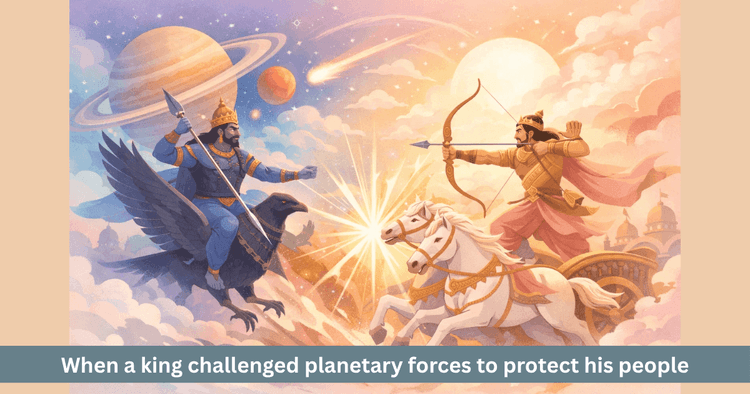
Table of Contents
Within the narratives of Treta Yuga, there are certain episodes that do not remain limited to earthly history alone but extend into the deeper realm of the sky, nakshatras and planetary forces. This story is one of those rare episodes. It is not merely the story of a king’s courage but of a moment when a righteous ruler resolved to challenge even the movement of the planets for the protection of his people.
The period before the birth of Lord Rama was not only a time of waiting within the royal household. It was also a time connected with the safety, stability and future of the kingdom itself. During that phase, a grave danger was foreseen. It was not regarded as an ordinary natural change. Rather, it was linked with a particular astrological condition of Shani Dev. This was the moment when King Dasharatha’s role rose beyond kingship and became that of a vigilant protector of dharma.
Why Was Shani’s Influence on Rohini Nakshatra Considered So Serious
In Vedic astrology, Rohini Nakshatra is regarded as extremely important. It is associated with the Moon and is seen as a symbol of prosperity, fertility, growth, nourishment and the sustaining flow of life. Where Rohini remains balanced, life is nourished, the earth yields abundance and resources increase.
On the other hand, Shani Dev represents justice, karma, patience, trials, discipline, hardship and deep transformation. His influence is not always negative but it certainly brings testing according to one’s deeds. In astrological tradition, it is said that when Shani reaches a position where he is about to pierce Rohini Nakshatra, the possibility of drought, scarcity and widespread suffering on earth increases.
This is not merely a matter of fear but of symbolic understanding. Rohini is the center of nourishment, while Shani brings contraction and testing. When these two meet in a difficult alignment, the flow of prosperity can come under pressure. That is why the sign of an approaching famine was taken so seriously.
Why Did Dasharatha Not See It as Only an Astrological Event
When this warning reached King Dasharatha of Ayodhya, he did not dismiss it as a distant celestial phenomenon. He understood that if this condition were allowed to manifest fully, its consequences would not remain in the heavens. They would affect his people, the kingdom, food, water and the continuity of life itself.
This was the special quality of Dasharatha. He was not merely a ruler seated upon a throne. He was a king whose heart was joined to the well being of his subjects. He did not treat the coming danger as a matter that could be ignored until later. He accepted it immediately as part of his responsibility.
It is at this point that the story becomes deeply inspiring. An ordinary person may become frightened on hearing of a coming danger. A ruler may wait for counsel. But Dasharatha resolved that he himself would move forward. This decision shows that responsibility is not only the quality of managing a kingdom but also the strength to recognize danger before it arrives.
Did Dasharatha Truly Journey Toward the Realm of the Nakshatras
Traditional narratives say that King Dasharatha mounted his divine chariot and moved toward the region of the nakshatras. This may appear beyond ordinary human experience, yet it carries a deep symbolic meaning. A king rising toward the sky suggests that he did not limit his duty only to earthly administration. He resolved to go as far as the source of the danger itself.
This journey was not merely movement through space. It was a journey of resolve. It shows that righteous leadership does not only mourn consequences. It confronts causes. Dasharatha did not say that whatever must happen will happen. Nor did he surrender to the idea that no human effort matters before planetary forces. He raised his courage and resolve so high that in the story it appears to reach even the heavens.
That is what makes this episode more than an ordinary tale of valor. The battle here is not only against an external force. It is also against passivity itself, the passive acceptance of disaster without effort.
What Does Dasharatha’s Courage Before Shani Dev Represent
When Dasharatha approached Shani Dev, he prepared himself for battle. To see this merely as a display of strength would diminish the depth of the episode. Here stood a king who had come neither for personal power nor for fame nor for conquest. He stood for the grain, life and future of his people. That is what gives his courage a sacred dimension.
Shani Dev is traditionally seen as solemn and severe. He is the giver of karmic justice. He is not moved by status, prestige or outer force. Before him only truth, endurance and dharma hold value. Dasharatha’s fearless presence before such a deity shows that within him burned the fire of selfless duty.
This courage was not recklessness. It was firmness born from righteousness. That is why in this story Dasharatha shines not first as a warrior but as a king rooted in dharma.
Why Did Shani Dev Become Pleased with Dasharatha
It is incomplete to see Shani Dev only as a punishing force. He is truly the deity of justice. Where there is adharma, he brings trial. Where there is ego, he breaks it. Where there is falsehood, he does not allow it to stand forever. But where there is truth, tapasya, duty and concern for the welfare of others, he responds accordingly.
When Shani Dev looked upon Dasharatha, he saw a king who was not asking for anything for himself. He had not come for expansion of kingdom, for personal longevity or for victory in battle. He had come only to save his people. Behind his power there was no selfishness but the welfare of all. This is why Shani Dev was moved by his courage and intention.
This is one of the most beautiful dimensions of the story. Shani may be severe but he is not unjust. He honors truth. Dasharatha carried truth, dharma and complete responsibility toward his people. therefore even Shani’s stern heart softened toward him.
What Boon Did Dasharatha Ask For
When Shani Dev became pleased, Dasharatha did not ask for anything for himself. He did not seek long life, expansion of kingdom, personal safety or a special blessing of fame. He made only one request: that Shani Dev should refrain from piercing Rohini Nakshatra, so that drought and widespread suffering would not descend upon the earth.
This is the heart of the story. Where selfishness is absent, prayer gains power. Dasharatha’s appeal was not merely the request of a king. It was a plea made on behalf of countless living beings. This is why Shani Dev granted it.
His acceptance was not only a boon. It was also proof that when a human being stands for true dharma, even the sternness of planetary force may shift its course. That is why this episode is not only about danger being removed. It is also about the meeting of righteousness and justice.
Does Jyotisha Only Predict Fate or Also Show the Way to Balance
This episode offers a very important teaching. Jyotisha is not merely a means to look at destiny and become afraid. It is also a sacred science through which coming tendencies may be understood and balance may be sought. Dasharatha did not see the position of Shani only as an unchangeable disaster. He understood it, respected it and then responded to it through effort.
That is the Vedic vision. Planets indicate conditions, yet the conscious resolve of a human being is also a force. Not every situation can be erased but its effect can be understood and brought into harmony through proper action. Dasharatha’s story teaches exactly this: when true knowledge, courage and dharma come together, even calamity may be turned aside.
For this reason, the episode does not leave Jyotisha as a science of fear. It elevates it into a science of awareness, responsibility and sacred adjustment.
Why Does This Story Still Matter Today
Even today life brings many forms of crisis. Sometimes they are outer, sometimes mental, sometimes social, sometimes material. Often human beings feel helpless before them. In such moments, the story of Dasharatha reminds us that one must not only tremble before approaching hardship. One must understand it, recognize its source and stand before it with courage rooted in dharma.
This story also teaches that true power is that which is used for the welfare of others. Dasharatha possessed power but he did not use it selfishly. He offered it for the protection of his people. That is why his valor becomes more than ordinary heroism. It becomes an ideal of royal dharma.
The nature of Shani Dev is equally important here. He is not only the giver of suffering. He also shows that when life is lived in truth and responsibility, even the sternest force may become cooperative.
The Deeper Spiritual Signal of This Episode
The story of Dasharatha and Shani Dev is not merely a tale of combat. It is the tale of the trust a king placed in his dharma. It is the tale of resolve greater than fear. It is the tale of the truth that when purpose is pure, even the cosmic forces may take a different direction.
In this episode Dasharatha is not only a king riding a chariot. He becomes a symbol of human effort. And Shani is not merely a severe planet. He becomes a symbol of divine justice. When effort and justice meet, the very nature of a crisis can change. That is the deeper secret of this narrative.
For this reason, the episode should not be left behind merely as a mythic wonder. It is also a principle of life. When resolve is genuine, when the aim is collective welfare and when the heart remains aligned with dharma, even difficult times may turn in a new direction.
Frequently Asked Questions
1. What is the connection between Shani Dev and Rohini Nakshatra in this story
In Vedic astrology, it is said that when Shani reaches a position to pierce Rohini Nakshatra, drought, scarcity and large scale suffering may arise.
2. Why is Rohini Nakshatra considered so important
Rohini is associated with the Moon and is linked with nourishment, prosperity, growth and fertility, which is why a harsh influence upon it is considered serious.
3. What did King Dasharatha request from Shani Dev
He requested that Shani Dev should refrain from piercing Rohini Nakshatra so that famine and hardship would not descend upon the earth.
4. Why did Shani Dev become pleased with Dasharatha
Because Dasharatha approached him not for personal gain but for the welfare of his people and the protection of his kingdom.
5. What is the greatest lesson of this story
This story teaches that when resolve is true, the purpose is for collective good and courage is joined with dharma, even the most difficult situation can be transformed.
Get your accurate Kundali
Generate KundaliDid you like it?
Author
Pt. Suvrat Sharma (63)
Experience: 20
Consults About: Family Planning, Career
Clients In: Punjab, Haryana, Delhi
Share this article with friends and family
About ZODIAQ
ZODIAQ is an online Vedic Astrology platform. It connects clients seeking astrological advice to experienced astrologers with deep knowledge. Our users also generate kundali and perform kundali milan for free. ZODIAQ also offers services to the Astrologers. Astrologers utilize various offerings by ZODIAQ to serve their clients effectively.
If you are a User
Consult with experienced astrologers and seek their guidance. You can also order handwritten Janm Patrika report with life prediction prepared by experienced astrologers. Generate accurate Kundali, perform Kundali Matching and check horoscope and muhurat. Utilize our online library for all the necessary astrological and spiritual information.
If you are an Astrologer
Create accurate kundali for your clients and perform Kundali Matching for up to 5 people at a time. Write comprehensive Janm Patrika report for your clients with ZODIAQ. Check client details anytime by saving it in client directory. Become more productive by tracking how many clients you guide every day.
WELCOME TO
ZODIAQ
Right Decisions at the right time with ZODIAQ
